
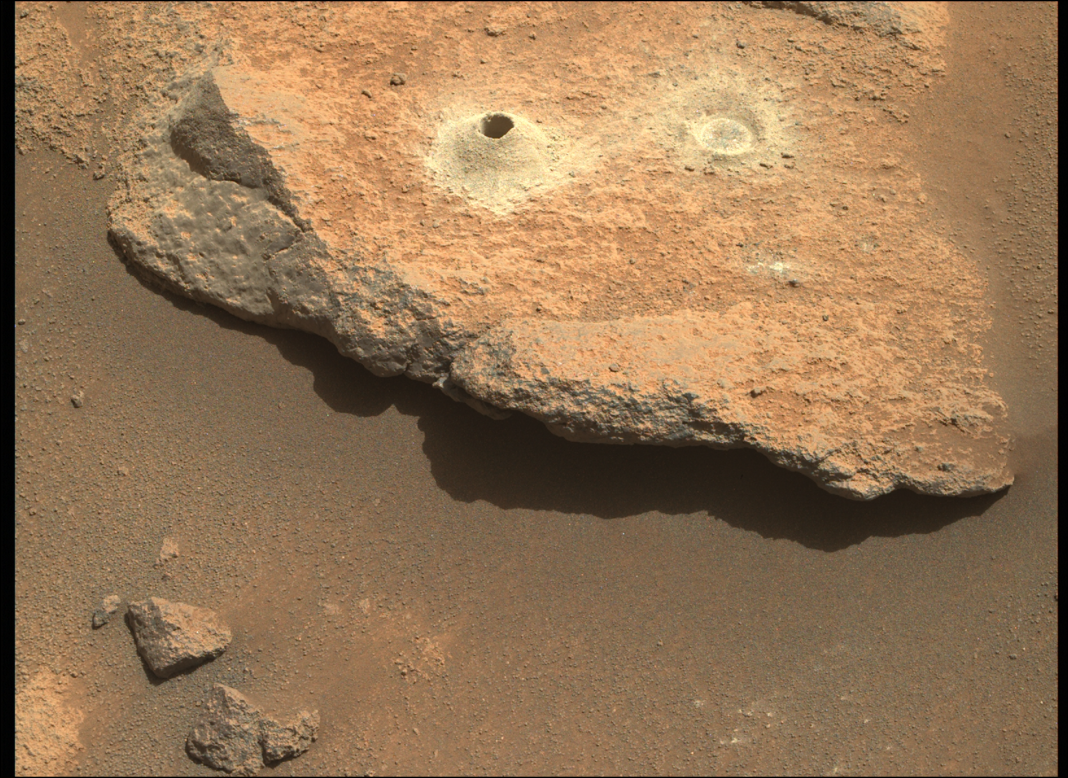


NASA has confirmed the detection of potential biosignatures in a Martian rock sample collected by the Perseverance rover, marking a significant development in the search for life beyond Earth. The sample, extracted from a rock formation called “Chevaya Falls” within an ancient river channel, contains mineral patterns and chemical signatures that could indicate past microbial activity, though non-biological explanations remain possible.
The Discovery
Since landing in Jezero Crater in February 2021, Perseverance has been investigating a 45-kilometer-wide impact basin that once held a lake. The Chevaya Falls sample stands out because it contains distinctive features: circular reaction fronts nicknamed “leopard spots,” along with concentrations of organic carbon associated with phosphate, iron, and sulfur minerals. On Earth, similar mineral arrangements often form through biological processes.
NASA scientists emphasize that while these features match what we expect from microbial activity, they could also result from abiotic chemical reactions. The rover’s instruments can only provide limited analysis from Mars’ surface. Definitive answers will require the sophisticated laboratory equipment available on Earth.
Implications of the Findings
If these biosignatures prove biological in origin, it would suggest that life emerged independently on two neighboring planets. This would have profound implications for the prevalence of life throughout the universe. Alternatively, if Mars and Earth share a common origin of life, it could indicate that life is rare enough that it needed to travel between worlds to survive.
The mudstone composition of the Chevaya Falls rock confirms that Mars once had persistent liquid water—a key requirement for life as we know it. Understanding how long these habitable conditions lasted helps scientists determine whether life had sufficient time to emerge and evolve on the Red Planet.
Next Steps
Perseverance has sealed the Chevaya Falls sample in a titanium tube for potential return to Earth through the Mars Sample Return campaign, a joint NASA-ESA mission planned for the 2030s. Once on Earth, scientists will analyze the sample using instruments too large and complex for spaceflight, including mass spectrometers and electron microscopes capable of detecting molecular-level evidence of life.
The Mars Sample Return mission will attempt to retrieve dozens of samples collected by Perseverance. These tubes represent humanity’s first opportunity to study Martian material with Earth’s full scientific arsenal, potentially answering whether we’re alone in the universe.
The Long Road to Confirmation
What makes this discovery so compelling isn’t just what we’ve found—it’s what we still can’t determine. From 140 million miles away, Perseverance’s instruments provide tantalizing hints but cannot deliver conclusive proof. The rover’s SHERLOC instrument has detected organic molecules, but these carbon-based compounds can form through geological processes, meteorite impacts, or atmospheric chemistry without any biological involvement.
The smoking gun would be detecting enantiomeric excess—a preference for either left-handed or right-handed molecules. Life on Earth exclusively uses left-handed amino acids and right-handed sugars. Finding similar molecular bias in the Martian sample would strongly suggest biological origins, but this analysis requires laboratory instruments far too massive for Mars missions.
Earth’s Parallel History
Ancient Mars and early Earth share remarkable similarities. Both planets formed 4.5 billion years ago and both show evidence of liquid water in their youth. Earth developed a protective magnetic field that shielded developing life, while Mars lost its magnetic shielding early, allowing solar winds to strip away its atmosphere and transform it into the cold, desert world we observe today.
What if life began on both planets? The Last Universal Common Ancestor of all Earth life lived 3.5 to 3.8 billion years ago—approximately when Jezero Crater contained liquid water. This temporal overlap suggests a narrow window when both planets could have hosted microbial life.
| Timeline (Billion Years Ago) | Mars | Earth |
|---|---|---|
| 4.5 | Formation | Formation |
| 4.1 | Liquid water present | Liquid water present |
| 3.8 | Jezero Crater forms | Heavy bombardment ends |
| 3.5 | Lake in Jezero Crater | First life appears |
| 3.0 | Atmosphere thinning | Photosynthesis begins |
This shared timeline raises fundamental questions. Did life arise independently on both worlds, suggesting it’s a cosmic inevitability when conditions permit? Or could microbes have traveled between planets on meteorites through panspermia? The Martian meteorite ALH84001, discovered in Antarctica in 1984, showed possible evidence of fossilized bacteria, though scientists remain divided on its interpretation.
The Human Connection
These potential biosignatures represent more than scientific data—they form a bridge across space and time, connecting us to whatever once stirred in ancient Martian waters. The generation that watched Apollo 11 land never imagined we’d search for life on Mars within their lifetime, yet here we are, potentially answering humanity’s oldest question: Are we alone?
The mission team has shown admirable restraint in not overstating their findings. They understand that extraordinary claims require extraordinary evidence, and they’re willing to wait years for definitive answers. This patience contrasts with our instant-gratification culture, reminding us that some questions merit extended investigation.
Looking Ahead
As we await these precious samples, the implications extend beyond Mars. If life arose independently on two neighboring planets, it likely emerges wherever suitable conditions exist. The Drake Equation, which estimates civilizations in our galaxy, may need upward revision. The universe could contain far more life than we imagined, and we might belong to a cosmic community larger than previously conceived.
Alternatively, if Martian and Earth life share origins, it suggests life is rare enough that it needed to travel between worlds to survive. Either scenario would fundamentally reshape our understanding of biology, chemistry, and our place in cosmic history.
The Chevaya Falls discovery transcends scientific milestone status—it reflects our deepest hopes and fears about existence. Whether those leopard spots represent fossilized ancient microbes or unusual geological processes, they remind us that the universe still holds wonders beyond current understanding. Sometimes the most profound discoveries emerge not from looking outward at stars, but from what those distant lights reveal about ourselves.