
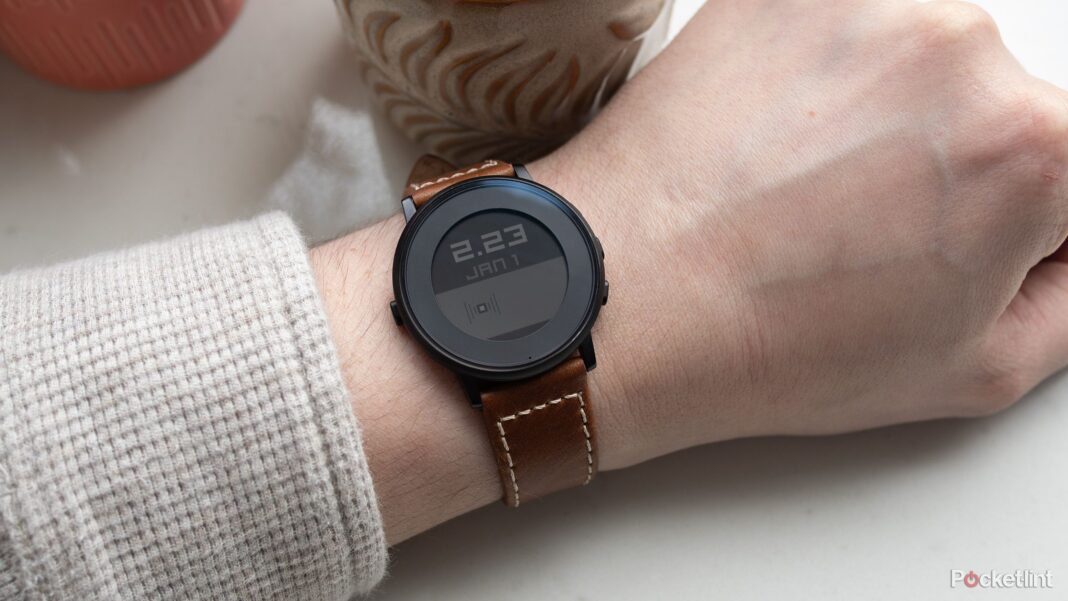


Pebble has updated its classic round smartwatch with the Pebble Round 2, a direct response to the 2015 Pebble Time Round’s shortcomings. The new model trims the oversized bezel, doubles display resolution, and stretches battery life to roughly two weeks—all while hitting a $199 price point that undercuts most premium competitors by half.
A Sleek New Design
The most obvious change is the screen: the 1.3-inch color e-paper panel now reaches the edge of the 8.1 mm stainless-steel case, eliminating the thick border that made the original Round look dated. Resolution jumps from a fuzzy 144 × 168 to a sharp 260 × 260 at 283 DPI, so text, icons, and custom watch faces appear crisp even when viewed off-axis. The result is a watch that looks like a watch first and a gadget second.
E-paper still delivers daylight-readable, always-on visibility without the battery penalty of OLED, and the new panel improves contrast by roughly 30 percent compared with the Time Round. Gorilla Glass 3 covers the face, and the 22 mm quick-release straps use standard lugs, so swapping bands takes seconds.
Enhanced Performance and Features
Inside, Pebble swapped the old ARM Cortex-M4 for a more efficient dual-core M33 that drives the new display and handles background tasks without stutter. The OS remains open-source Pebble OS, giving access to more than 5,000 apps and watch faces in the Pebble Appstore. Core hardware includes an accelerometer, magnetometer, and ambient-light sensor—enough for automatic sleep tracking, step counting, and basic workout logging. There is no heart-rate sensor or GPS, choices that help the 250 mAh battery last 10–14 days under typical use.
Charging still uses a magnetic snap-on cable, but a 15-minute top-up adds two days of runtime. Bluetooth 5.3 LE keeps the connection to iOS and Android phones stable to about 30 ft, and notifications mirror with the same granular controls Pebble users expect: you can filter by app, set quiet hours, or reply with canned responses on Android.
What’s Next for Pebble?
The Round 2 ships in three finishes—graphite, silver, and rose gold—with silicone sport bands in the box and leather or metal upgrades sold separately. Pre-orders open today, and Pebble says units will leave warehouses within two weeks. The company has not announced cellular or voice-assistant variants, but firmware updates will add sleep-score insights and Google Calendar integration before year-end.
Pebble’s bet is straightforward: most people want notifications, long battery life, and a watch that does not look like a mini-smartphone. By cutting sensors that drive up cost and drain power, the Round 2 lands at $199 with little direct competition—Samsung’s Galaxy Watch 6 starts at $299 and lasts two days; Apple’s Series 9 starts at $399 and lasts 18 hours. Whether that middle ground is large enough to sustain Pebble’s second act will depend on how many worn-out Wear OS and watchOS users are ready to trade flashy specs for two weeks between charges.
The $199 Sweet Spot: Pricing Strategy That Actually Makes Sense
Pebble priced the Round 2 at $199, a figure that now looks almost rebellious. Flagship watches from Apple and Samsung routinely hit $400–500, while bargain-bin fitness bands fall below $100. The Round 2 plants itself in the narrow space between—cheap enough to avoid sticker shock, expensive enough to suggest quality.
The original Time Round debuted at $249 in 2015 and was hammered for poor battery life and limited functionality. Pebble trimmed $50 and doubled longevity this time, a move that makes the Round 2 the cheapest round smartwatch you can buy outside of no-name brands. At this price, Pebble is not trying to out-spec Apple; it is offering refugees from nightly charging a place to land.
What Pebble’s Revival Says About Wearable Fatigue
Pebble skipped the heart-rate sensor, SpO₂ monitor, and ECG hardware that pad spec sheets today. The decision looks less like corner-cutting and more like a response to wearable fatigue: after years of watches promising to revolutionize health, many owners admit they rarely glance past step count and notifications. The Round 2 embraces that reality instead of fighting it.
By limiting sensors to an accelerometer and magnetometer, Pebble keeps power draw low and cost down while still covering the basics: steps, distance, sleep, and simple workout tagging. The WHO recommends 150 minutes of moderate activity per week—data the Round 2 captures without drowning users in recovery scores or stress rings they never asked for.
| Feature Category | Pebble Round 2 | Typical Premium Smartwatch |
|---|---|---|
| Battery Life | 10-14 days | 1-2 days |
| Price | $199 | $400-500 |
| Heart Rate Monitor | No | Yes |
| Display Type | Color e-paper | OLED/LCD |
| App Ecosystem | Thousands (Pebble OS) | Platform dependent |
The E-Paper Advantage: Why This “Old” Tech Still Matters
While competitors chase brighter OLED panels, Pebble stuck with color e-paper because it solves real-world problems. The display is always visible in direct sunlight without backlight boost, and it sips power so the battery can last two weeks. At 283 DPI, text is sharp, colors are muted but readable, and the lack of flashy animations keeps attention demands low.
Viewing angles have improved 40 percent over the Time Round, so legibility does not fall off when you glance from your bike or during a run. The panel refreshes at 30 Hz—fast enough for smooth menu scrolling—yet uses 1 percent of the energy an OLED needs when showing a static watch face.
Bottom Line: The Smartwatch Market Needed This
The Pebble Round 2 is not the most advanced smartwatch you can buy; it is the one you can forget to charge for two weeks and still trust to buzz for an alarm or an important call. At $199, it undercuts premium rivals while delivering the essentials better than most: notifications, readable time, and battery life measured in days, not hours.
Pebble’s revival is built on subtraction—fewer sensors, smaller bezel, lower price—yet the result feels complete. In a category addicted to adding, the Round 2 proves that knowing what to leave out can be the smartest feature of all.