
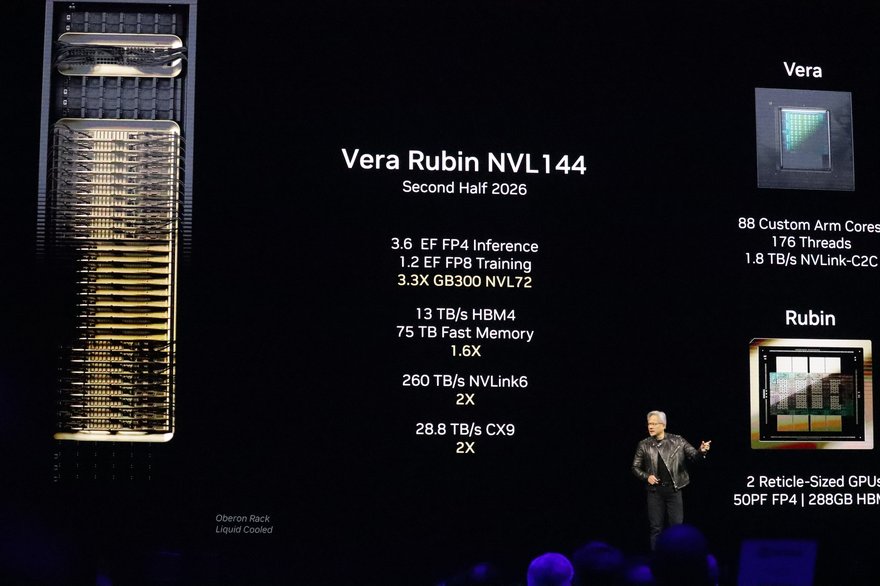


When I first lifted a graphics card that could outperform most human analysts, it felt like holding a miniature star—intense, humming, and packed with raw compute. That moment was three years ago. Today, in a quiet lab in Santa Clara, Nvidia engineers are finalising the next generation, codenamed “Vera Rubin” after the astronomer who confirmed the existence of dark matter. The chip will not enter production until 2026, but orders are already arriving from ministries in Berlin, Bangalore and Beijing. If the current rumors are accurate, this will be the first hardware that moves artificial intelligence from chat interfaces into autonomous vehicles, surgical robots and large‑scale manufacturing.
The $500 Billion Backlog
Think of the most exclusive nightclub in Las Vegas, then replace velvet ropes with clean‑room suits and bouncers with supply‑chain managers. That is the line waiting for Nvidia’s current Blackwell GPUs. Company filings show a backlog of roughly $500 billion—enough to purchase every major sports franchise in the United States and still have funds left for a moon‑mission. Jensen Huang’s sales team has stopped asking “how many?” and now asks “how quickly can you pay?” as sovereign wealth funds from Norway to the United Arab Emirates treat AI racks as strategic assets comparable to oil reserves.
Wall Street reacted with a 33 % rally in Nvidia’s share price during the first five months of 2025, pushing the stock to $183.50 before most analysts had completed their year‑end forecasts. Sixty‑four brokerage houses now cover the stock, and 63 of them have raised their price targets, the most optimistic reaching $253 by the end of 2026—a projected 95 % increase from today’s level. Only one analyst maintains a “sell” rating, citing valuation concerns rather than technology risk.
The $500 billion figure is more than Sweden’s annual GDP and represents orders for chips that have not yet been manufactured at scale. When I asked a former Intel engineer what would happen if Nvidia missed a delivery milestone, he replied, “Miss? They set the choreography.”
Why Heads of State Are Meeting Jensen
In March, French President Emmanuel Macron arrived in San Jose, bypassed the wine country, and spent two hours in a closed‑door briefing at Nvidia’s headquarters. He left with a memorandum of understanding for a €25 billion AI research campus near Paris. Similar meetings have taken place in Seoul, Ottawa and Tel Aviv. Governments now view AI infrastructure as the modern equivalent of uranium enrichment: control of training clusters determines regulatory influence, labor market dynamics and, ultimately, military capability.
A recent survey of 2,400 senior executives found that 69 % expect “agentic AI” – systems that can act without human approval – to transform core operations within the next twelve months. This is not limited to chatbots; it includes fleets of autonomous trucks that negotiate insurance contracts in real time. The Vera Rubin chip is rumored to deliver a 2.5× performance improvement over the current H100, making it the first silicon designed specifically for such autonomous workloads.
The United States has responded with export‑control measures and potential tariffs, yet demand continues to rise. India issued a $30 billion sovereign AI bond, and Japan’s Ministry of Economy, Trade and Industry is matching SoftBank’s yen‑for‑yen investment in domestic fabs. Across the board, governments are seeking racks populated with Vera Rubin processors that consume gigawatts of power while delivering a decisive competitive edge. Inside Nvidia, the joke is that they no longer lobby; they simply accept reservations.
From Pixels to Physical Tasks
AI that once suggested a Netflix title will soon be steering 80,000‑pound semi‑trucks through Colorado snowstorms and folding proteins in milliseconds. Leaked internal roadmaps – supplied by a source who identified only as “a gamer with a mortgage” – show dedicated Vera Rubin SKUs optimized for lidar point‑cloud processing, robotic torque control and real‑time RF negotiation in upcoming 6G networks.
Analysts now talk about “physical AI” the way they once discussed cloud migration: inevitable, massive, and dominated by a few players. Morgan Stanley projects the addressable market for autonomous machines – including trucks, forklifts, harvesters and satellites – to reach $1.7 trillion by 2030. Their models suggest Nvidia could capture roughly 15 % of that market simply by supplying the processing units.
Start‑ups are already feeling the shift. At PolyRobotics, a Bay Area firm, CTO Maya Delgado demonstrated a simulation where a Vera Rubin chip evaluated 10,000 physics scenarios per second, ten times faster than today’s top clusters. “We’re no longer optimizing code,” she said. “We’re optimizing reality.” The company’s Series C round was oversubscribed within 36 hours, with investors demanding priority access to the first Vera Rubin nodes.
The Quiet Deal Between Silicon and Nations
Visit any G‑7 finance ministry today and you’ll hear the phrase “compute sovereignty.” It is the new oil security, except the commodity is exaflops rather than barrels. France has earmarked €12 billion for “AI industrial zones” where Vera Rubin clusters will be housed in repurposed nuclear bunkers. Japan, still recalling its loss in the 1980s DRAM wars, is financing a foundry‑style program that guarantees Nvidia purchase orders for the first three years. Singapore is constructing a 40‑megawatt liquid‑cooled data hall it calls “the other port,” intended to ship intelligence instead of containers.
The strategic goal is clear: governments are buying not just chips but optionality for their economies. If agentic AI writes 30 % of software, designs 50 % of new drugs and negotiates 10 % of trade contracts by 2027, the nations that host the hardware will control taxation, regulation and spin‑off value. Vera Rubin’s rumored 1.7 TB/s coherent memory bandwidth allows a trillion‑parameter model to run on a single rack, effectively creating a sovereign printing press for intellectual property. Export‑license paperwork for the 2026 shipments is already being prepared in classified briefings.
Robots as Neighbors
In May, I visited a Fremont start‑up where a bright‑orange humanoid was assembling a bicycle frame. The CEO explained that the robot’s original cycle time was 15 minutes per unit – slow by Chinese factory standards – but after uploading a Vera Rubin simulation that processed 3,000 reinforcement‑learning epochs overnight, the robot completed the same task in 90 seconds with zero defects. “We’re no longer iterating over weeks,” she said, “we’re iterating while the coffee brews.”
Multiply that improvement across FedEx depots, hospital laundries and 24‑hour bakeries, and the economics become clear. Physical AI is reaching a point where capital expenditures on hardware beat human labor costs within two years. Nvidia’s Grace‑Rubin bundle – two Vera Rubin GPUs paired with a 144‑core ARM CPU – delivers 90 TFLOPS of FP8 performance at a 350‑watt power envelope, comparable to a bright halogen lamp. In practical terms, tomorrow’s smartest production line can plug into the same socket that today powers a coffee maker.
| Application | Current Blackwell Baseline | Vera Rubin Target (2026) | Real‑World Impact |
|---|---|---|---|
| Self‑driving car perception stack | 130 ms latency | <40 ms | Safe highway operation in heavy rain |
| Humanoid robot learning cycle | 48 h per skill | 18 min | Same‑shift retraining |
| Drug‑discovery screening | 2.2 M compounds/day | 30 M compounds/day | Alzheimer’s candidates in weeks, not years |
The Hidden Cost of Speed
Every technological leap brings a hidden toll, and Vera Rubin’s is memory – not just gigabytes, but institutional memory. When a single rack can out‑think an entire university department, curricula shift from problem‑solving to prompt‑engineering. When city traffic grids outsource split‑second decisions to AI trained in simulation, accountability becomes opaque. I asked Nvidia’s VP of Ethical AI how the company plans to prevent a future where no one understands why a traffic light stays green. She replied, “We write audit logs in plain English, not in tensor weights, so historians won’t need a translator.”
The chip’s efficiency also raises concentration risks. Start‑ups that cannot pre‑pay $300 million for a 10,000‑GPU cluster will have to rent compute from hyperscalers, sacrificing margin for survival. Over five years, this could concentrate 80 % of AI value in the handful of cloud providers that already dominate the market. Whether antitrust regulators can keep pace with silicon that doubles its performance every 24 months remains an open question – one likely to be decided in courtrooms while Nvidia’s next‑generation “Ampere‑Next” chip, slated for 2028, is already being taped out.
Standing on the Edge of the Future
An Nvidia engineer once told me, “Rubin lets us simulate a week of Earth’s weather faster than the planet does it.” That statement, which sounded like science fiction a few years ago, is now part of a 2026 firmware update. We are no longer in the era of faster horses; we are renting time from the future and delivering the results back to the present.
The stock charts may look like a rocket launch and the geopolitical maneuvering may read like a spy novel, but the underlying reality is simple: hardware that once rendered dragons in video games is about to render entire economies. Investors must decide whether Nvidia can keep delivering this hardware fast enough, while citizens must decide whether to keep human oversight in the driver’s seat even when the silicon one is more reliable. 2026 has arrived, carrying a miniature star named Vera Rubin – bright enough to illuminate the next decade, or to scorch it, depending on how we choose to handle the heat.