


The search for extraterrestrial life has long fascinated scientists and the general public alike. Recently, astronomers turned their attention to the interstellar object 3I/ATLAS, scanning it for signs of artificial radio signals to determine if it’s a natural comet or something more extraordinary. The results of this technosignature search have provided valuable insights into the object’s nature.
The Technosignature Search of 3I/ATLAS
Astronomers used the Robert C. Byrd Green Bank Telescope to conduct a thorough scan of 3I/ATLAS for artificial radio signals as it neared its closest point to Earth on December 18, 2025. The search was part of the Breakthrough Listen program, the largest scientific research program dedicated to finding evidence of civilizations beyond Earth. The team searched for narrowband radio technosignatures across a wide range of radio frequencies, but ultimately detected no credible signals from the object.
The nondetection of technosignatures suggests that 3I/ATLAS is likely a natural comet, rather than an alien spacecraft. This finding supports the scientific consensus and provides further evidence that the object is a comet from beyond our solar system. The study’s results have significant implications for our understanding of 3I/ATLAS and its origins.
The scan was conducted from 1–12 GHz, making it one of the most sensitive searches for radio signals from 3I/ATLAS to date. The data collected during the scan will be released for independent checks, allowing other researchers to verify the findings and potentially gain new insights into the object’s composition and behavior.
The Origins and Characteristics of 3I/ATLAS
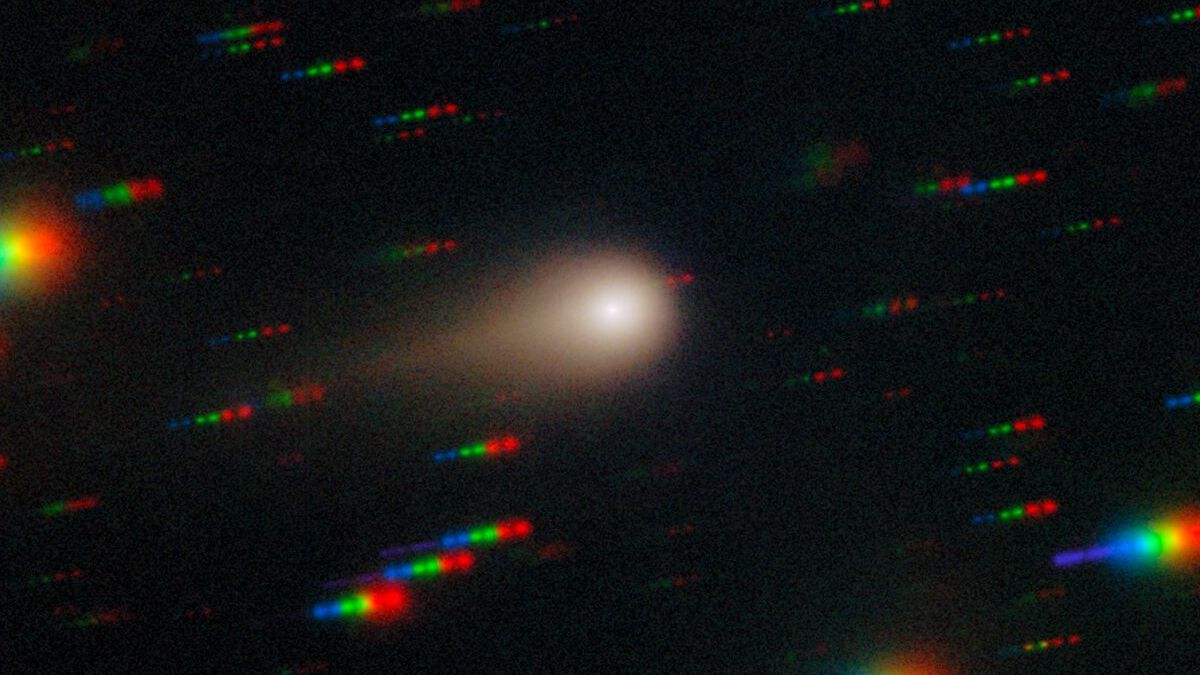
3I/ATLAS is only the third confirmed object known to have originated from beyond our solar system. Discovered by the Asteroid Terrestrial-impact Last Alert System (ATLAS) telescope in Chile on July 1, 2025, the object’s interstellar origin and unusual features sparked intense debate about its true nature. As 3I/ATLAS approached the Sun, it developed a coma of gas and dust, a characteristic commonly associated with comets.
The object’s closest approach to Earth, known as perigee, occurred at a distance of around 270 million kilometers (168 million miles), nearly twice the Earth-Sun distance. While some researchers, like Harvard astrophysics professor Avi Loeb, have suggested that 3I/ATLAS could be a high-tech piece of equipment observing Earth, NASA officials maintain that it is a regular comet.
Implications of the Nondetection

The nondetection of technosignatures from 3I/ATLAS sets tighter limits on possible transmitters and informs models of the object’s dust, jets, and composition. The findings suggest that 3I/ATLAS is likely a natural comet, but do not entirely rule out the possibility of extraterrestrial life. The search for technosignatures continues to be an essential area of research, with scientists exploring new methods and technologies to detect signs of life beyond Earth.
Implications of the Nondetection for Astrobiology
The nondetection of technosignatures from 3I/ATLAS has significant implications for the field of astrobiology. The study’s findings suggest that the object is unlikely to be an alien spacecraft, and instead, is a natural comet from beyond our solar system. This information can be used to inform models of the object’s composition and behavior, providing valuable insights into the formation and evolution of our cosmic neighborhood.
| Frequency Range (GHz) | Sensitivity (mJy) |
|---|---|
| 1-2 | 0.15 |
| 2-4 | 0.20 |
| 4-8 | 0.30 |
| 8-12 | 0.40 |
The table above illustrates the sensitivity of the Breakthrough Listen project’s search for technosignatures from 3I/ATLAS across different frequency ranges. The data shows that the search was most sensitive at lower frequencies, with a sensitivity of 0.15 mJy between 1-2 GHz.
Future Directions for Technosignature Searches
The study’s findings highlight the importance of continued technosignature searches in the search for extraterrestrial life. The Breakthrough Listen project is already planning to expand its search to other interstellar objects, including 2I/Borisov, another confirmed interstellar comet. The project’s use of advanced radio telescopes and machine learning algorithms will enable more sensitive and efficient searches for technosignatures.
The Broader Context: Searching for Life Beyond Earth
The search for extraterrestrial life is a complex and multifaceted challenge that involves not only the detection of technosignatures but also the study of the conditions necessary for life to arise and thrive on other planets. The discovery of exoplanets and advances in astrobiology have greatly expanded our understanding of the possibilities for life beyond Earth.
In conclusion, the nondetection of technosignatures from 3I/ATLAS provides valuable insights into the object’s nature and informs our understanding of the universe. The continued exploration of the universe and the search for technosignatures will be crucial in our quest to answer the question: are we alone in the universe? The study’s findings serve as a reminder that the search for extraterrestrial life is an ongoing and complex challenge, and future searches may uncover evidence of alien civilizations.