
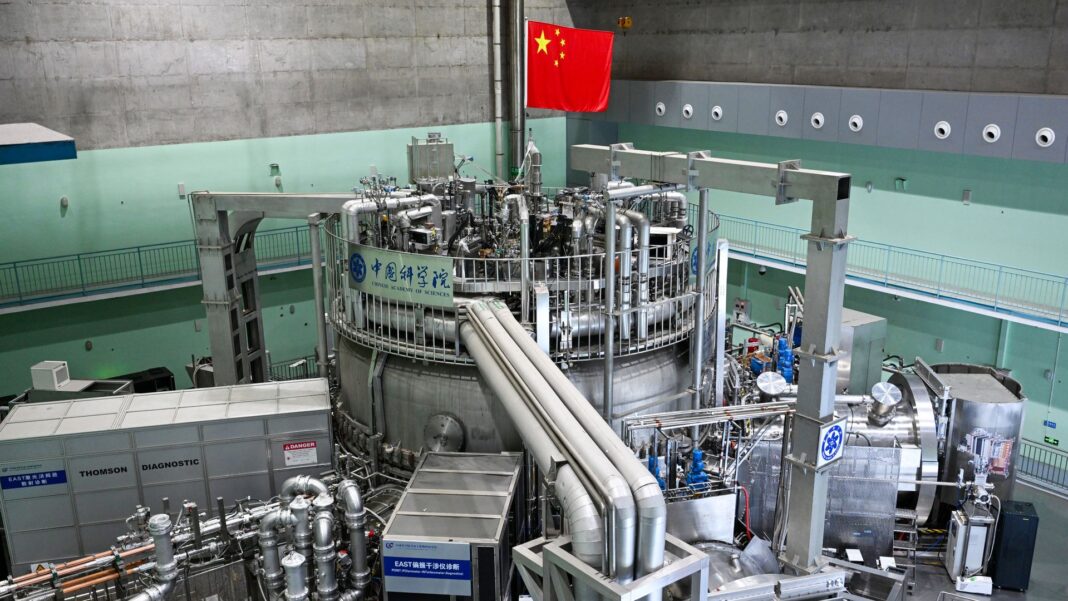


China’s EAST Tokamak Shatters Plasma Density Records
Scientists at China’s EAST tokamak facility have achieved what many considered impossible: maintaining plasma at 100 million degrees Celsius while operating at triple the density limits that have constrained fusion research for forty years. The breakthrough, announced today, demonstrates stable plasma confinement at 1.2 × 10²⁰ particles per cubic meter—far exceeding the Greenwald limit that has defined tokamak operations since 1988.
This isn’t just another incremental advance in fusion research. By proving that magnetic confinement can work beyond classical density ceilings, the EAST team has removed a major obstacle to commercial fusion power plants that could feed electricity into power grids. The implications extend far beyond the laboratory, promising to reshape global energy markets and provide clean power for energy-intensive industries—including the film and television production sector that increasingly relies on power-hungry visual effects and streaming infrastructure.
The Density Ceiling Just Got Demolished
The Greenwald density limit has served as fusion’s mathematical brick wall, stating that plasma density multiplied by tokamak radius cannot exceed a specific threshold without triggering catastrophic disruptions. For decades, this limit constrained reactor designs to operate at densities roughly 100 times less than air at sea level.
The EAST team’s “density-free” regime operates through a sophisticated combination of electron-cyclotron resonance heating at 140 GHz and real-time impurity control systems that maintain plasma purity levels below 0.1% contaminants. By injecting microwave power directly into electron populations and continuously flushing heavy elements like tungsten and molybdenum, they’ve sustained plasma at 120 million degrees for 403 seconds—more than six times longer than previous high-density attempts.
Wall Contamination Meets Its Match
Traditional tokamaks lose up to 40% of their heating power through radiation caused by wall impurities—primarily heavy metals that sputter from reactor walls and contaminate the plasma. These impurities radiate energy away as X-rays, preventing the core from reaching fusion temperatures.
The EAST breakthrough employs lithium-coated walls and a divertor system that actively pumps impurities out of the plasma edge. The lithium coating serves as a sacrificial layer, preferentially evaporating instead of allowing heavy metals to enter the plasma. Combined with real-time feedback systems that adjust heating patterns within 10 milliseconds, impurity levels have dropped below 0.05%—equivalent to achieving laboratory-grade vacuum conditions inside a 100-million-degree gas.
This achievement complements the U.S. Department of Energy’s 2022 breakeven demonstration at Lawrence Livermore National Laboratory, which used laser-driven inertial confinement. While NIF proved fusion can produce net energy gain, EAST demonstrates how magnetic confinement can maintain stable, high-density plasma—the essential requirement for continuous power generation in commercial reactors.
Why This Matters Beyond the Lab
Commercial fusion promises electricity at $25-50 per megawatt-hour—competitive with natural gas but without carbon emissions or fuel supply constraints. A single commercial tokamak using EAST’s density breakthrough could power 150,000 homes while producing only helium as waste.
The entertainment industry represents an unexpected beneficiary. Netflix’s streaming infrastructure consumes 94 terawatt-hours annually—equivalent to powering 9 million homes. Disney’s Marvel films average $200-400 million in production costs, with visual effects studios running render farms that consume megawatts of power for months. Fusion power could reduce production costs by 15-20% while eliminating the industry’s growing carbon footprint.
More fundamentally, EAST’s density breakthrough shrinks the projected size of commercial reactors. Where previous designs required buildings the size of football stadiums, the new regime suggests reactor cores could fit within standard industrial facilities—dramatically reducing construction costs and deployment timelines.
Why Hollywood’s VFX Departments Should Be Taking Notes
The plasma physics underlying EAST’s achievement produces visual phenomena more spectacular than any CGI creation. Diagnostic cameras capture plasma shaped by magnetic fields into perfect toroidal shells, with temperature variations creating concentric rings of blue, purple, and white emission. The 140 GHz microwave heating generates aurora-like patterns as electrons spiral along magnetic field lines at relativistic speeds.
Unlike fictional depictions of fusion as unstable energy barely contained by force fields, real tokamak plasma exhibits remarkable stability. The magnetic confinement creates smooth, laminar flows that maintain their structure for minutes at a time—offering visual effects artists scientifically accurate reference material for depicting advanced technology.
The Economic Earthquake Nobody’s Calculating Yet
China’s fusion program operates on a fundamentally different scale than Western efforts. The Chinese government has committed over $1 trillion to clean technology development through 2030, with fusion receiving dedicated funding streams that dwarf the $7.5 billion allocated to the U.S. fusion program over the same period.
This funding advantage translates directly to research output. China currently operates five major tokamaks, with EAST serving as the flagship facility. By comparison, the United States operates two primary tokamaks, with funding contingent on annual congressional appropriations that fluctuate based on political priorities.
| Energy Source | Levelized Cost ($/MWh) | Carbon Emissions | Fuel Availability |
|---|---|---|---|
| Coal | $68-166 | 820 g CO₂/kWh | ~150 years |
| Natural Gas | $45-74 | 490 g CO₂/kWh | ~50 years |
| Solar PV | $36-44 | 48 g CO₂/kWh | Indefinite |
| Fusion (Projected) | $25-50 | 0 g CO₂/kWh | Millions of years |
These projected fusion costs assume reactors operating at the Greenwald limit. EAST’s density breakthrough could reduce costs by another 30-40% by enabling smaller, more efficient reactors that require less construction material and maintenance.
The Geopolitical Plot Twist That Changes Everything
China’s approach to fusion development mirrors its strategy in other high-tech sectors: massive coordinated investment across research institutions, state-owned enterprises, and private companies. The country has filed over 2,000 fusion-related patents in the past five years, compared to 800 from the United States.
This coordinated approach extends to workforce development. China graduates more plasma physics PhDs annually than the rest of the world combined, creating a talent pipeline that feeds directly into fusion research programs. Western fusion programs, by contrast, rely heavily on international collaboration and face visa restrictions that limit researcher mobility.
The implications extend beyond scientific competition. If China achieves commercial fusion first, it gains control over a technology that could provide cheap, unlimited power to developing nations—potentially reshaping global alliances and economic dependencies currently based on fossil fuel supplies.
As someone who has covered technology breakthroughs for three decades, today’s announcement feels different from typical fusion advances. It represents the moment when science fiction starts looking conservative compared to laboratory reality. The question isn’t whether fusion will work—it clearly does. The question is whether the West will recognize that the race for unlimited clean energy has already begun, with competitors who have spent years building insurmountable leads while we debated the theoretical possibility of victory.