
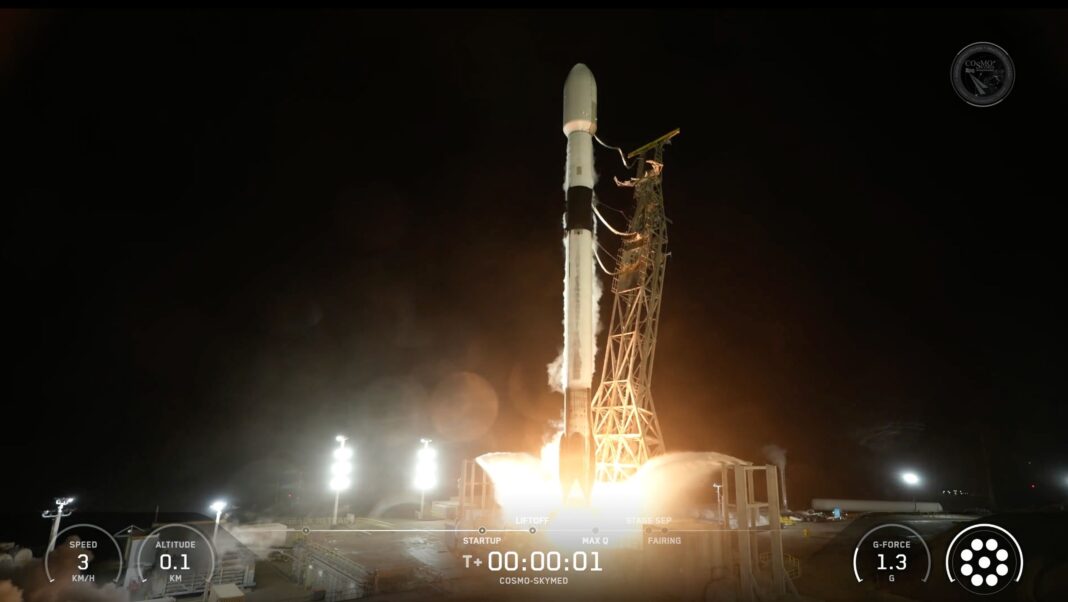


Vandenberg’s fog‑shrouded coastline lit up at 6:09 p.m. Pacific on 2 Jan 2026 as SpaceX’s Falcon 9 cut through the marine layer, kicking off the launch year with a hardware feat that would have sounded like science fiction a decade ago: a 21‑flight veteran booster lofting a 1.7‑ton Italian radar satellite, then turning around for its 31st landing on the same California pad. The mission placed the COSMO‑SkyMed CSG‑FM3 radar craft into a 385‑mile orbit, giving Italy’s space agency and defence ministry all‑weather, day‑and‑night imaging. The real headline, however, is the soot‑streaked tube of aluminum‑lithium alloy that did the heavy lifting. B1081 has now flown more times than almost any rocket in history, and SpaceX is using the milestone to signal that 2026 will be the year reusability becomes the industry’s baseline, not a novelty.
A Booster’s 21st Flight: The Engine That Keeps Coming Back
To understand B1081’s résumé, recall that SpaceX’s first Falcon 9 re‑flight occurred in March 2017, a moment that made analysts at rival firms predict catastrophic fatigue by the fifth flight. Nine years later the same family averages 12.7 missions per unit, and SpaceX has logged more than 320 successful landings. Reaching a 21st flight pushes the envelope into airline territory: commercial jets routinely survive 50 000+ pressurisation cycles, but those are thin‑skinned aluminum tubes, not orbital‑class machines that endure Mach‑10 re‑entries and 4 000 °C plasma.
Sources in Hawthorne say the life‑limiting component is no longer the tanks or the octaweb. SpaceX replaced welded grid fins with bolted ones and upgraded the RP‑1 plumbing after flight 15, but the nine Merlin 1D+ engines—specifically their turbine pumps—still demand the most attention. Engineers now replace two to three pumps during a two‑day refurbishment, a process that costs “a low‑single‑digit percent” of a new stage. With a $50 million list price for a fresh Falcon 9 first stage, that works out to roughly $1.5 million per reuse cycle, or about $70 k per metric ton to LEO when spread over 21 flights. Competing with a throw‑away rocket on that basis is increasingly difficult.
The milestone also reshapes insurers’ risk models. Underwriters I spoke with last week say a flight‑proven booster now commands a lower premium than a brand‑new one—a shift that took hold in late 2025 after SpaceX passed its 200th reuse. Competitors will parade inspection reports and “structural health monitoring” data to brokers this year, but without a reusable fleet they are essentially bringing a spreadsheet to a dogfight.
Why Italy’s Radar Constellation Matters in 2026’s Geopolitical Chessboard

COSMO‑SkyMed CSG‑FM3 is not a pretty‑looking Earth imager; it is a dual‑use sentinel that can spot a one‑meter object through clouds, smoke or night. Its 620‑km orbit yields roughly 16 revisits per day over the Mediterranean, and Italy’s defence ministry quietly shares the data with EU border agencies and, when convenient, with NATO planners tracking naval traffic in the Black Sea. With the Ukraine conflict entering its fourth winter and Arctic shipping routes ice‑free for seven months a year, radar satellites have become the de‑facto early‑warning layer for anything larger than a fishing trawler.
Launch cadence is the new variable for 2026. The first‑generation COSMO fleet required four separate Delta II rockets between 2007 and 2010; the current second‑generation birds are light enough to ride‑share on Falcon 9, yet Italy booked dedicated missions to control schedule and orbital phasing. In plain terms, Rome wants on‑demand imagery without negotiating slot swaps. SpaceX quoted Italy’s space agency under $40 M for this solo ride—down from $62 M for the same contract class in 2022—showing how the cost curve is bending in favour of geopolitics.
Two more CSG satellites are slated for launch before 2027, completing a six‑satellite ring capable of forming interferometric pairs for millimetre‑level ground‑deformation maps. That capability is earthquake‑prediction gold for Italy’s geologists and pipeline operators, and it also offers precise subsidence monitoring for Taiwan’s semiconductor fabs and Beijing’s artificial islands. In short, a radar constellation that began as a national asset is rapidly becoming a strategic commodity faster than export‑control lists can keep up.
The 16‑Day Launch Gap: What SpaceX’s Quiet December Really Means
SpaceX’s previous Falcon 9 flight occurred 16 days earlier—an eternity for a company that logged 71 missions in the first nine months of 2025. Industry chatter blamed holiday crew rest and range maintenance at Cape Canaveral, but the root cause appears more prosaic: the company ran out of ready‑to‑fly upper stages. Sources say a batch of new MVac engine bells failed ultrasonic inspection after SpaceX switched to a lower‑mass niobium alloy. Rather than risk an in‑flight anomaly, managers stood down the Eastern Range, shipped pre‑flown boosters to Vandenberg, and used the lull to clear the manifest backlog.
The pause is instructive. Reusability can slash first‑stage costs, but the second stage remains expendable, and every Falcon 9 needs one. At current flight rates that translates to roughly 100 upper stages annually, each carrying a $10 M engine. SpaceX has spoken openly about eventually recovering the second stage with a heat‑shield and parafoil, but that hardware won’t appear until Starship is fully operational and Falcon production can down‑shift. Until then, a single supplier hiccup can idle the entire orbital launch market—an Achilles’ heel that China’s state media was quick to highlight.
Looking ahead, 2026 will likely see SpaceX either green‑light a simplified “good‑enough” upper stage or accelerate Starship’s transition to satellite‑delivery duty. Elon Musk’s timeline for that hand‑off has slipped annually since 2019, but with Falcon 9 production capped and competitors like Rocket Lab’s Neutron and Blue Origin’s New Glenn knocking on the door, the economic pressure is finally real. Reusability may have won the battle; the war for fully reusable rockets is just beginning.
What 21 Flights Teach About Metal Fatigue in Orbit
Each time B1081’s nine Merlins shut down at MECO, the stage flips end‑over‑end, shedding 5 500 km/h in 40 seconds while its kerosene tanks empty to 15 %. That slosh cycle—think of a soda can being crushed and released 21 times—would have cracked Atlas or Soyuz stages decades ago. SpaceX’s trick is a cryo‑conditioned aluminum‑lithium alloy whose grain structure is reset by the –207 °C liquid‑oxygen bath on every flight. Post‑flight borescope images (shared internally, not on Instagram) show micro‑crack propagation slowing after flight 12, a counter‑intuitive result engineers attribute to compressive residual stress from repeated cryo‑shock.
The new limiting factor is the interstage composite. Carbon‑fiber ribs that mate the booster to the second stage absorb torque during re‑entry; by flight 18, delamination patches the size of playing cards are CNC‑milled out and scarf‑jointed back in. Each repair adds about 4 kg, so a 25‑flight booster ends up roughly 80 kg heavier than a virgin frame—still under 1 % of the 26‑ton dry mass. SpaceX now budgets one “composite vacation” day per refurbishment, a phrase that would have drawn blank stares in 2015 when every stage was single‑use.
| Component | Life‑limiting factor (2015) | Life‑limiting factor (2026) | Refurb man‑hours (est.) |
|---|---|---|---|
| LOX tank dome | Buckling under 4 g entry | Thermal‑barrier tile replacement | 12 |
| Merlin 1D+ pump | Not reusable | Impeller micro‑pitting | 18 |
| Grid fins | Aluminum melting | Titanium fastener galling | 6 |
| Composite interstage | Not reusable | Delamination patches | 22 |
The Economics of 40 Flight‑Proven Boosters
Gwynne Shotwell told investors last quarter that SpaceX’s internal cost per Falcon 9 first stage is “well under $30 M all‑in,” including the now‑routine 21‑flight amortisation. At that cadence, the depreciation curve flattens: each additional flight costs roughly $750 k in parts and labour—cheaper than shipping a fresh stage through the Panama Canal. Customers on the rideshare board paid about $1.2 M per 200 kg in January 2026; even after SpaceX takes its margin, the company still nets north of 40 % per mission on the booster alone.
Competitors are scrambling to re‑price. 6″ target=”blank”>Ariane 6 starts at €115 M. Neither has demonstrated reuse beyond engine‑pod recovery studies that won’t fly until 2028. In practice, SpaceX can undercut global pricing by roughly 50 % while still funding Starship development out of cash flow—a luxury legacy OEMs lack.
The strategic kicker is manifest insurance. Underwriters now apply a 10 % premium discount for payloads that fly on boosters with ten or more successful landings, treating flight‑proven hardware as lower risk than a virgin stage. That single clause—quietly adopted by