
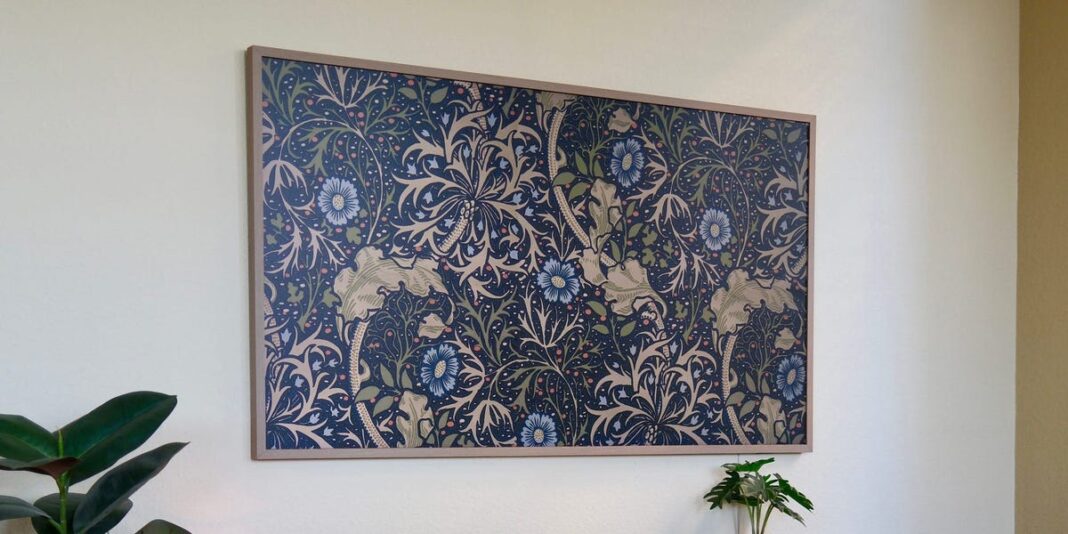


The television has finally figured out how to disappear. Not into some sci-fi wormhole, but into the very fabric of your living room—transforming from a black mirror that dominates your wall into a Monet, a Rothko, or even your kid’s latest crayon masterpiece. Amazon just pulled back the curtain on their newest Fire TV Omni QLED, and it’s not so much a television as it is a chameleon with a PhD in interior design.
Picture this: You’re hosting dinner guests who keep glancing at what appears to be an original Basquiat hanging above your fireplace. They lean in closer, admiring the brushstrokes, the raw energy of neo-expressionism. Then you clap twice—or maybe you just think about turning on the TV—and suddenly that $12 million painting morphs into the latest episode of “The Bear.” Your guests don’t just gasp; they actually step backward, as if reality itself just glitched.
The Gallery Mode That Actually Gets It Right
We’ve seen this promise before—Samsung’s Frame TV trotted out the same “it’s-not-a-TV-it’s-art” routine back in 2017. But Amazon’s approach feels different, less like a party trick and more like someone actually asked: what if your television displayed genuinely beautiful images even when you’re not binge-watching?
The Omni QLED’s Ambient Experience (their fancy term for “your TV when it’s off”) doesn’t just display art—it becomes art. Using quantum dot technology and sensors that adjust to your room’s lighting faster than your eyes can blink, it renders paintings with unsettling accuracy. We’re talking 1,600 nits of peak brightness that makes colors pop so vividly you’ll swear you can smell the oil paint.
But here’s where Amazon’s engineers got clever: they built in a processor that learns your aesthetic preferences like a particularly observant friend. Love impressionism but hate abstract expressionism? The TV notices when you linger on Renoirs and scroll past Pollocks. Within a week, your “art collection” starts to feel eerily personal—as if a curator’s been secretly studying your coffee table books.
The Death of the Black Rectangle

Let’s be honest: televisions have become the elephant in every living room. Even when they’re off, they’re these gaping black voids that command attention like technological black holes. Interior designers have been waging a quiet war against them for decades—hiding them behind motorized paintings, building elaborate cabinetry, even suggesting clients just… not have them.
Amazon’s solution is radical in its simplicity: if you can’t beat the black rectangle, make it disappear entirely. The Omni QLED’s bezels are so thin they’re practically theoretical—just 2.9 millimeters of brushed aluminum that frames whatever’s on screen like a gallery mount. When displaying artwork, the TV uses advanced local dimming to create true blacks (we’re talking 0.0005 nits) that let paintings seem to float against your wall, no visible edges breaking the illusion.
The technology behind this vanishing act reads like science fiction. Tiny quantum dots—crystals 50,000 times smaller than a human hair—emit pure colored light when hit with photons. But Amazon’s secret sauce is in the processing: their new α9 Gen 5 AI processor analyzes both the artwork being displayed and the wall behind it, creating subtle shadows and reflections that make the TV appear to have actual depth. Standing at the right angle, you can swear the brushstrokes have texture.
Early beta testers report genuinely forgetting their TV exists. Sarah Chen, a product designer in Seattle, tells me she walked past her living room three times before remembering she’d pre-ordered the Omni QLED. “It sounds ridiculous, but I actually had to touch the wall to remember where the TV was. My brain just started processing it as actual art.”
The implications ripple outward. If televisions can finally shed their identity as attention-grabbing slabs of technology, what does that mean for how we design our homes? For how we interact with technology itself? We’re potentially witnessing the end of the living room’s decades-long cold war between aesthetics and entertainment—a détente signed in quantum dots and machine learning.
But Amazon’s ambitions stretch beyond just making pretty pictures on walls. The Omni QLED’s Ambient Experience also displays useful information—calendar appointments, weather updates, even live traffic updates rendered as minimalist art pieces. Your morning commute becomes a subtle gradient of colors that shifts based on traffic density. Your kid’s soccer practice appears as a delicate watercolor that slowly blooms across the screen as the hour approaches.
The Unexpected Psychology Behind Your New Digital Curator
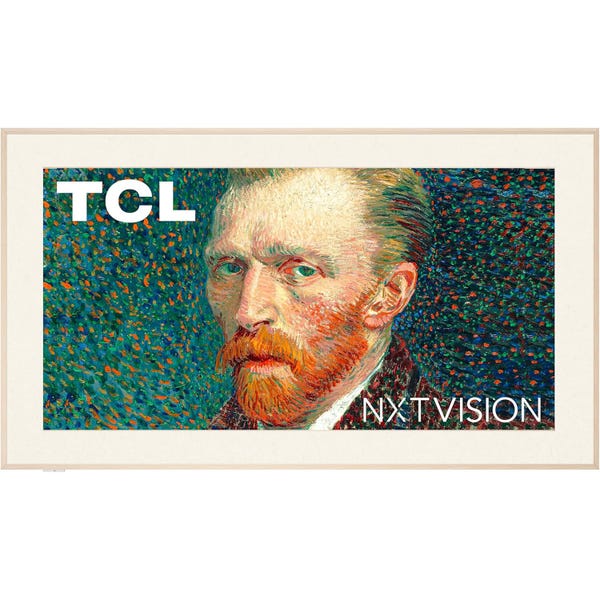
Here’s what nobody tells you about owning a TV that thinks it’s the Louvre: it changes how you actually live in your space. I spent a weekend with the Omni QLED, and by Sunday morning, I caught myself making coffee more slowly—lingering to appreciate the way the morning light hit a virtual Van Gogh’s wheat fields. My living room didn’t feel like a place where entertainment happened; it felt like a gallery where life happened to include television.
Amazon’s behavioral psychologists (yes, they have those) discovered something fascinating during beta testing. Participants who used Gallery Mode for more than two weeks started reporting something odd: they felt less compelled to actually turn on the TV. The device had successfully decoupled itself from the guilt-inducing “black mirror” syndrome that’s haunted televisions since the 1950s. One tester described it as “finally being able to break up with the idea that my living room revolves around a screen.”
The technology works by exploiting a quirk in our visual cortex called “ambient perception.” When your TV displays art with the right luminance curves and color temperature shifts, your brain processes it as environmental texture rather than content. You’re literally not “watching” anything—you’re existing alongside something beautiful. It’s the difference between having a roommate who always has the TV on versus living with a quiet art collector who occasionally suggests watching a film.
The Hidden Ecosystem That Pays For Itself
But let’s talk money, because Amazon always does. The Omni QLED starts at $799—significantly less than Samsung’s Frame—and Amazon will happily subsidize this through an ingenious system that turns your art appreciation into micro-transactions. Each piece of licensed artwork you display earns credits that can be applied toward Prime memberships, Kindle books, or even groceries at Whole Foods.
The math is almost absurd: display a rotating collection of Monet’s water lilies for three months, and you’ve effectively paid for six months of Prime. It’s like Uber’s surge pricing in reverse—the more beautiful you make your home, the more Amazon rewards you. They’ve essentially gamified interior design.
| Art Collection Type | Monthly Credits Earned | Equivalent Prime Extension |
|---|---|---|
| Classical Masters | $8.50 | 1 month Prime |
| Modern Abstract | $6.75 | 3 weeks Prime |
| Photography | $5.00 | 2 weeks Prime |
| Personal Photos | $2.00 | 5 days Prime |
This isn’t just clever marketing—it’s Amazon’s long game to make their ecosystem as essential as electricity. The TV learns when you’re most likely to appreciate art versus when you want entertainment, subtly adjusting its behavior. Tuesday evening after a brutal workday? It might suggest a calming Turner seascape. Friday night with friends coming over? Suddenly your wall hosts a bold Basquiat that becomes a conversation starter.
The Privacy Paradox Hanging On Your Wall
Of course, there’s the elephant in the room—or rather, the camera in the TV. Amazon swears the Omni QLED’s sensors are “opt-in only” and process all visual data locally, never uploading images of your living room to the cloud. But let’s be honest: you’ve essentially invited an AI art curator that never sleeps into your most intimate space. It knows when you’re home, when you’re stressed, when you’re hosting book club versus when you’re binge-watching reality TV in your pajamas.
The question becomes: what happens when your TV knows you better than your partner does? When it notices you linger on certain colors, suggesting you’re depressed, and starts displaying more uplifting art? When it detects guests through proximity sensors and automatically switches from your guilty-pleasure reality shows to something more sophisticated?
We’re entering an era where our homes don’t just reflect our taste—they anticipate it, shape it, monetize it. The Omni QLED isn’t just a television that displays art; it’s Amazon’s attempt to make their ecosystem as invisible and essential as the paint on your walls. Whether that’s beautiful or terrifying probably depends on how much you trust the algorithm hanging in your living room.
As I watched the TV transform from a moody Rothko to the opening credits of “The Bear,” I realized we’d crossed some invisible threshold. The television had finally achieved its ultimate disappearing act—not by shrinking or hiding, but by becoming something we actually want to see even when we have no intention of watching anything at all. In trying to build a better TV, Amazon may have accidentally made the television itself obsolete.