



The first time I watched Atlas, Boston Dynamics’ electric humanoid, pivot from stacking crates to interpreting a supervisor’s frustrated gesture and rerouting an entire assembly line, the concrete floor vibrated under the impact of its carbon-fiber feet. Google’s Gemini processor inside its head converted the chaos into motion—air hissing through pneumatics, shoulder actuators whirring, and the future of factory work quietly shifting from PowerPoint slides to actual motion.
The Android Moment Clocks In
Google DeepMind isn’t assembling arms and legs; it’s supplying the nervous system that lets machines improvise. By embedding Gemini into Atlas, the company is copying the formula that made Android the world’s leading mobile OS: provide the intelligence, let partners handle the hardware. This time the “device” can dead-lift an engine block and ask clarifying questions.
In a sealed test bay outside Boston, engineers handed Atlas a coffee-stained work order—plain English, no code. The robot’s head-mounted LiDAR surveyed the scene, Gemini parsed the paragraph, and within seconds Atlas selected the right torque wrench, tightened bolts on a transmission casing, then noticed a misaligned gasket and paused for confirmation. That small hesitation felt more significant than any acrobatic stunt.
According to DeepMind, every Atlas production slot through 2026 is sold. Hyundai Motor Group, which owns Boston Dynamics, will receive the first fleet, sending the humanoids to plants in Alabama and the Czech Republic to learn—in real time—how to build the cars they’ll eventually help assemble. They won’t replace workers yet; they’ll absorb the repetitive, injury-prone tasks that drive attrition: torqueing 400 bolts per chassis, shuttling 30-kg battery packs, inspecting under-body clearances at midnight when human backs ache and eyelids sag.
China’s 200-Robot Race Meets One Platform
While Chinese startups compete to build the flashiest humanoid shell, Google is wagering that software, not servos, will decide the winner. CMRA, China’s robotics trade group, lists more than 200 domestic companies prototyping bipedal machines, a rush that echoes the early smartphone wars. Motors, batteries, and sensors have all dropped in price, lowering the barrier for any engineer with a dream and machine-shop access. The catch? Most of these mechanical athletes still need a coach whispering every move.
Gemini aims to be that coach—an invisible, multilingual mentor that can teach any compliant body to weld, sort, or lift on day one. DeepMind quietly hired Boston Dynamics’ former CTO in November, signaling that the platform push is accelerating. Imagine an app store where manufacturers download skills—”install windshield,” “inspect weld seam,” “balance 50-lb crankshaft”—and the robot adapts the motion to its own joints the way a phone resizes an app for its screen.
A logistics director at a Fortune 100 auto supplier has piloted three humanoid brands. His verdict: “Hardware is converging; the differentiator is who can read a messy work instruction and not panic when the conveyor jams.” He laughed and added, “Right now only the Google-powered Atlas asks, ‘Do you want me to reroute the part or wait for maintenance?’ In Mandarin, no less.”
From Demo to Day Shift—The 2026 Rollout

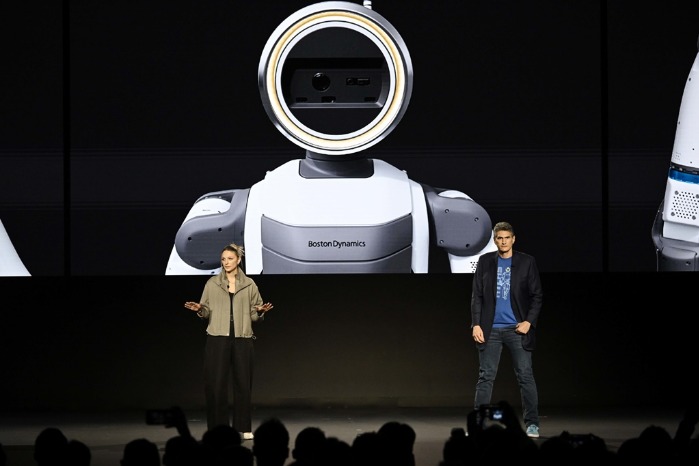
CES 2026 felt like graduation. On the showroom floor, Atlas units weren’t performing rehearsed parkour; they were swapping door panels between two mock assembly lines while journalists shouted curveballs: “Now the red sedan, not the SUV!” Each robot’s chest display flashed Gemini’s chain-of-thought—snippets like “detect color mismatch” or “request torque spec update”—offering onlookers a view into an artificial mind that reasons in real time.
The production models leaving Boston Dynamics’ Massachusetts facility are fully electric, a quiet rebuttal to earlier hydraulic prototypes that hissed like leaky radiators. Battery packs rated for eight hours of continuous lift-and-carry sit where a human sternum would be, while liquid-cooled hip and shoulder actuators can briefly hit 90 percent of a veteran factory worker’s output without risking rotator-cuff surgery.
Google’s wider vision stretches past any single automaker. DeepMind executives describe an upcoming “Robot Skills SDK” that will let third-party developers—the same indie coders who build mobile games—sell specialized behaviors to factories. Need Atlas to learn the odd way your plant installs seat heaters? Download the module, feed it ten minutes of human demonstration, and Gemini fine-tunes the motion overnight. Revenue split? Think Google’s Play Store, except each download is a skill that keeps an assembly line humming rather than a thumb tapping.
The factory floor is unforgiving. One mis-torqued lug nut can trigger a million-dollar recall, so every Atlas ships with a “human veto” pendant. Workers can freeze the robot mid-motion, a concession to unions and safety officers. During my visit, a veteran line supervisor named Marta used the pendant twice in an hour, then admitted: “It’s like training a greenhorn—except this one remembers forever and never asks for a smoke break.”
The Platform Play: Why Google Wants to Be the Android of Robotics
Inside a glass-walled conference room at DeepMind’s London headquarters, the future of factory automation looked like a circuit diagram. Google’s strategy isn’t to build the best robot—it’s to supply the only brain that matters. By licensing Gemini to any manufacturer that pays, Google aims to become the universal translator between human intent and mechanical action.
Industry analysts project the global industrial robotics market will reach $165 billion by 2028, but Google isn’t chasing hardware margins. It’s following the Android playbook: give away the intelligence, monetize the ecosystem. Every Atlas running Gemini generates data—millions of micro-decisions about torque, spatial relationships, and optimal motion. That data flows back to Google’s cloud, training the next model generation. The robots get smarter, factories get more efficient, and Google widens its real-world intelligence moat.
The revolutionary part is the network effect. When a robot in Hyundai’s Alabama plant finds a faster way to install seat belts, that knowledge propagates instantly to every Gemini-powered unit worldwide. Traditional automation meant painstaking reprogramming; Google’s system learns like an apprentice, sharing insights across a workforce that never sleeps, never forgets, and never demands overtime.
| Traditional Industrial Robots | Gemini-Powered Humanoids |
|---|---|
| Pre-programmed movements only | Real-time adaptation to new tasks |
| Months of integration time | Minutes to understand new instructions |
| Fixed location, single purpose | Mobile, multi-task capable |
| Safety cages required | Human-safe collaboration |
| $2-5 million per installation | $200k per unit, flexible deployment |
The China Factor: A Global Race for Robotic Supremacy
On a recent visit to Shenzhen’s robotics district, I watched Unitree Robotics engineers demonstrate their H1 humanoid in a workshop wedged between smartphone plants. The robot interpreted Mandarin instructions, navigated a mock warehouse, spotted defective parts, and calmed a “frustrated” worker with a gentle shoulder pat—grace that would have seemed impossible five years ago.
China’s robotics boom isn’t about catching up; it’s about leapfrogging. With 200-plus companies developing bipedal systems, per the Chinese Machinery Industry Federation, competition is accelerating innovation. Firms like Fourier Intelligence and Agibot aren’t chasing general intelligence; they’re zeroing in on specific industrial tasks, building specialized robots that can outperform generalists.
What keeps Google executives awake isn’t just the number of Chinese rivals—it’s the data advantage. Every robot in China’s vast manufacturing sector feeds training data from conditions that often surpass Western plants in scale and complexity. The question isn’t whether Gemini can compete today, but whether Google’s platform can scale quickly enough as Chinese manufacturers deploy thousands of units across domestic supply chains.
The Human Question: What Happens to the Factory Worker?
Sarah Chen, 28, an assembly-line worker at a Hyundai parts supplier, doesn’t fear robots—she’s learning to partner with them. During a break, she used a tablet to teach Atlas the delicate task of cable routing. “It’s like training a very strong, very literal apprentice,” she said, adjusting the robot’s grip. “Except this one never tires and remembers everything.”
This collaboration model is the subtle heart of Google’s vision. Instead of replacing workers, Gemini-powered robots amplify human expertise. The system learns from veterans like Chen, preserving decades of institutional knowledge before it retires out the door. In Hyundai trials, lines using human-robot teams logged 47 percent fewer defects and 23 percent higher output than traditional automation.
Still, the shift hurts. Younger workers adapt quickly; veterans struggle moving from manual skill to robot supervision. The most successful plants create new roles: robot whisperers who grasp both technology and task, translating human intuition into machine precision. These jobs pay more but demand different talents—less brute strength, more systems thinking.
The Inevitable Convergence
Back in the Boston testing bay, watching Atlas pause mid-task to reassess, I realized I wasn’t seeing the replacement of people—I was witnessing a new industrial species emerge. Google’s Gemini isn’t just code; it’s the first universal translator between human intent and mechanical action, a nervous system that can animate anything from humanoids to autonomous forklifts.
The implications reach far beyond factory floors. When robots grasp natural language and handle surprises, automation itself changes. We’re not just building better machines; we’re creating industrial life that learns, adapts, and evolves with us. The question isn’t whether this future arrives—it’s whether we shape it deliberately or simply react.
The robots aren’t coming; they’re here, learning jobs, reading frustration, and quietly rewriting the relationship between intent and action. In that rewrite lies huge promise and real responsibility. The future of work isn’t humans versus machines—it’s humans with machines, opening possibilities neither could reach alone.