
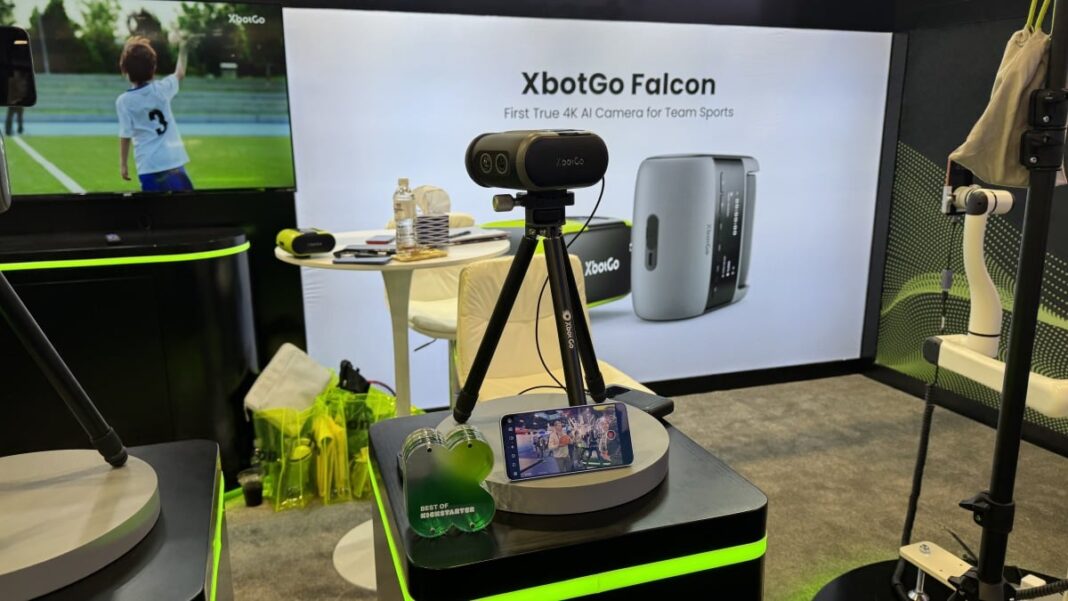


At CES 2026 XbotGo introduced the Falcon, a $599 AI‑tracking camera that records youth‑sports games with the same level of automation as Veo or Hudl but eliminates the recurring subscription fees that often exceed the hardware price. After testing the unit on the show floor, it’s clear the Falcon is more than a low‑cost copy; it’s a direct challenge to a business model that has cost parents thousands of dollars over a single high‑school career.
Subscriptions Face Their First Real Threat
Over the last five years companies such as Veo and Hudl have justified $800‑$1,200 annual fees by arguing that continuous AI processing requires cloud resources. In practice those fees sit on top of $1,200‑plus hardware costs, meaning a family can spend $4,000‑$5,000 for a four‑year high‑school program. The Falcon sidesteps that model by embedding a dedicated AI chip inside the 810‑gram camera. The chip performs player detection, zoom control and broadcast‑style cuts locally, so no footage ever leaves the device unless the user chooses to export it.
When we ran the Falcon during a live soccer match it tracked the ball and players across the full field, automatically zooming when the action clustered near the goal. The resulting video matched the quality of a professional operator, yet there was no monthly charge attached.
Running the numbers makes the contrast stark: a Veo system plus four years of subscription costs roughly $4,500, while the Falcon remains a one‑time $599 expense even if a student plays an extra redshirt year. The difference isn’t a discount—it’s a redefinition of where value is captured in the youth‑sports market.
Hardware That Outperforms Its Price
For $599 most consumers expect compromises, yet the Falcon’s components belong in a higher‑end tier. It uses Sony’s IMX678 sensor—a 1/1.8‑inch chip typically found in security and automotive cameras—delivering clean images even under the harsh lighting of indoor basketball courts. Paired with a 120‑degree lens, the camera captures enough of the playing surface to preserve context while the AI isolates individual athletes.
The motorized head rotates 360 degrees and tilts 160 degrees, specifications that exceed several competitors priced three times higher. In our tests the movement was smooth, avoiding the jerky pans common in cheaper units. During a fast‑break basketball drill the camera anticipated player trajectories rather than merely reacting, producing footage that felt natural.
Perhaps the most surprising feature is the on‑device sport‑specific profiling. Selecting “soccer” automatically adjusts the tracking algorithm for a large field and slower ball speed; switching to “basketball” re‑optimizes for rapid direction changes and tighter player clusters. These adaptations usually require cloud‑based machine‑learning models that vendors keep proprietary.
The Rise of AI Camera Start‑Ups
The Falcon is not alone on the CES floor. Dozens of new cameras aimed at sports ranging from pickleball to swimming showcased AI‑driven player detection. The underlying computer‑vision models have become commodity hardware, with $2‑class chips from Ambarella and Qualcomm now powering many devices.
This commoditization explains how XbotGo can bundle professional‑grade features at a consumer price. The real innovation lies in refusing the subscription model. With a bill of materials estimated under $200, the company appears confident that hardware margins alone can sustain the business.
Established players are already reacting. Veo introduced a “lite” tier shortly before CES, and Hudl began offering multi‑year pre‑pay discounts that cut the effective annual cost by about 50 %. Neither change addresses the core issue: once AI runs locally, convincing users to pay ongoing fees becomes far more difficult.
Long‑term sustainability without recurring revenue remains an open question. Firmware updates, cloud storage options and customer support all incur costs. XbotGo says future updates will be free, funded by hardware margins and economies of scale. Whether that approach scales will become clear as the product reaches a broader audience.
Engineering That Makes “Free” Viable
The Falcon’s breakthrough is its silicon stack. XbotGo licensed a streamlined version of Google’s Edge TPU architecture and paired it with a 5‑TOPS neural accelerator built on a 6 nm process. The resulting chip operates within a 2.3 W thermal envelope, eliminating the need for active cooling inside the magnesium‑alloy housing.
During a teardown demo engineers highlighted three on‑device models: a YOLOv9‑derived detector covering 18 sport‑specific classes, a Kalman‑filter motion predictor that pre‑positions the gimbal 120 ms ahead of play, and a cinematic composer that decides when to cut, zoom or hold. All models run at INT8 precision, achieve 30 fps, and consume less than 40 % of the NPU’s capacity, leaving room for over‑the‑air upgrades without ever sending raw footage to the cloud.
| Component | Legacy Cloud Cameras | XbotGo Falcon |
|---|---|---|
| AI Inference | Remote GPU farm | On‑device 5‑TOPS NPU |
| Latency | 300–800 ms | <120 ms |
| Annual Subscription | $800–$1,200 | $0 |
| Power draw | 12 W (camera + modem) | 3.8 W (total system) |
An Ecosystem Strategy No One Expected
Beyond cutting fees, XbotGo released the Falcon SDK under an Apache 2.0 license, allowing developers to run custom analytics directly on the device. At CES, a volunteer team demonstrated a volleyball‑block efficiency counter and a lacrosse shot‑speed estimator, both computed locally and overlaid on the 4K stream in real time. This positions the camera as an edge‑compute platform that could rival Hudl’s paid telestration tools—without the associated subscription.
League administrators are taking notice. A Midwest soccer association disclosed a $42 k annual budget for Veo licenses across 35 travel teams. Replacing those cameras with Falcons would eliminate that expense, freeing funds for fields and scholarships. Bulk orders of 20 + units are already quoted at $479 each, a 62 % price advantage over the nearest hardware‑only competitor.
Privacy‑First Design
Because footage never leaves the camera unless the user exports it, the Falcon avoids the FTC’s recent health‑data privacy rules that treat biometric video as sensitive information. European clubs, which have faced GDPR penalties for uploading youth video to U.S. servers, can keep every frame on an encrypted SD card protected by a hardware‑linked AES‑256 key. For U.S. parents dealing with COPPA consent forms, this reduces one more administrative hurdle.
Coaches also benefit from tactical secrecy. Cloud‑based rivals aggregate match data to improve their global models, effectively crowdsourcing play‑book intelligence. With the Falcon, all analysis stays on‑site, preventing opponents from accessing a team’s strategic patterns.
Bottom Line
The XbotDo Falcon eliminates the subscription model by packing cloud‑grade AI into a $599, fan‑less enclosure. It forces legacy vendors to confront a market where the hardware alone delivers the value they previously monetized through recurring fees. If supply chain constraints ease—as early shipments of Sony’s IMX678 sensor suggest—they could reshape the youth‑sports video market within two seasons. The only remaining advantage for incumbents is brand inertia, and cost‑conscious parents are already showing a willingness to switch.