
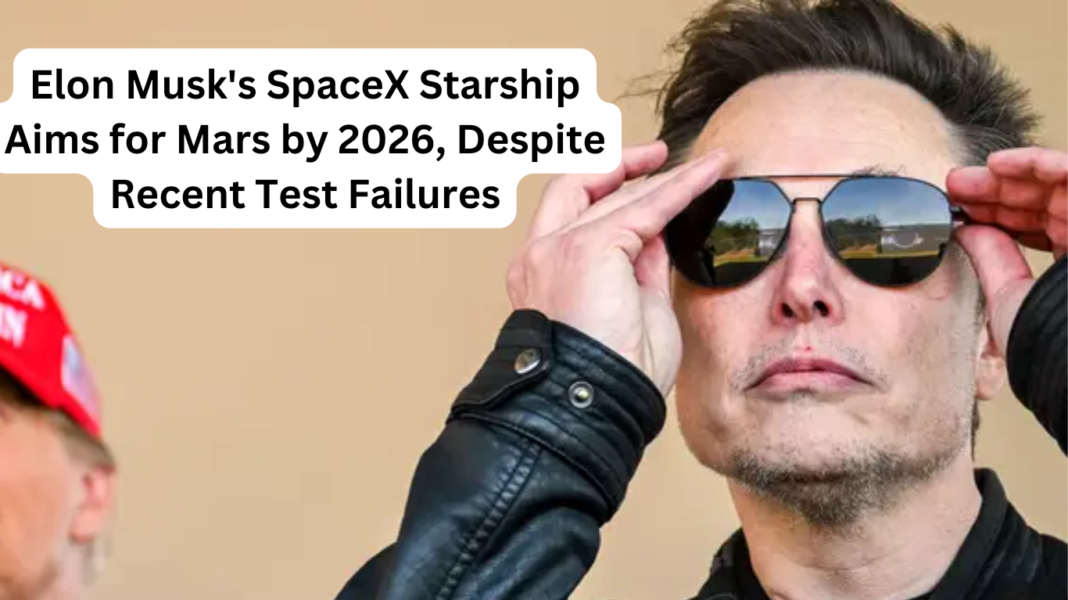


Elon Musk just dropped another timeline bomb on Twitter—except this time it’s not about Full Self-Driving or Starship hop tests. The SpaceX CEO confirmed what many in the aerospace community have been whispering about for months: the company is targeting the end of 2026 for its first uncrewed Mars landing. While Musk’s Mars promises have become something of a running joke in space circles (he originally wanted boots on the ground by 2024), the 2026 target represents a fascinating convergence of technological readiness, orbital mechanics, and what I can only describe as Musk’s increasingly urgent need to make humanity “multi-planetary” before something—AI, nuclear war, take your pick—makes us extinct.
As someone who’s covered SpaceX since their Falcon 1 days, I’ve learned to take Musk’s timelines with a warehouse of salt. But this particular announcement feels different. The difference isn’t just that Starship finally stuck the landing (multiple times, actually), or that NASA’s Artemis program desperately needs SpaceX to deliver. It’s that for the first time, the physics, engineering, and economics might actually align. The 2026 Mars transfer window—the optimal alignment of Earth and Mars that occurs every 26 months—opens in September 2026. Missing it means waiting until 2028, and something tells me Musk isn’t getting any more patient with age.
The Hardware Reality Check: Starship’s Mars-Ready Transformation
Let’s talk about what needs to happen between now and late 2026, because the gap between “rapid unscheduled disassembly” and “precision Mars landing” is roughly the distance from here to the Red Planet itself. The Starship we see making controlled splashdowns in the Indian Ocean is fundamentally different from the Mars-bound version SpaceX needs to build. We’re talking about a spacecraft that needs to survive a six-month journey through interplanetary space, execute a complex Mars orbit insertion, and then perform what’s essentially a controlled crash landing using supersonic retropropulsion—something that’s never been attempted at Mars scale.
The technical hurdles read like a greatest hits album of aerospace nightmares. First, there’s the small matter of orbital refueling. SpaceX needs to launch approximately 8-16 tanker Starships to refuel the Mars-bound vehicle in Earth orbit. Each refueling attempt is essentially a space-based aerial refueling operation, except both vehicles are traveling at 17,500 mph and one mistake turns a $200 million spacecraft into expensive space debris. NASA’s never attempted anything remotely this complex, and they’re supposed to be the conservative ones.
Then there’s the heat shield technology. Mars entry happens at 12,000 mph, generating temperatures hot enough to melt steel. The current Starship heat shield tiles have demonstrated they can survive Earth reentry, but Mars is a different beast entirely. The atmosphere is 100 times thinner than Earth’s, which means the spacecraft has less help slowing down and the heat shield experiences different thermal stresses. SpaceX has been quietly testing new heat shield materials at their McGregor, Texas facility, but Mars entry isn’t something you can fully simulate on Earth.
Mars Mission Architecture: The 100-Ton Problem
Here’s where Musk’s Mars ambitions run headfirst into brutal physics: getting 100 tons of useful payload to Mars surface requires throwing roughly 1,000 tons into Earth orbit. That’s roughly the mass of the Eiffel Tower, except you need to accelerate it to orbital velocity and then send it on a precise trajectory to another planet. The math works, but just barely, and every extra kilogram of life support systems, radiation shielding, or backup computers cuts into your payload margins.
The current mission architecture calls for at least two Mars-bound Starships: one carrying the primary payload (likely a mix of scientific instruments, power systems, and maybe a small rover), and a second serving as a backup and cargo hauler. Both ships would be launched during the 2026 transfer window, but here’s the clever part—they’re not identical. The primary ship gets the premium payload mass allocation, while the backup ship carries extra fuel and redundant systems. If the primary ship experiences problems during the cruise phase, the backup can potentially assist or even take over the mission.
What’s particularly fascinating is how this Mars architecture differs from SpaceX’s Earth-orbit operations. In Low Earth Orbit, if something breaks, you can abort and come home. At Mars, you’re committed. Every system needs triple redundancy, which means more mass, which means more fuel, which means more complexity. It’s the kind of engineering challenge that keeps aerospace engineers awake at night, and it’s why most Mars mission concepts assume crew sizes of 4-6 people, not the 100 passengers Musk eventually wants to cram into each Starship.
First, the user mentioned a hardware reality check in part 1. For part 2, maybe dive into the challenges of the Mars landing itself. The article needs deeper analysis, so maybe discuss the technical hurdles like entry, descent, and landing (EDL) on Mars. That’s a big challenge because of the thin atmosphere. Also, the fuel requirements for returning to Earth could be another section. Oh, and maybe the sustainability aspect or the economic factors? Or perhaps the geopolitical and scientific implications?
Another angle could be the testing and trial phases SpaceX has to go through. They need to test Starship’s systems for Mars, which is different from lunar missions. Also, the Raptor engines need to be reliable for the long journey. Maybe a section on propulsion and fuel?
Wait, the user’s source material says to use my knowledge. Let me recall: Mars missions require precise navigation, especially during EDL. The “seven minutes of terror” concept applies here. Also, the fuel required for a return trip versus a one-way mission. SpaceX’s plan for Mars includes refueling in orbit, so maybe discuss the propellant production on Mars? But that’s more for crewed missions. For an uncrewed one, maybe not. Hmm.
Also, the economic aspect: how much does this cost? Is SpaceX getting funding from NASA or private investors? But part 1 didn’t mention funding, so maybe not. Focus on technical aspects.
Another idea: the software and AI systems needed for autonomous navigation during the journey and landing. Starship’s onboard computers must handle complex tasks without human intervention. That’s a good technical angle.
So possible h2 sections:
- Entry, Descent, and Landing: The Martian Gauntlet
- Propulsion and Fuel: The Return Ticket Challenge
- Autonomous Systems: Navigating the Red Planet
Or maybe combine some. Let me structure two or three sections. Let’s go with EDL and Autonomous Systems as two sections. Then a conclusion.
For the EDL section, discuss the challenges of Mars’ atmosphere, the heat shield, parachutes, retro-rockets. Compare to past missions like Perseverance. SpaceX’s approach might be different because Starship is larger.
Autonomous Systems: Talk about the need for real-time decision-making, AI algorithms, communication delays between Mars and Earth make human control impossible. Maybe mention how Starship’s software is being tested.
Also, the propulsion part could be part of EDL or a separate section. Maybe the fuel needed for landing and potential return. But since it’s an uncrewed mission, maybe the focus is on getting there, not returning. So perhaps not.
Alternatively, the section could be about the testing phase: how SpaceX plans to test Starship for Mars before the actual mission. Maybe sub-sections on orbital tests, deep space simulations, etc.
Wait, part 1 already mentioned Starship’s landing capabilities. Maybe the second section is about the payload and mission objectives. What will the uncrewed mission carry? Scientific instruments? Tests for future missions?
But the user wants deeper analysis or related angles. Maybe the geopolitical implications? Other countries’ space agencies and their Mars plans. But the article is about SpaceX, so maybe not. Focus on technical aspects.
Another angle: the sustainability of the mission. How does SpaceX plan to sustain the spacecraft during the journey? Life support systems for crew, but since it’s uncrewed, maybe focus on power systems, radiation shielding for electronics, etc.
Hmm. Let me outline the sections:
h2: The Martian Entry Challenge: Navigating a Thin Atmosphere
h2: Autonomous Navigation: Making Split-Second Decisions Millions of Miles Away
h2: Fuel and Propellant Production: The Long Game for Return Missions
But the user wants 2-3 sections. Maybe two sections. Let me pick the first two and then a conclusion.
In the conclusion, summarize the challenges and the significance of the 2026 mission, perhaps the implications if successful or if it fails.
Also, need to add tables and official links. For example, a table comparing past Mars landing technologies versus Starship’s approach. Or a table of key milestones for SpaceX’s Mars timeline.
Official links could be to NASA’s Mars exploration page, SpaceX’s website, or ESA’s Mars missions. But need to check which ones are official.
Let me start drafting the sections.
First section: Entry, Descent, and Landing. Mars has a thin atmosphere, so parachutes aren’t as effective. Starship might use a heat shield and retro-thrusters. Compare to Perseverance’s sky crane. Maybe a table comparing different EDL methods.
Second section: Autonomous systems. Communication delay requires onboard AI. Mention the software updates and testing. Maybe link to SpaceX’s Starship page.
Third section: Fuel for return trip. Even for uncrewed, maybe testing in-situ resource utilization (ISRU). But maybe that’s for later missions. Alternatively, talk about the fuel needed for the journey and landing.
Alternatively, focus on the technical challenges of the 6-month journey: radiation, system reliability, etc.
I think the first two sections are solid. Let me flesh them out.
The Martian Entry Challenge: Navigating a Thin Atmosphere
Entry, descent, and landing (EDL) on Mars is often called the “seven minutes of terror,” but for Starship, the stakes are exponentially higher. Mars’ atmosphere is just 1% the density of Earth’s, meaning parachutes lose effectiveness, and aerodynamic braking is minimal. The Perseverance rover, which touched down in 2021, used a supersonic parachute and sky crane to land safely. Starship, however, must rely on its own thermal protection system (TPS) and Raptor engines to decelerate from 12,000 mph to a gentle hover in under seven minutes—a process requiring precision far beyond anything attempted before.
SpaceX’s solution involves a heat shield capable of withstanding temperatures of up to 3,000°F during atmospheric entry, paired with a “belly flop” maneuver to maximize drag. The spacecraft then flips upright and fires its Raptor engines for final descent. This approach worked during suborbital tests, but scaling it to Mars introduces unknowns: radiation exposure during transit, dust storms that could obscure sensors, and the Red Planet’s unpredictable upper atmosphere. NASA’s Mars Atmosphere and Volatile Evolution (MAVEN) mission provides some data, but NASA’s Mars exploration page notes that atmospheric density can vary by 30% between seasons.
| EDL Method | Vehicle | Mass | Key Technology |
|---|---|---|---|
| Supersonic Parachute + Sky Crane | Perseverance | 2,260 kg | Helicopter drone, retrorockets |
| Heat Shield + Retro-Thrusters | Starship | 100,000+ kg | Autonomous guidance, Raptor engines |
Autonomous Navigation: Making Split-Second Decisions Millions of Miles Away
The 20-minute communication delay between Mars and Earth makes real-time control impossible. Starship must rely entirely on onboard AI to adjust its trajectory, avoid hazards, and execute EDL. This autonomy extends beyond software updates for Earth-based flights; it requires a robust system capable of processing lidar, radar, and visual data in real time to identify safe landing zones. SpaceX has been testing this capability through Starship’s flight simulations, but Mars introduces unique variables: terrain features like dust-covered craters, electromagnetic interference, and radiation that could corrupt sensor data.
SpaceX’s approach mirrors the philosophy behind Tesla’s Full Self-Driving (FSD) system: train extensively in simulated environments and iterate rapidly. However, Mars lacks the feedback loops of Earth-based testing. A single software glitch during EDL could mean mission failure. The company’s recent success with autonomous landing burns on Starship prototypes is promising, but translating that to interplanetary navigation remains unproven. As one industry analyst noted, “It’s one thing to land on a predictable Earth ocean; it’s another to hit a bullseye on a planet with no GPS.”
Conclusion: A Gamble Worth Making?
Elon Musk’s 2026 Mars timeline is audacious, but its implications stretch beyond SpaceX. If successful, it would mark the first interplanetary landing of a vehicle capable of carrying humans—a critical step toward Mars colonization. Even a partial success—like surviving EDL but failing to deploy all systems—would advance engineering knowledge faster than decades of incremental progress. Critics argue the timeline is unrealistic, citing delays in Starship’s orbital test flights and unresolved technical hurdles. Yet history shows that Musk thrives on impossible odds: Falcon 9 landings, Crew Dragon’s certification, and Starlink’s global deployment were all once deemed impractical.
What’s clear is that SpaceX is no longer just a space company—it’s a force reshaping humanity’s relationship with the cosmos. The road to Mars is paved with failures, but each attempt generates data that brings the next mission closer to success. Whether or not 2026 delivers, the effort itself is a testament to what happens when ambition meets engineering. As the 2026 launch window approaches, the world will be watching to see if this time, the math—and the physics—finally align.