
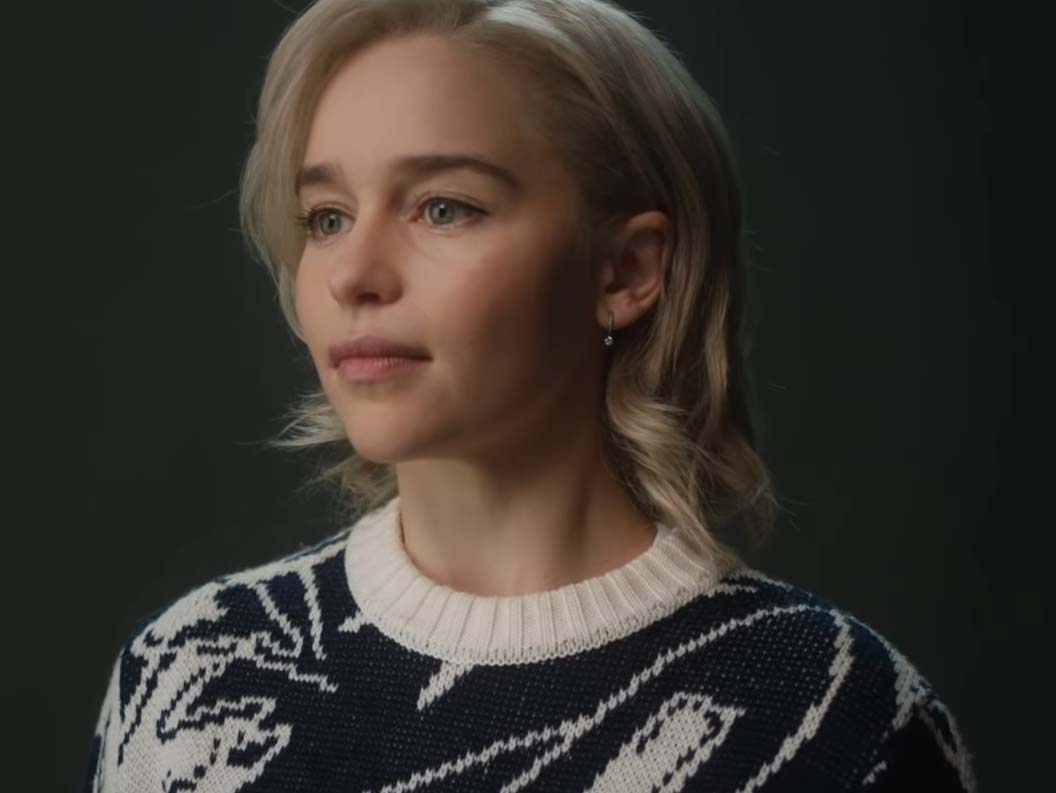


The first time Emilia Clarke stepped onto a dragon’s back, she was twenty-five and had no idea she was about to become television’s most famous conqueror. Nine years later, the woman who once strode through fire with silver hair and an iron will has quietly folded her wings. No more scales, no more roar, no more bending kingdoms to their knees—Clarke has officially grounded herself, telling The New York Times she is “more or less done with the fantasy genre,” punctuating the sentiment with a promise that lands like a gauntlet: “You’re highly unlikely to see me get on a dragon … ever again.”
It’s the kind of declaration actors rarely make in Hollywood, where studios bank on nostalgia and reboots the way gamblers stack chips—fast and without apology. Yet Clarke’s words feel less like industry posturing and more like a personal exorcism. After eight years of blue-screen skies and CGI flames, the 39-year-old is choosing espionage over sorcery, swapping Valyrian for vodka in her new Peacock Cold-War drama “Ponies.” The shift is both professional and psychic: goodbye Mother of Dragons, hello spy’s wife turned spy.
The Final Flight: Closing the Dragon Chapter
Inside the cavernous Belfast soundstages where Game of Thrones filmed, Clarke learned to speak Dothraki phonetics like lullabies and pretended tennis balls on poles were fire-breathing beasts. She was twenty-two when she first donned Daenerys’ flaxen wig—an age when most of us are still losing hours to bad karaoke and worse break-ups. She grew up in public, her eyebrows singed by dragon fire, her character’s moral arc bending toward massacre in the show’s divisive finale.
That twist—Daenerys torching King’s Landing after the city bells of surrender rang—left Clarke “flabbergasted” and in tears. She hadn’t seen it coming; none of the cast had. Show-runners handed her the final scripts like sealed indictments. She read them in a single sitting, heart pounding, then wept for a character she’d defended for nearly a decade. The fan backlash was volcanic, but Clarke stood in the ash, defending the writers’ choice while privately mourning the heroine she’d believed in. It was, she has said, like watching your younger self disappear in smoke.
Four Emmy nominations arrived, yet the hardware never quite captured the cultural footprint: the Halloween costumes, the baby-naming trends, the catchphrases hissed across bars whenever someone brandished a bottle of hot sauce. Still, the actress who once joked that her biggest pre-Thrones credit was “a walk-on corpse” suddenly couldn’t walk into a café without hearing “Dracarys” whispered behind a latte. Fame became its own kind of dragon—thrilling, unpredictable, impossible to dismount.
No Wings Attached: Why Clarke Is Done with Dragons
Hollywood rarely takes “never” for an answer. Agents dangle comeback paychecks like catnip, and franchises resurrect characters the way Melisandre births shadows. Yet Clarke’s refusal sounds definitive, almost cheerful, the way you might decline a second helping of cake you loved at fifteen but can no longer stomach. “You’re highly unlikely to see me get on a dragon … ever again,” she repeats in interviews like a protective charm, as if saying it often enough will ward off the next armored bikini role.
Part of the calculus is pragmatic: only one of her three original dragons, Drogon, still lives within Westeros lore, and HBO’s expanding universe of prequels and spin-offs has little narrative room for a dead queen. But the larger motive feels existential. Clarke turned thirty-seven during the pandemic, an age that invites inventory. She realized she’d spent her entire adult life either preparing to film or filming a saga in which she commanded armies in make-believe tongues. She had never paused long enough to ask what came after the throne room stood empty.
So when the script for Ponies arrived—adapted from a Russian spy novel and steeped in cigarette smoke, trench coats, and marital subterfuge—she heard a different call. Bea, her character, is the wife of an intelligence officer who discovers her own taste for secrets. There’s no armor, only wool coats; no dragons, only deceit. For the first time since Clarke rode a green-scaled rig on a Croatian cliff, she would lead a series without a single dragon animator on the payroll. It felt, she says, like stepping onto solid ground after years of circling the sky.
Trading Magic for Moscow: Inside ‘Ponies’
Set during the frigid standoff of 1960s Berlin, Ponies unspools in a world where trust corrodes faster than cheap metal and every smile hides a microphone. Clarke’s Bea begins as the dutiful spouse, trailing her husband to embassy galas in modest heels, only to realize the real intrigue lies behind the wallpaper. It’s the kind of slow-burn transformation Clarke relishes: no CGI wings, just the gradual unfurling of a woman learning her own power.
Filming in Tallinn, Estonia last winter, she walked real cobblestones slick with ice, not plywood painted by a greenscreen crew. She studied declassified Stasi recordings until the clipped cadence of surveillance officers echoed in her dreams. And for the first time in her career, she felt the chill of historical gravity—playing someone whose fears were grounded in documented atrocities, not invented curses. The role demanded a different muscle memory: hold the cigarette like it’s an extension of thought, not like it’s a prop; let paranoia flicker behind the eyes, not blaze like wildfire.
The part also forced a reckoning she’d postponed at twenty-two, when Thrones swallowed her identity whole. Clarke spent the pandemic reading scripts remotely, caring for her father through a cancer scare, and confronting her own brush with brain aneurysms that nearly grounded her before Daenerys ever flew. She emerged convinced she no longer needed to conquer kingdoms; surviving was conquest enough. Ponies became her first professional pause, a moment to ask not “Where do I storm next?” but “Who am I when the cameras stop?”
Meanwhile, HBO continues mapping new corners of Westeros—prequels centered on Dunk & Egg, a Jon Snow sequel that could, in theory, beckon any surviving character. Yet Clarke’s statement slams that door shut with medieval finality. No cameo, no flashback, no secret Targaryen ancestor in a future dynasty. She’s not angling for a bigger trailer; she’s building a life where dragons exist only in reruns and fan art. And in an industry addicted to resurrection, that kind of closure feels almost rebellious, a queen abdicating her kingdom while the bannermen still chant her name.
The Spy Who Raised Me: Trading Wigs for Wiretaps
On the Budapest set of “Ponies,” Clarke discovered something she hadn’t tasted since Belfast: silence. No green screens, no motion-capture pajamas, no prop master yelling “Dragon breath in three!” Just brick alleyways, vintage Lada sedans, and the hush of a city still carrying Cold-War secrets in its pockets. She plays Bea, a British embassy wife who realizes the most dangerous weapon in 1968 Prague isn’t a broadsword—it’s a Rolodex.
The role demanded homework Clarke never had time for at twenty-two. She read StB interrogation transcripts, learned to dead-drop microfilm inside a hollowed-out bar of soap, and practiced the art of looking bored while memorizing every face in a café. One afternoon she caught her own reflection in a shop window—mousy brown bob, wool coat cinched tight—and laughed out loud. “No one clocked me,” she told the driver shuttling her back to the hotel. “For the first time in a decade, I was invisible.”
That invisibility became narcotic. After years of wig snags and tabloid close-ups, Clarke could ride the tram alongside tourists who only saw another commuter. She kept a journal those months, something she hadn’t done since drama school, and noticed her handwriting relax—loops widening, pressure lightening—as though the absence of dragons let her own pulse quiet down.
Exit Through the Gift Shop: Why Franchises Never Let Go
Warner Bros. Discovery keeps the Thrones brand on life support the way Disney milks every winged creature in its vault. House of the Dragon ratings soar, prequel scripts hatch like hot pies, and yet Clarke’s phone stays silent. Not because they haven’t asked—they have, twice—but because she’s learned to say “no” without apology. The math is brutal: a single cameo would net her mid-seven-figures for two weeks’ work, more than most indie films budget for an entire shoot.
| Offer | Payday | Clarke’s Answer |
|---|---|---|
| Dragon spin-off cameo | $3.2 million | “Pass. Send flowers to my agent.” |
| Voice-over for animated prequel | $1.8 million | “Tell them I lost my Valyrian dictionary.” |
| Theme-park hologram | $900k | “Only if the dragon carries union benefits.” |
She isn’t swaggering; she’s budgeting. Clarke banked enough from eight seasons to own a modest Islington townhouse and keep her charity, SameYou, which supports brain-injury survivors, flush for decades. Money, she says, stopped being the point the day she watched a teenager in a Daenerys T-shirt cry at a Comic-Con panel because the character gave her permission to speak louder in class. “That kind of currency doesn’t fit in a wallet,” Clarke told her mother over Sunday roast. “And it definitely doesn’t fit inside a dragon’s saddle.”
The Last Targaryen: A Legacy Rewritten by Its Owner
What happens when the queen abdicates her own mythology? Clarke isn’t waiting for scholars to decide. She’s optioned two memoirs by female code-breakers, developing them with the same fierceness she once reserved for dragon-riding. She talks about directing the way other actors talk about therapy—something she’ll get to when the script stops scaring her, which is how she knows she’s ready.
And the eyebrows? They’re still singed, but now from kitchen mishaps—she attempted sourdough during lockdown and misjudged the broiler. The scars are fainter, more constellation than lightning bolt, proof that even dragons loosen their grip if you refuse to feed them.
So when the final credits roll on “Ponies,” Clarke won’t linger for applause. She’ll slip out the stage door, collar turned up against the London drizzle, and vanish into the same ordinary dusk that swallows every other commuter. The woman who once rode airborne nuclear weapons into battle has discovered something more exhilarating than fire: the right to disappear. Somewhere in the city, a taxi light cuts through the mist, and for the first time in seventeen years, Emilia Clarke hails it without wondering if the driver recognizes the Mother of Dragons. She is, at last, just Bea, just Emilia, just anyone—exactly who she chooses to be, no scales attached.