
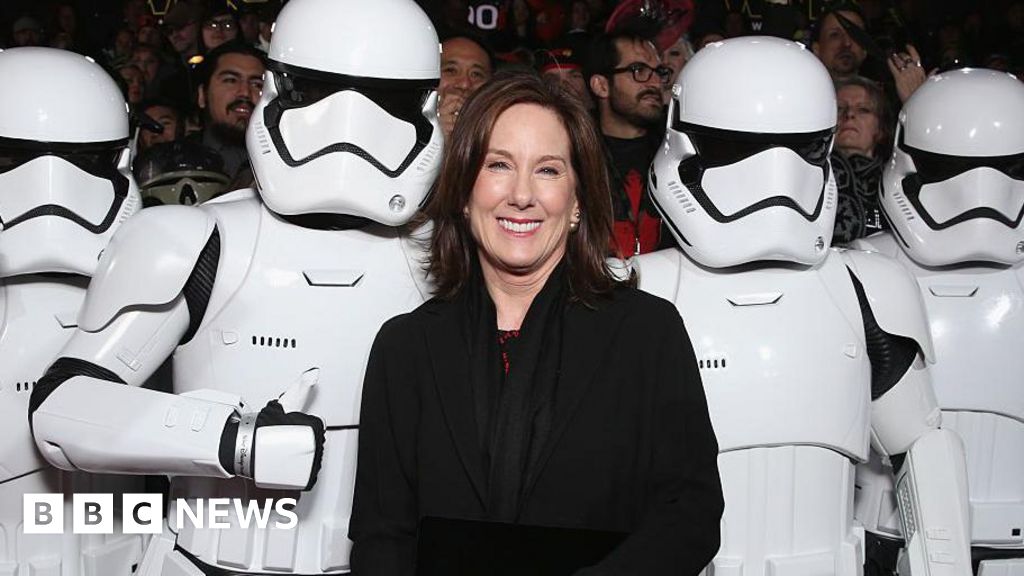


After fourteen years at the helm of Lucasfilm, Kathleen Kennedy will step down this summer, turning the bridge over to Dave Filoni, the creative force behind The Clone Wars, Rebels, and The Mandalorian. The change ends a tenure that revived Star Wars on the big screen, weathered fan backlash, and turned Disney+ into the franchise’s new home.
From Spielberg Whisperer to Galaxy Guardian
Kennedy’s résumé began in the Spielberg era—E.T., Jurassic Park, Amblin—before George Lucas personally tapped her to take over Lucasfilm in 2012. Days later, Disney’s $4 billion purchase closed, handing her custody of cinema’s most scrutinized mythology. The job: launch a sequel trilogy, spin off stand-alone films, and keep toy aisles stocked without dulling the mythic shine that made lightsabers iconic.
She delivered commercially: five theatrical releases—The Force Awakens, Rogue One, The Last Jedi, Solo, and The Rise of Skywalker—took in more than $5 billion globally. Merchandise, theme-park tie-ins, and a streaming slate that began with The Mandalorian in 2019 turned Star Wars into a year-round profit center. Critically, the record was mixed: Force Awakens still holds the domestic opening-weekend record ($247 million), while Solo’s production chaos and under-performance in 2018 shelved the plan for annual movies. The Last Jedi’s subversive choices scored 91 percent on Rotten Tomatoes yet fractured the fandom, and Skywalker’s course-correction pleased neither camp.
Sky-High Box Office, Mixed Critical Reception
Inside Burbank, Kennedy is credited with pulling off the near-impossible: relaunching a forty-year-old property without the original stars in leading roles. Rogue One’s gritty war tone opened new genre lanes, while Last Jedi deconstructed legacy heroes and still earned an A CinemaScore. The backlash highlighted a paradox: modern Star Wars must surprise a multigenerational audience that also wants the comfort of its own head-canon.
Corporate synergy flourished. ILM’s StageCraft LED wall, first used on The Mandalorian, cut location costs and became the standard for Marvel and HBO series. Disney+ trailers now rely on Lucasfilm’s VFX pipeline, and new park expansions in Anaheim and Orlando draw directly from stories developed under Kennedy. After Solo, planned Boba Fett and Obi-Wan features were re-engineered as limited series, a format Kennedy argued gave creators “long-form oxygen” while driving subscriber growth.
The Rise of Dave Filoni: Fan-Favorite to Corner-Office
Dave Filoni’s promotion from executive producer/creative overseer to president and chief creative officer feels inevitable to anyone who has followed Lucasfilm animation. Starting with 2008’s The Clone Wars, he filled prequel-era gaps, resurrected Darth Maul, and introduced Ahsoka Tano—now a live-action fixture played by Rosario Dawson. Rebels deepened lore with the World Between Worlds, while Resistance targeted younger viewers. On Disney+, Filoni teamed with Jon Favreau on The Mandalorian, smuggling western beats into space opera and debuting “Baby Yoda,” the platform’s first viral icon.
His approach: respect Lucas’ canon without handcuffing it. Writers’ room whiteboards map character arcs across centuries of in-universe history, endearing him to Reddit theorists. He also balances the budget: StageCraft shoots trimmed location costs and COVID delays, a discipline that impressed both Bob Chapek and Bob Iger. Co-president Lynwen Brennan—who handles business operations, legal, and tech—will mirror Marvel’s Feige/D’Esposito structure.
What shifts under Filoni? Expect tighter links between animation and live-action: heroes seeded in Clone Wars and Rebels already headline Ahsoka, Skeleton Crew, and an upcoming New Republic crossover. Film development will likely stay inside Filoni’s “Mandoverse” timeline before venturing into the Old Republic or Rian Johnson’s rumored trilogy. Merchandising will lean harder on legacy callbacks—lightsabers, starfighters, droids—pitched as much to 40-something collectors as to TikTok cosplayers.
Yet the new boss inherits Kennedy’s core challenge: keep Star Wars special when peak-genre content is everywhere. Disney+ has scheduled at least one Star Wars series per fiscal quarter through 2027, testing the scarcity model that once made the brand an event. Filoni must also manage aging actors, social-media flare-ups (Gina Carano’s firing, CGI Luke debates), and competition from Marvel, DC, and Harry Potter. The throne room door has closed on Kennedy’s era; the next story waits inside a galaxy of streaming metrics, toy sales, and fans who tweet plot fixes before breakfast.
The Streaming Renaissance: How Television Saved the Franchise
While the film schedule faltered, Kennedy’s team pivoted to Disney+, transforming Lucasfilm from a tent-pole supplier into a premium streaming studio. The Mandalorian’s 2019 premiere re-anchored Star Wars in weekly appointment viewing, racking up 5.4 billion minutes watched in Q4 2020, per Nielsen. Kennedy approved a slate that now spans six live-action series, each carrying VFX budgets north of $15 million per episode.
The economics were persuasive: Disney+ subscriptions jumped 28 percent quarter-over-quarter whenever a new Star Wars show arrived, and Baby Yoda plush became Disney’s fastest-selling toy. Serialized storytelling also let creators probe morally gray corners—Andor’s slow-burn espionage, Ahsoka’s time-warp lore—that a two-hour film could never justify. By owning the streaming backend, Lucasfilm kept toy revenue and avoided the marketing cost of a theatrical campaign. Between 2019 and 2023, division operating income tripled despite zero new films.
| Series | Estimated Budget/EP | Global Viewership (Nielsen) | Merch Revenue FY |
|---|---|---|---|
| The Mandalorian S3 | $16.5 M | 3.2 B min | $700 M |
| Andor S1 | $15.0 M | 1.1 B min | $85 M |
| Ahsoka S1 | $17.2 M | 2.7 B min | $410 M |
Handoff to Filoni: Continuity Custodian or Creative Bottleneck?
Dave Filoni’s ascension is less coup than culmination. Starting as George Lucas’ story assistant on The Clone Wars, he memorized planets, species, and Force mechanics until he could recite them backwards. Under Kennedy he became unofficial canon keeper, inserting Bo-Katan Kryze and Grand Admiral Thrawn into live-action for the first time, thrilling hardcore fans who map hyperspace routes on Wookieepedia.
Yet encyclopedic loyalty can harden into risk aversion. His animated shows excel at filling gaps, not upending mythology. The rumored “Mandoverse” crossover film will braid Disney+ heroes into an Avengers-style event, reinforcing interconnectedness instead of launching fresh timelines. The danger: Star Wars becomes a Möbius strip of Thrawn, Boba Fett, and Maul callbacks until the galaxy feels claustrophobic.
Insiders note Filoni quietly backs new voices—he defended Tony Gilroy’s gritty rewrite of Andor and pushed Bryce Dallas Howard into directing live-action. If he can balance reverence with real authorship, Lucasfilm could echo Marvel’s post-Feige model: legacy oversight plus indie hires.
What Kennedy Leaves Behind: A Template for Modern IP Stewardship
Whatever one thinks of her choices, Kennedy exits with a playbook studios now photocopy: raid deep archives for streaming, weaponize nostalgia without freezing canon, and globalize casting—Donnie Yen in Rogue One, Verónica Navas in Andor—to offset domestic plateaus. Her mandate for practical creatures over pure CGI kept toy margins high, while location shoots in Jordan’s Wadi Rum and Ireland’s Skellig Michael fed park expansions.
The next president inherits a pipeline locked through 2028: Skeleton Crew’s Amblin-flavored kids adventure, a second Andor season that adds K-2SO, and James Mangold’s Dawn of the Jedi film set 25,000 years pre-Luke. More important is a culture that treats Star Wars not as a trilogy of trilogies but as an elastic universe—closer to DC’s multiverse than Tolkien’s finite saga.
Kennedy’s departure lands amid Disney’s cost-cutting; the blank-check space-western era is over. Filoni’s task is to keep the sandbox fertile with leaner budgets and shorter seasons while superhero fatigue looms. If he succeeds, the Kennedy era will be remembered as the franchise’s unruly adolescence—one that learned to thrive on television, survived its own fandom, and finally hit hyperspace again, lightsaber ready to pass.