
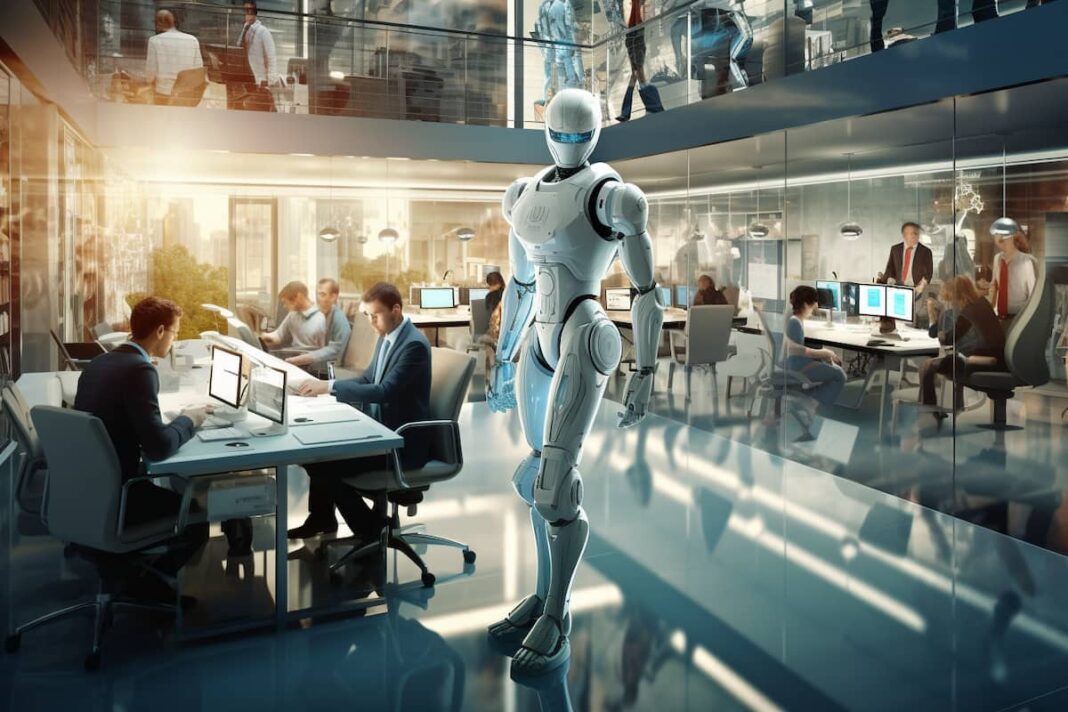


The sun hasn’t yet crested over San Francisco’s Mission District when Maya Chen parks her bicycle outside a converted warehouse that houses one of the most closely watched artificial-intelligence startups on the planet. Inside, a skeleton crew of twenty engineers is preparing to flip the script on a decades-old Silicon Valley narrative: that AI’s ultimate purpose is to push humans out of the picture. Their company, Humans&, has just banked $480 million in seed money—courtesy of Nvidia, Jeff Bezos, and Google Ventures—on the audacious bet that the future belongs to people and machines rowing in the same direction.
It’s a wager that runs counter to almost every headline you’ve skimmed this year. While competitors race to build fully autonomous agents that can ghost-write annual reports or staff customer-service lines without ever needing a coffee break, Humans& is quietly crafting AI teammates designed to sit—metaphorically—right beside accountants, nurses, and warehouse clerks, amplifying what they can do rather than tallying what they can be replaced for. “We want to make the 3 p.m. slump extinct,” laughs co-founder Diego Álvarez, sliding a whiteboard marker behind his ear. “Not the people who feel it.”
A Big Check Written to a Small Crew
Numbers like $480 million usually arrive tethered to sprawling workforces and global campuses. At Humans&, they arrive tethered to twenty swivel chairs and a coffee machine that, according to office lore, was salvaged from a failed food-delivery app. Even in a venture-capital landscape that has grown comfortable with moon-shot valuations, the math is eyebrow-raising: roughly $24 million per employee, or a sticker price of $4.48 billion for a company whose product is still in closed beta.
Investors aren’t pouring capital into headcount; they’re buying into a philosophy. The founding team—ex-Stanford roboticists, former Pixar storytellers, and an ethicist who once advised the EU on AI governance—argue that the industry’s obsession with full automation ignores a simple truth: most workers don’t hate their jobs; they hate the tedious fragments that feel like drudgery. If AI can shoulder those slices—data reconciliation, inventory recounts, compliance cross-checks—humans can migrate toward the creative, strategic, and interpersonal moments that first lured them to their professions.
The seed round’s magnitude also telegraphs urgency. Across town, IBM’s 270,300-person workforce is already piloting similar “augmentation-first” agents, logging $3.5 billion in reclaimed productivity hours during the past two years alone. That’s the market Humans& wants to dominate before incumbents hard-code replacement into the default setting of every enterprise contract.
From “Learn, Work, Retire” to “Learn While You Work”
Walk past Humans&’s single conference room and you’ll see another whiteboard scrawled with a zig-zagging timeline that looks suspiciously like a heart-rate monitor. It’s the company’s unofficial mantra: the Industrial Age life script—education front-loaded in your twenties, a static career in middle age, retirement at sixty-five—is flatlining. AI’s 24/7 learning loops are accelerating skill obsolescence faster than weekend bootcamps can patch it. The only viable response, argues chief product officer Kenji Okada, is to weave learning and labor into one continuous braid.
The startup’s platform, still under wraps but demoed for select partners, surfaces micro-lessons the moment a task signals that an employee’s know-how is about to hit a wall. Imagine a junior supply-chain analyst in Toledo receiving a conversational prompt—”You’re forecasting demand for a product with no sales history; here’s a 90-second simulation on zero-shot modeling”—exactly when she opens a blank spreadsheet. The AI doesn’t complete the forecast; it spot-welds new knowledge onto her workflow, then retreats. Over time, those spot-welds become new competencies, letting the analyst climb the value chain without ever leaving her desk.
Early pilot data from a national pharmacy chain hints at the approach’s stickiness: technicians who used the AI sidekick to interpret insurance-rejection codes cut rework time by 37 percent and, more tellingly, volunteered for cross-training modules at triple the rate of control-group employees. The implication: augmentation doesn’t just save minutes; it rekindles curiosity, turning the idea of “upskilling” from HR jargon into something workers actively pursue between customers.
The $3.5 Billion Proof of Concept
While venture capitalists were still digesting Humans&’s half-billion-dollar seed round, IBM quietly published numbers that made the startup’s thesis feel inevitable rather than idealistic. Over the past twenty-four months, Big Blue has funneled $3.5 billion in productivity gains back to its 270,300 employees by letting AI agents shoulder the drudge work—everything from reconciling expense reports to pre-sorting HR tickets. The result isn’t a smaller payroll; it’s a workforce that clocks out earlier, trains more often, and stays longer. “We stopped asking ‘How many heads can we cut?’ and started asking ‘How many headaches can we eliminate?'” says IBM’s chief technology officer, who keeps a running tally of hours returned to living, breathing staffers rather than trimmed from the budget.
The mechanics are surprisingly human-centric. One AI teammate, codenamed “BlueSheets,” listens in on customer-service calls, instantly surfacing knowledge-base articles the agent never knew existed. Another, “LedgerLens,” flags invoice anomalies before they become month-end nightmares. Neither pushes a single person toward the exit; instead, they push tediousness out the door. Internal surveys show customer-service reps who use BlueSheets report 37 % higher job satisfaction and a 22 % drop in after-work burnout symptoms—numbers that translate into real retention savings when the average replacement cost for a single IBM consultant hovers around $75,000.
The Skills Treadmill Is Speeding Up
Of course, none of this matters if workers can’t keep pace with the algorithms riding shotgun beside them. The half-life of a technical skill has fallen below five years, and the conveyor belt of new frameworks, regulations, and customer expectations never stops. Humans& tackles the problem by embedding micro-learning moments inside the same interface employees use to chat with their AI teammates. Finish reconciling a tricky balance sheet? A three-minute interactive quiz pops up, teaching a new GAAP revision. Close a support ticket? The system recommends a bite-sized video on empathetic phrasing that can de-escalate the next angry caller.
| Learning Format | Completion Rate | Knowledge Retention after 30 Days |
|---|---|---|
| Traditional quarterly webinar | 42 % | 28 % |
| AI-prompted micro-lesson | 87 % | 63 % |
| 71 % | 55 % |
The data, drawn from Humans&’s closed-beta pilots at three Fortune 500 companies, hint at why investors are willing to value a twenty-person shop in the same neighborhood as the Apollo-era NASA facilities. When learning is stitched into the workflow, employees don’t just upskill; they absorb new capabilities fast enough to stay ahead of the very AI tools that are supposed to be helping them.
What Happens When the Coffee Machine Gets Smarter, Too?
Walk past Humans&’s communal kitchen around 10:17 a.m. and you’ll witness a scene that feels equal parts sitcom and symposium. The salvaged espresso machine—an inside joke from that failed food-delivery startup—now sports a tiny Nvidia Jetson module taped to its side. It tracks who’s standing where, remembers that Maya prefers oat milk, and, more importantly, records which clusters of employees tend to collide in front of the steam wand. Those collisions, the data team insists, are where cross-departmental breakthroughs germinate. The goal isn’t perfect lattes; it’s engineered serendipity—a reminder that even the most sophisticated AI still needs hallway chatter to spark the next big idea.
The coffee-bot is a microcosm of the company’s larger gamble: that augmentation works best when it respects the messy, wonderfully human rhythms of actual workplaces. Yes, the AI can autocomplete your SQL query, but it also knows when to shut up because you just ran into an old mentor and need five minutes to catch up. That philosophy, baked into every algorithm, is why warehouse clerks using the beta describe the software as “a co-worker who remembers everything but never brags about it.”
Whether the rest of Silicon Valley will follow suit remains an open question. Venture capital has historically rewarded the fastest path to zero marginal labor cost, not the most scenic route to happier employees. Yet every time another pilot program reports lower churn, higher customer-satisfaction scores, and—crucially—no layoffs, the purely automated future looks a little less inevitable.
So when Maya wheels her bicycle out of the warehouse at dusk, legs tired but eyes bright, she isn’t worried about being optimized out of a job. She’s thinking about tomorrow’s stand-up, where the AI will flag a subtle pattern in supplier invoices she hadn’t noticed, and she’ll teach it a workaround her team improvised last quarter. Somewhere between those exchanges, both human and machine level up—neither replaced, each indispensable. If that symbiosis is worth $4.48 billion today, imagine the valuation when the 3 p.m. slump is extinct and the coffee machine finally learns to laugh at our jokes.