
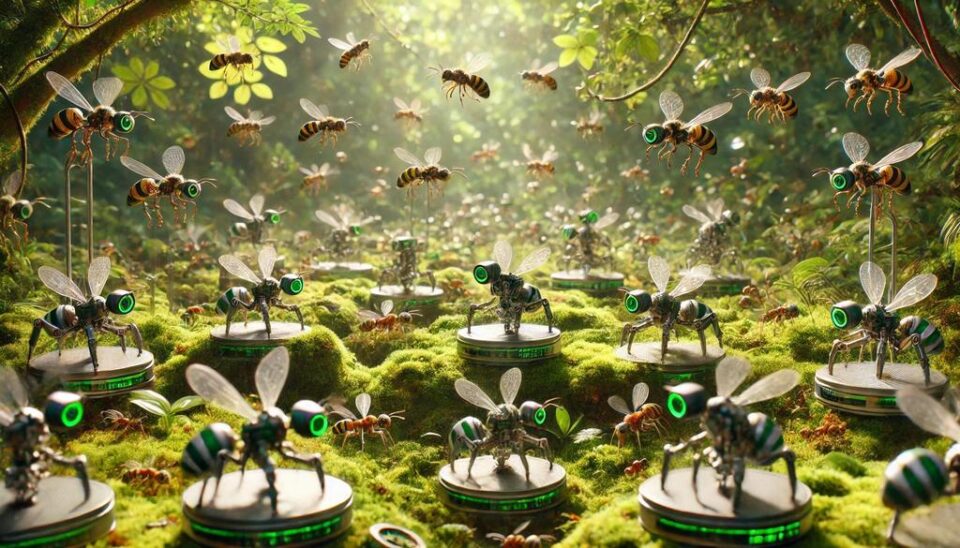


Breaking: Scientists Create Blooming Robot Swarm Inspired by Nature
Buildings that open like flowers when the sun rises, facades that ripple like leaves in the wind, and walls that rearrange themselves around the people inside are no longer fantasy. Researchers at Princeton University have built a colony of palm-sized robots that unfurl in response to light, mimicking the way a garden blooms at dawn. The project, led by mechanical engineer Sigitas Senas, is the first demonstration of a programmable architectural material that can change its shape without human intervention.
The Inspiration Behind the Robotic Swarm
The team began by filming fire-ant rafts in slow motion. A single ant is barely buoyant, but link thousands together and they become a living, self-healing bridge that can support 500 times their collective weight. Senas translated that lesson into hardware: each robot has four spring-loaded arms with magnetic tips. When a photodiode senses a drop in light, the microcontroller releases the arms, letting neighboring units snap together. No central computer tells the swarm what to do; instead, every robot follows the same three rules—detect light, check for neighbors, and decide whether to extend or retract.
“We wanted the math that keeps an ant raft afloat to keep a building facade upright,” Senas said. “If one robot fails, the others route around it, exactly the way ants rebuild a damaged raft within minutes.”
The Robotic Swarm: A Marvel of Engineering
The current prototype is a lattice of 120 hexagonal robots, each 9 cm across and weighing 42 g. Inside every unit are a 3.7 V lithium-polymer cell, a magnetic encoder that measures arm angle to within 0.5°, and a 2.4 GHz radio that exchanges 16-byte packets with any neighbor within 6 cm. The arms lock with a force of 2.3 N—strong enough to support the weight of three additional robots hanging beneath them.
Because the robots share power through the magnetic connectors, a single charging pad on the edge of the lattice can refill the entire swarm in 90 minutes. During operation the collective draws an average of 1.8 W, less than a bright LED bulb.
Towards Dynamic Facades and Beyond
Princeton’s architecture school has already requested a 4 m × 3 m section of the material for the south wall of a new lab building. On bright days the lattice will flatten into a shade; as the sun sets it will curl outward to create ventilation channels. Simulations predict the system will cut cooling demand by 18 % compared with static louvers.
Outside architecture, the U.S. Army Corps of Engineers is testing whether the robots can form temporary bridges over gaps of up to 8 m, while a biomedical group at Johns Hopkins is exploring capsules only 2 mm wide that could travel through blood vessels and unfold into stents at targeted locations.
From Lab to Living Architecture: Real-World Applications
While the blooming robot swarm currently exists as a laboratory prototype, the implications for real-world architecture are profound. Picture walking into a building where the walls themselves respond to your presence, opening like petals to create private spaces or closing to form communal areas. The Princeton team’s innovation could revolutionize how we think about smart buildings, moving beyond simple temperature control to create structures that literally breathe and adapt to their inhabitants.
The potential applications extend far beyond mere aesthetics. These robotic swarms could be deployed as adaptive shading systems in skyscrapers, automatically adjusting throughout the day to optimize natural light while reducing energy consumption. In disaster zones, emergency shelters could be constructed using similar principles, with robots linking together to form protective barriers against harsh weather conditions. The technology could even be scaled down for medical applications, creating microscopic swarms that deliver targeted treatments within the human body.
What’s particularly exciting is how this technology could democratize architectural design. Instead of static buildings that remain unchanged for decades, we could see community spaces that residents can reconfigure on demand. Your apartment could literally transform from a cozy bedroom to a spacious entertainment area, all controlled by light patterns or even your smartphone.
The Technical Challenges Ahead
Of course, we’re not quite at the stage where robot swarms will be blooming on our city streets tomorrow. The Princeton team faces significant hurdles before this technology becomes commercially viable. Power consumption remains a major concern – each robot needs enough energy to move, communicate, and process environmental data, yet must remain lightweight enough to move efficiently as part of the collective.
| Challenge | Current Solution | Future Goal |
|---|---|---|
| Power Management | External power source | Self-charging via solar/light |
| Communication Range | Local neighbor-to-neighbor | Global swarm coordination |
| Response Time | Several seconds | Real-time adaptation |
| Scalability | Dozens of robots | Thousands+ robots |
The computational complexity also scales exponentially with swarm size. Each robot must make decisions not just based on its own sensors, but by interpreting the collective behavior of its neighbors. This requires sophisticated algorithms that can predict emergent patterns – essentially teaching each robot to be both an individual and part of a greater whole.
Cost presents another barrier. While the current prototypes are relatively inexpensive individually, outfitting an entire building facade with hundreds or thousands of these robots would require significant investment. However, as with most technologies, economies of scale should drive prices down once manufacturing processes are optimized.
When Nature Meets Nanotechnology
The most fascinating aspect of this research might be how it blurs the line between living and artificial systems. The Princeton team isn’t just copying nature – they’re creating a new form of synthetic life that operates by similar principles but with capabilities beyond biological constraints. Unlike fire ants, these robots can operate in extreme temperatures, don’t require food, and can be instantly reconfigured for different tasks.
This convergence of biology and engineering opens up philosophical questions about what constitutes intelligence. If a swarm of robots can collectively solve problems, adapt to changing conditions, and even exhibit something that looks like coordinated movement, at what point do we consider it a form of artificial life? The researchers are essentially creating a new kingdom of existence – neither fully alive nor entirely mechanical.
The technology also represents a shift from the traditional approach of building bigger, stronger machines to building smaller, smarter collectives. It’s the difference between designing a powerful crane versus creating an army of ants that can collectively lift objects many times their individual capacity. This philosophy could reshape how we approach everything from space exploration to environmental cleanup.
Looking ahead, we might see hybrid systems where biological and robotic swarms work together. Imagine bees carrying tiny robots that help them navigate polluted areas, or robotic fish that swim alongside real schools to monitor ocean health. The possibilities are as endless as nature’s own solutions, refined over billions of years of evolution.
This blooming robot swarm represents more than just a cool tech demo – it’s a glimpse into a future where the boundaries between the natural and artificial worlds become beautifully blurred. While we’re still years away from walking through buildings that bloom around us like living gardens, the seeds of that future have definitely been planted in Princeton’s lab. And if science fiction has taught us anything, it’s that today’s laboratory curiosities have a habit of becoming tomorrow’s everyday miracles.