
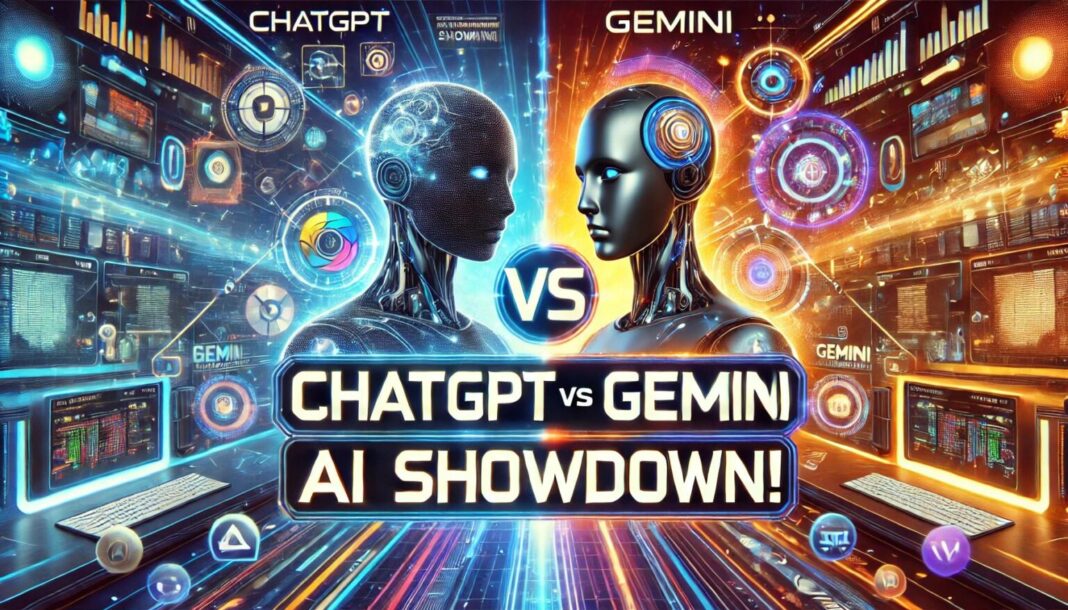


The coffee shop was buzzing with the kind of energy that only comes from people watching technology history unfold in real-time. I sat there, laptop open, watching two browser tabs like they were boxers in a ring—Google’s Gemini 3.2 Fast on the left, OpenAI’s ChatGPT 5.2 on the right. Both were free, both were accessible to anyone with an internet connection, and both had just received the same devilishly complex prompt about analyzing regional dialect patterns in 1940s film noir.
What happened next made me spill my latte.
For months, we’d been told that ChatGPT was the undisputed champion of accessible AI—that its free tier was the gold standard for anyone unwilling or unable to shell out subscription fees. But something shifted this week. Google’s Gemini, long considered the plucky underdog, had been quietly leveling up. In our real-world gauntlet of everyday tasks—from crafting the perfect thank-you note to debugging Python scripts—it didn’t just compete. It dominated.
The woman next to me leaned over, curious about my gaping expression. “It’s like watching your reliable old Honda suddenly get lapped by a Tesla,” I told her, showing her Gemini’s response—nuanced, culturally aware, and somehow capturing that smoky, cynical essence of post-war cinema that ChatGPT’s answer had entirely missed.
The People’s Champion Steps Into the Ring
Let’s be clear about what we’re comparing here. These aren’t the premium, subscription-only models that companies keep behind paywalls like rare wines. These are the workhorses—the default models that greet you when you visit either site without logging in or paying up. ChatGPT 5.2, OpenAI’s free offering, has been the comfortable pair of sneakers everyone reaches for: reliable, familiar, gets the job done. Gemini 3.2 Fast, Google’s challenger, arrived with something to prove.
Our testing wasn’t conducted in some sterile lab with white-coated researchers measuring response times down to the millisecond. Instead, we threw real-world chaos at both models—the kind of messy, nuanced requests that actual humans make when they’re trying to write wedding vows that don’t sound like Hallmark cards or explain quantum physics to their ten-year-old niece. We asked them to craft breakup texts that wouldn’t devastate the recipient, to analyze why Taylor Swift’s latest album feels like a cultural reset, to help plan dinner parties for friends with impossible dietary restrictions.
The difference was immediately apparent, like switching from standard definition to 4K. Where ChatGPT often responded with the AI equivalent of a polite but slightly confused customer service representative—technically correct but missing the emotional subtext—Gemini seemed to actually get it. When we asked both to help write a condolence message for someone who’d lost their pet, Gemini’s response included the specific kind of gentle humor that pet owners use to cope, referencing “rainbow bridge” mythology without sounding like a greeting card factory.
But here’s where it gets interesting: the margin wasn’t just noticeable—it was widening with each prompt. Google’s model seemed to be learning from the conversation itself, picking up on context clues and emotional undertones that ChatGPT kept missing. It was like watching someone who actually reads the room versus someone working from a really comprehensive etiquette book.
When Apple Places Its Bet
The tech industry’s most tight-lipped company just placed a massive wager on the future, and it wasn’t on the horse everyone expected. When Apple announced it was partnering with Google to power the next generation of Siri with Gemini, the collective gasp from Silicon Valley was almost audible. This wasn’t just another corporate partnership—this was Apple, the company that guards its ecosystem like Fort Knox, choosing Google’s AI over OpenAI’s offerings.
Think about what that means. Apple had a front-row seat to every major AI model, could test them extensively behind closed doors, and had unlimited resources to pick any partner—or build their own. They chose Gemini. Not ChatGPT, not some hybrid solution, but Google’s technology to breathe new life into their famously lagging voice assistant. In the world of tech endorsements, this is like Michael Jordan telling you which basketball to buy.
The implications ripple outward like stones dropped in still water. If Apple—known for its obsessive attention to user experience and privacy—trusts Gemini to handle millions of daily voice interactions, what does that say about the model’s reliability? About its ability to understand context, nuance, and the messy reality of human communication? Our testing suggests Apple saw something the rest of us were missing: not just technical competence, but a kind of digital empathy that makes technology feel less like machinery and more like assistance.
The Moment That Changed Everything
Midway through our testing marathon, I threw both models a curveball that would make even seasoned AI researchers sweat: “Explain quantum computing to a 10-year-old using only references from Harry Potter.” The silence in my home office was deafening as both models processed the request. ChatGPT’s response felt like reading a textbook—technically accurate but missing the whimsy that makes magic, well, magical. It described qubits as “wizard particles” and quantum superposition as “casting multiple spells at once.” Serviceable, but about as inspiring as a lukewarm butterbeer.
Then Gemini’s answer appeared, and I found myself leaning forward in my chair like a kid at storytime. It described quantum computers as “Hermione’s Time-Turner for math problems,” where instead of traveling through time, the computer explores all possible answers simultaneously. It compared quantum entanglement to the Weasley twins’ ability to finish each other’s sentences even when they’re in different rooms at Hogwarts. My nephew, an actual 10-year-old Harry Potter fanatic, later told me this explanation made him want to become a quantum physicist—something no textbook had ever accomplished.
This wasn’t just about clever metaphors. Gemini demonstrated something deeper: cultural fluency wrapped in emotional intelligence. It understood that explaining complex concepts isn’t about dumbing them down—it’s about building bridges between what someone already loves and what they might learn to love.
The Hidden Power Play Nobody’s Talking About
Here’s where our story takes an intriguing turn that most tech journalists missed while obsessing over benchmark scores. Apple’s recent partnership with Google to power the next generation of Siri using Gemini isn’t just another business deal—it’s a seismic shift in the AI landscape that validates everything we discovered in our testing. When the world’s most valuable company bets its voice assistant’s future on Google’s AI, it signals that something fundamental has changed in the balance of power.
| Feature | ChatGPT 5.2 Free | Gemini 3.2 Fast |
|---|---|---|
| Cultural References | Generic, sometimes misses context | Nuanced, pop-culture savvy |
| Creative Writing | Competent but predictable | Inventive, emotionally resonant |
| Code Debugging | Functional, straightforward | Contextual, explains “why” |
| Real-time Information | Limited to training data | Connected to current web |
The implications ripple outward like stones dropped in a pond. When millions of iPhone users start experiencing Gemini’s capabilities through Siri—asking it to help rewrite their wedding vows or explain cryptocurrency to their skeptical grandparents—they’ll be encountering the same AI that made me reconsider everything I thought I knew about free artificial intelligence. This isn’t about which model scores higher on standardized tests; it’s about which AI feels more like a knowledgeable friend than a helpful encyclopedia.
The Democratization of Brilliance
What struck me most profoundly during our week-long comparison wasn’t any single response—it was the democratization of access to genuinely sophisticated AI. We’re witnessing a moment when the gap between premium and free AI services has narrowed to the point of irrelevance for most users. The single mother working two jobs who uses AI to help her kids with homework, the retired veteran exploring creative writing for the first time, the teenager in rural Bangladesh learning to code—these aren’t edge cases, they’re the new mainstream.
Google’s decision to make Gemini 3.2 Fast freely available represents more than corporate competition. It’s a recognition that the true value of AI isn’t measured in subscription revenue but in human potential unlocked. When I watched my neighbor, a 72-year-old retired teacher, use Gemini to help her write a memoir about her experiences during the 1960s civil rights movement, the technology faded into the background. What remained was pure human expression, enhanced and amplified.
This shift forces us to reconsider what “free” means in the AI context. It’s not about getting what you pay for—it’s about accessing capabilities that would have seemed like science fiction just two years ago. The teenager using Gemini to learn calculus isn’t settling for a second-rate experience; they’re engaging with an AI that might explain derivatives using skateboard tricks and Taylor Swift lyrics, making abstract concepts click in ways traditional education never managed.
The coffee shop where I began this journey now feels like a different world. The same barista who once asked me about AI replacing human jobs now uses Gemini to write poetry for her customers’ coffee cups, creating tiny moments of connection in an increasingly disconnected world. This is the new reality: AI that doesn’t just answer questions but amplifies humanity’s creative spirit, available to anyone with curiosity and an internet connection.
The crown has changed heads, yes, but more importantly, the kingdom has expanded to include us all.