
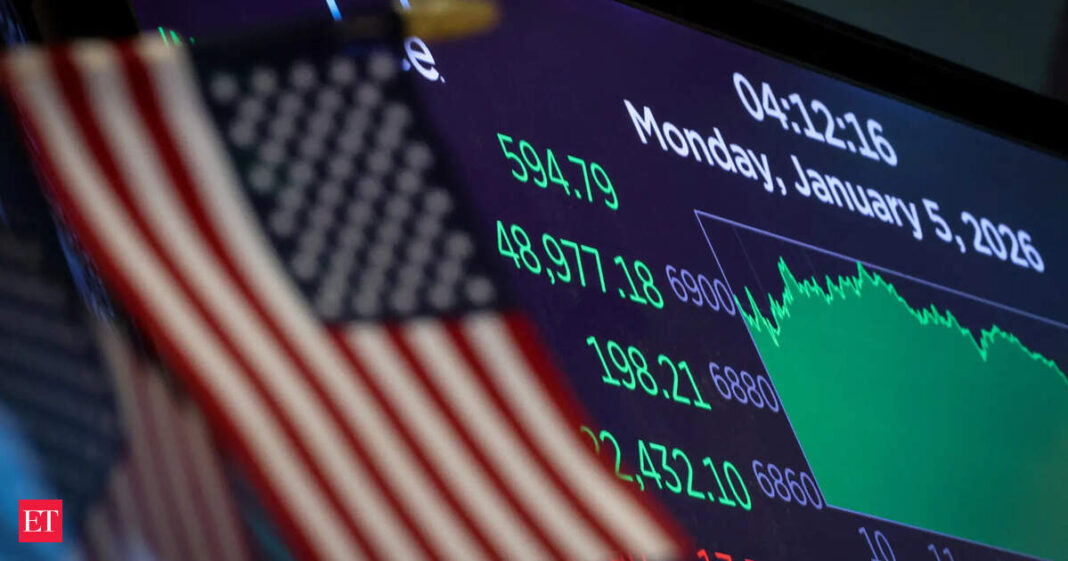


The screens on the trading floor glowed red like warning lights on a dashboard Tuesday morning, and anyone with a retirement fund—or just a fondness for their tech-heavy portfolio—felt that familiar lurch in the stomach. The Dow Jones had just shed nearly 1 %, a 292-point drop that translated into hundreds of billions in market value evaporating before lunch. Behind the rout: a quiet but seismic tremor in the bond market. The 10-year Treasury yield punched up to 4.29 %, its highest perch in months, reminding investors that “higher-for-longer” is more than a catch-phrase; it’s a headwind that can flatten even the mightiest tech giants. Futures traders spent the overnight hours nibbling on modest gains, but the aftertaste of the session’s tech-led selloff lingered like burnt coffee. Tesla, Microsoft, Meta, Apple—names that have become shorthand for the future itself—were the day’s biggest losers, dragged down by nothing more sinister than math: when risk-free bonds pay more, the eye-watering valuations of growth stocks look suddenly, well, ordinary.
What the Bond Market Just Whispered in Wall Street’s Ear
If the stock market is a raucous stadium, the bond market is the whispering section where every word carries. Tuesday’s yield spike was the financial equivalent of someone stage-whispering, “Fire.” Investors who had grown comfortable with the Federal Reserve’s waltz toward lower rates suddenly replayed Chairman Powell’s recent chorus: inflation remains stubborn, the labor market resilient, and rate cuts may be fewer and farther between. The 10-year Treasury—benchmark for everything from mortgages to corporate borrowing costs—climbed above 4.29 %, its highest since late last year. Put simply, the risk-free annual return on a government IOU just became more attractive than the dividend yield on most S&P 500 companies. When bonds compete, growth stocks retreat.
Tech firms are especially vulnerable because their valuations rest on profits expected years from now. Higher discount rates erode the present value of those far-off cash flows faster than you can refresh a browser. The result: a collective re-pricing that feels like a selloff but is really a sober second take on what the future should be worth. Overnight futures suggested traders were hunting for bargains, yet the hesitation in the tape was palpable—nobody wants to catch a falling Apple, literally or figuratively, until the yield picture stabilizes.
Microsoft’s Moment: From Cloud Nine to Cloudy Outlook
Among the FAANG-adjacent casualties, Microsoft absorbed an extra jab from the analyst community. UBS’s Karl Kierstead trimmed his price target to $600—still implying a juicy 28 % upside over the next year, but down from prior hopes. The haircut wasn’t theatrical; it was surgical. Kierstead points to margin pressure inside Microsoft’s Intelligent Cloud unit, where Azure lives. That segment’s 42 % operating margin is robust by any earthly measure, yet it pales next to the 58 % margin enjoyed by the Productivity and Business Processes division—home to the ubiquitous Office suite. In short, the faster-growing piece of Microsoft’s empire is also the less profitable one, and growth is migrating there. Investors who once shrugged at that trade-off now count basis points the way gamers count frames-per-second: obsessively.
Still, UBS isn’t selling its Microsoft jersey. The bank’s note highlighted the impending ramp of Microsoft’s Fairwater AI data centers—sprawling, power-hungry campuses purpose-built for the machine-learning boom. One such facility in Wisconsin is slated to flicker online in Q1 2026, a milestone Kierstead calls a “near-term catalyst” for Azure adoption. Translation: once those racks begin humming, the revenue they pull could offset the margin compression, restoring the glossy growth narrative that powered Microsoft’s 60 % rally since 2022. For long-term holders, the story remains cloud-centric; for jittery traders, any delay in that timeline is another reason to hit the sell button today and ask questions tomorrow.
The Cloud’s Silver Lining: Why Microsoft Still Has Friends in High Places
While the Nasdaq bled red, UBS analyst Karl Kierstead quietly slid a note across investors’ desks that read more love-letter than obituary. Yes, he trimmed Microsoft’s price target to $600—down from $650—but even the reduced figure implies a 28 % gain over the next year, a promise that feels almost quaint in a market that has forgotten what “up” looks like. The math behind his optimism lives inside two arcane-sounding divisions: Intelligent Cloud and Productivity & Business Processes. One generates a 42 % operating margin, the other a luxurious 58 %. Those aren’t typos; they’re cash machines dressed up as software suites.
What keeps the machines humming is an infrastructure armada most people never see. Fairwater AI data centers—steel-and-glass cathedrals the size of shopping malls—are rising in places like Wisconsin cornfields. The first is scheduled to flicker to life in Q1 2026, feeding Azure’s ravenous appetite for compute cycles. Kierstead’s bet is simple: whoever owns the racks of GPUs and custom AI chips when enterprise budgets rebound will harvest the next upgrade cycle. If bond yields are the storm cloud, Microsoft’s capex binge is the airplane flying above it, seeding the sky with silver iodide.
Still, the immediacy of today’s 4.29 % risk-free rate makes every long-dated cash flow look like a mirage. The tension is almost literary: a company pouring billions into future capacity while investors demand returns before tomorrow’s coffee cools. Which narrative wins—Kierstead’s data-center optimism or the bond market’s cold math—will decide whether Tuesday’s selloff becomes a footnote or the first page of a darker chapter.
The 60/40 Portfolio Is Back from the Dead—With a Vengeance
Remember the 60/40 stock-bond split? Financial advisors buried it two years ago, eulogizing “alternatives” and “private credit.” Yet the corpse just sat up in the morgue, blinked at the 10-year Treasury yielding 4.29 %, and asked for a sandwich. A portfolio allocating 60 % to the S&P 500 and 40 % to intermediate Treasuries is having its best relative year since 2009, beating most hedge-fund contortions with nothing fancier than compound interest and a yawning yield gap.
| Asset Class | 2021 Yield | Today’s Yield | Annual Income on $1 M |
|---|---|---|---|
| 10-Year Treasury | 1.5 % | 4.29 % | $42,900 |
| S&P 500 Dividend | 1.3 % | 1.5 % | $15,000 |
The table isn’t just numbers; it’s a lifestyle choice. A retiree can now fund a year of groceries, utilities, and the occasional Mediterranean cruise using coupons clipped from Uncle Sam’s IOUs, no stock-picking heroics required. That safety valve is why tech shares felt the ground shift: capital no longer needs to climb the risk curve to pay the electric bill. The renaissance of boring is the market’s way of reminding us that risk and reward are pen-pals, not strangers.
For younger investors, the takeaway is contrarian. Every crisis in the past four decades rewarded those who bought the dip in growth names while yields were cresting. The twist this time is that bonds themselves have become the high-yield asset. Parking cash in Treasuries at 4 % plus, then waiting for equity valuations to compress, is the rare strategy that lets you sleep and compound simultaneously.
Your Move, Investor: Three Scenarios for the Next 200 Sessions
Picture three doors, each labeled with a plausible year-end story. Behind Door One, the Fed’s “higher-for-longer” mantra cracks; core inflation drifts to 2 %, prompting two measured rate cuts. Tech rebounds 20 %, bond yields settle at 3.5 %, and the 2023-24 growth stock massacre becomes a scar rather than a disability. Behind Door Two, inflation re-accelerates, the 10-year kisses 5 %, and the Nasdaq surrenders another 15 %. Door Three is the muddle-through: yields hover near 4 %, earnings limp ahead, and markets trade sideways long enough for fundamentals to catch up with prices.
Assign your own probabilities, but notice the common denominator: volatility is the only certainty. The investors who survive will be the ones who pre-decide. Write down the price at which you’d buy more Microsoft or Nvidia. Set the yield that lures you into longer-dated Treasuries. Then turn off the financial television and let the algorithm inside your brokerage account do the bidding while you hike a trail or help a fifth-grader with pre-algebra. Markets reward patience more than foresight.
And if patience feels impossible? Dollar-cost average into a low-fee S&P 500 index while clipping 4 % on a Treasury ladder. It’s not glamorous, but neither is compound interest—until the decades pass and your future self sends a thank-you note written in early-retirement ink.
Parting Shot
I’ve lived through enough Tuesdays that bled red to know the next green one is already calendared. Bond yields will crest, ebb, and someday seem quaint again. What won’t change is the arithmetic: every dollar you tuck into a great business at a fair price is a seedling; every panic is a weather event. Water the saplings, ignore the thunder, and the forest arrives while no one is watching. So don’t bail—just buy a little, sleep a little, and let the world spin. The market’s drama is free entertainment; your future net worth is the subscription you actually want to keep.