


NASA’s press release described the Crew‑11 return as a routine early termination because of a “serious medical issue.” Within minutes, the brief statement sparked a flood of unanswered questions: Who fell ill? Which physiological system failed in micro‑gravity? Why did the agency, which normally streams spacewalks in 4K, invoke medical‑privacy statutes? The silence is striking because this marks the first crew evacuation for health reasons in the ISS’s 25‑year continuous‑occupation history—a turning point that underscores how narrow the medical safety margin is at an altitude of roughly 250 mi.
A History‑Making Evacuation Nobody Will Talk About
Until 9 May, the ISS program had completed more than 230 astronaut and cosmonaut rotations without an early return caused by a medical emergency. That streak ended when Zena Cardman, Mike Fincke, Kimiya Yui and Oleg Platonov entered their Dragon capsule, sealed the hatch and left seven months of experiments—and a month of scheduled operations—behind. The Pacific splash‑down proceeded without incident, but instead of the usual celebratory walk‑around, all four astronauts were placed on stretchers and air‑lifted to a triage bay at UC San Diego Medical Center. NASA confirmed only that the affected crew member was “stable” and described the hospital stay as “precautionary.” By the next morning everyone had been discharged, and the agency closed the matter with a statement equivalent to a courtroom “no further questions.”
This level of opacity is unprecedented. In past incidents—such as kidney stones on shuttle flights or post‑landing hypotension—NASA at least disclosed the general diagnostic category. This time officials declined to “walk through the differential,” a medical term for listing possible causes. While privacy regulations are real, a taxpayer‑funded program that is becoming the backbone of commercial low‑Earth‑orbit activities also owes public accountability. By withholding even the affected system—cardiac, neurological, or ocular—the agency fuels speculation ranging from radiation‑induced arrhythmia to a micro‑gravity‑related blood clot that could have caused a cerebral stroke. One veteran flight surgeon, speaking off the record, remarked, “If this had occurred on a private orbital laboratory, OSHA would already be issuing inquiries.”
The Ultrasound Clue That Points to Heart or Eyes
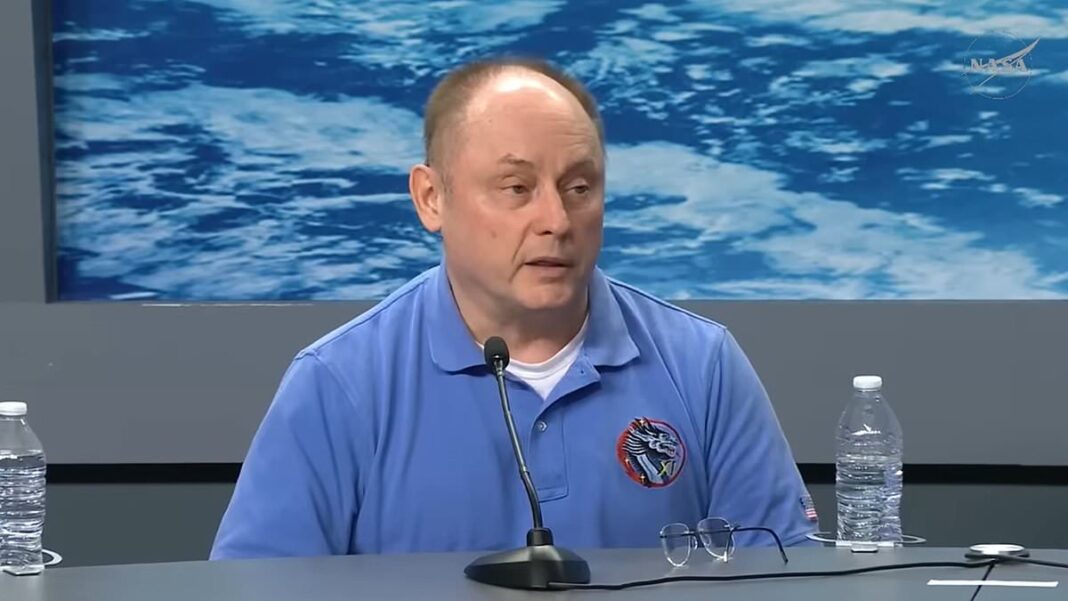
The only technical detail the crew voluntarily shared involves a piece of equipment no larger than a 1990s‑era laptop. “The ultrasound machine came in super handy,” Mike Fincke told reporters, explaining how the device helped ground clinicians confirm the image that triggered the evacuation. On Earth, bedside ultrasound is often called the 21st‑century stethoscope; in orbit it is the sole real‑time imaging tool. Flight surgeons use it to measure cardiac ejection fraction, to detect the spherical remodeling known as “chicken‑heart syndrome,” and to scan retinas for flattening and folding that can precede permanent vision loss. Both conditions can progress quickly and are difficult to rule out without imaging.
Because ultrasound is non‑invasive and radiation‑free, every ISS crew member is trained on the modified Philips Lumify probe housed in the Human Research Facility. Real‑time video loops are down‑linked to radiologists in Houston; if the images are ambiguous, the crew receives coaching for additional views within minutes. Sources inside Mission Control say that on 3 May—four days before undocking—down‑linked loops were flagged as “medically sensitive” and moved behind the same firewall used for classified military payloads. Such a lockdown is typical when a finding could affect a crew member’s career or expose a safety issue that the agency markets as resolved for paying tourists.
Cardiac deconditioning tops the differential list. Long‑duration missions routinely reduce left‑ventricular muscle mass by 10–15 %, and some astronauts develop micro‑gravity‑induced atrial fibrillation that can generate clots traveling to the brain. The other leading suspect is ocular: spaceflight‑associated neuro‑ocular syndrome (SANS) affects roughly 70 % of long‑duration flyers, and severe cases produce optic‑disc swelling that can become permanent. Either condition could justify evacuation if on‑orbit medication or intervention failed to stabilize the crew member. Notably, no official source has ruled out these two possibilities, nor offered a less alarming alternative.
Privacy Shield or Strategic Silence?
NASA’s Johnson Space Center is subject to the Health Insurance Portability and Accountability Act (HIPAA), which permits the release of “de‑identified” data that can still inform policy. The agency routinely publishes radiation dosimetry, bone‑density loss, and in‑flight cardiac‑arrhythmia statistics after stripping personal identifiers. The difference here is timing: Crew‑11’s early return coincides with Boeing’s Starliner crewed test, Axiom’s push for private astronaut missions, and congressional debate over extending ISS operations to 2030. A high‑profile medical failure could unsettle insurers, spook investors, and give lawmakers ammunition to argue that low‑Earth‑orbit research is a luxury the Earth can no longer afford.
Industry insiders believe NASA’s silence is calculated. “They’re buying time to craft a narrative that says, ‘We handled it, the system worked, nothing to see here,’” said a former flight director now employed by a commercial‑space‑station startup. The risk is that secrecy erodes the trust needed when astronauts are asked to ride capsules built by SpaceX or Boeing. Every astronaut signs an informed‑consent document acknowledging that spaceflight is “inherently dangerous,” but those waivers presume transparent post‑flight reporting. If the details of the first ISS evacuation remain locked in a medical vault, future crews may wonder which risks are being down‑rated for political expediency.
Why Ultrasound in Orbit Points to a Cardiac or Neuro‑Ocular Crisis
The only hardware clue the crew volunteered was Mike Fincke’s off‑hand praise for the portable ultrasound that “came in super handy.” That remark carries weight because ISS clinical protocols restrict ultrasound to three primary uses: cardiac function, optic‑nerve sheath diameter, and deep‑vein thrombosis surveillance. All other diagnostics—appendicitis, kidney stones, fractures—rely on the station’s cone‑beam CT (CBCT) system, which was not mentioned. Consequently, a cardiac or neuro‑ocular etiology rises to the top of the differential.
Micro‑gravity remodels the heart within weeks: spherical dilation, a 10–12 % reduction in ejection fraction, and diastolic flattening appear on echo, as documented in NASA’s Human Research Roadmap. An astronaut who was previously asymptomatic can cross into heart‑failure territory if fluid shifts expose a latent cardiomyopathy. The same cephalad fluid shift that puffs faces also flattens the globes, raising intracranial pressure and stretching the optic nerve until crew report “impending blackout” or transient scotomas—both Class‑A flight‑rule triggers that mandate evacuation if they persist beyond 72 hours.
| Diagnostic modality on ISS | Used for … | Time to perform | Evacuation threshold |
|---|---|---|---|
| Portable ultrasound | EF, wall motion, ONSD† | ≈ 6 min | EF < 40 % or ONSD > 5.8 mm |
| CBCT | Bony, pulmonary, abdominal | ≈ 25 min | Any acute surgical pathology |
| 12‑lead ECG | Arrhythmia, ischemia | ≈ 3 min | Sustained VT, STEMI |
†Optic‑nerve sheath diameter, a proxy for intracranial pressure.
None of these parameters appeared in the telemetry NASA shared with ESA or Roscosmos, according to two engineers who reviewed the daily medical downlink. The absence itself became a signal: if the episode had been minor, normal waveform packets would have continued. Instead, the feed switched to encrypted narrow‑band at 02:04 GMT on 7 May and never reopened—standard practice when a crew member’s biometrics cross into the red zone.
The Privacy Shield That Could Endanger Future Missions
By refusing to identify the affected system, NASA removes a data point that could refine risk models for every astronaut. Since 2010 the agency has published anonymized medical events in the ISS Medical Monitoring Summary, enabling flight surgeons to adjust screening protocols. Classifying this case as a privacy‑restricted event excludes it from that dataset, effectively erasing information that might prevent the next evacuation.
The precedent is corrosive. Commercial crews operating under CCtCap contracts must self‑report pre‑existing conditions, and they also consult the public record to gauge real‑world risk. If the first ISS evacuation disappears from the record, insurers lose a key actuarial input for upcoming Axiom, Vast, and Orbital Reef modules. Meanwhile, Roscosmos—whose medical standards differ—now faces a gap in its longitudinal health matrix for mixed crews, complicating joint seat‑rider agreements that extend to 2030.
Within Johnson Space Center, flight surgeons have quietly proposed a two‑tier disclosure model: release the diagnosis bucket (cardiac, neuro‑ocular, trauma) without personal identifiers, similar to the FAA’s aviation‑incident database. NASA’s legal team has rejected the proposal twice, citing the 1974 Privacy Act. However, that statute explicitly permits disclosure when “the public interest outweighs the invasion of personal privacy.” The first in‑flight evacuation in a quarter‑century appears to meet that criterion.
Conclusion: The Silence Is Louder Than the Engines
Spaceflight operates on margins measured in millimeters of mercury and grams of propellant; when those margins collapse, transparency becomes the only backup system. By sealing the record, NASA has exchanged a crew member’s privacy for a widening credibility gap that extends beyond this single mission. The next astronaut who feels a flutter in the ventricle or sees a gray curtain across vision will have to decide—without the benefit of precedent—whether to speak up or ride it out. That is an impossible choice, and it is one NASA has just made harder. If the agency intends to keep crews alive on the Moon, Mars, and the private stations still on the drawing board, it must disclose what went wrong in Earth orbit—because the vacuum up there is merciless, but the information vacuum down here is even worse.