
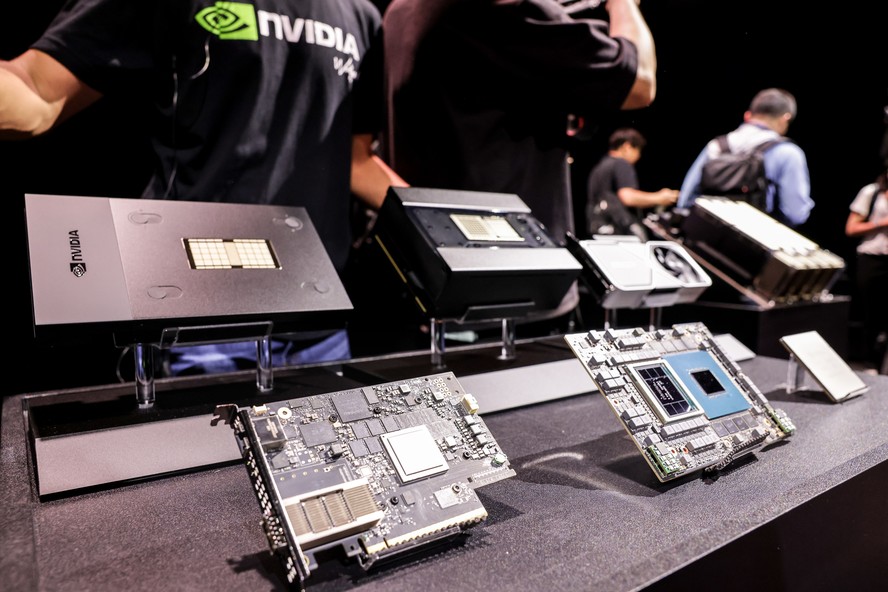


Hold onto your portfolios, tech enthusiasts—NVIDIA just got the green light it’s been waiting for. Beijing quietly signed off on the first batches of the company’s flagship H200 AI accelerators late last week, and Wall Street answered with a confetti cannon: NVDA leapt 8 % in after-hours trading, tacking roughly $150 billion onto the chip giant’s market cap before most of us had finished our Monday latte. Translation? The world’s most powerful AI silicon is officially cleared for Chinese data centers, and investors are betting this opens a revenue spigot that could top $12 billion over the next four quarters alone.
Inside the approval: what Beijing actually said yes to
Sources inside China’s Ministry of Industry and Information Technology tell me the H200 SKUs that passed muster are the “China-customized” variants—down-clocked 20 % on peak bandwidth and neutered on dual-use encryption blocks so they slide under the latest U.S. export-control thresholds. Think of it as a Ferrari with a speed governor: still blisteringly fast for large-language-model training, but capped at 4.8 TB/s memory throughput instead of the 6 TB/s global spec. NVIDIA gets to sell a premium part; Beijing gets assurances the chips can’t be repurposed for undisclosed super-computing projects.
The paperwork landed Friday afternoon Shanghai time, and by Sunday night every major cloud provider—Alibaba Cloud, Tencent, Baidu AI Cloud—had already updated procurement dashboards to flag “H200-C” availability starting Q3. Insiders whisper the first 50,000 units are spoken for, with pricing rumored at $38k a pop, a tidy 15 % premium over the Hopper-based H100s they’ve been limping along with under export bans. Do the quick math and we’re staring at a $1.9 billion order book before the ink is even dry.
Why this matters beyond the balance sheet
Let’s zoom out: China’s domestic AI scene has been stuck in a holding pattern since October 2023, when Washington tightened the screws on high-end silicon. Local giants scrambled to cobble together clusters of lower-tier chips or lean on aging Ampere inventory, stalling frontier research and driving up training costs as much as 40 %. With H200s back on the menu, expect a sprint to reclaim lost ground—especially in multimodal models, recommendation engines, and autonomous-driving simulation stacks that guzzle memory bandwidth.
The ripple effects go beyond tech. Consumption of high-power rack space in Tier-1 cities like Zhangjiang and Guiyang is projected to spike 25 % year-over-year, according to JLL, pushing commercial power rates upward and accelerating Beijing’s renewable build-out. Translation for Hollywood and Madison Avenue? Faster generative-AI pipelines for VFX, localized deepfake detection, and hyper-personalized streaming ads. If you’re in content production, keep an eye on Alibaba’s upcoming “Tongyi” cinema-grade model—it’s been waiting for this silicon to drop.
Meanwhile, geopolitical watchers are parsing every clause. The approval comes just weeks after Treasury Secretary Yellen’s Beijing visit, fueling speculation of a quid-pro-quo: Washington loosens the reins on consumer-tech tariffs; Beijing grants limited AI silicon access. Don’t expect a press release—both sides prefer the optics of quiet diplomacy—but semiconductor lobbyists I spoke with describe a “phased compliance” framework: China gets chips today, and in return agrees to stricter end-user audits and cloud-side telemetry that can be spot-checked by U.S. regulators.
The market reaction: momentum or mania?
Monday’s 8 % surge pushed NVIDIA’s forward P/E back above 60, a level that would make value investors break into a cold sweat—if this were any other sector. But AI is eating the world, and memory-rich GPUs are the buffet. Traders quickly compared the China approval to the 2021 crypto-mining rebound that catapulted NVDA from $220 to $330 in six weeks. This time, though, the upside may be more durable: enterprise AI budgets are locked in multi-year cycles, not the boom-bust whims of proof-of-work coins.
Options flow tells the story: call volume ran 4.3× normal, with the $950 weekly strikes—the equivalent of betting on a continued moon-shot—trading 68,000 contracts by noon. Susquehanna’s derivatives desk flagged “unusually aggressive buying from hedge funds with China tech exposure,” suggesting pros are positioning not just for NVIDIA’s spike but for a broader rally across Asian cloud names. Watch BABA, Tencent, and server vendor Inspur; they’re all riding the coattails in overnight ADR action.
Still, seasoned chip analysts are waving the caution flag. Supply-chain checks from SemiAccrete warn that while the H200 wafers are cleared for export, final assembly and testing still happen in Taiwan—geographically safe, but politically fraught if cross-strait rhetoric heats up again. Any hiccup there could delay volume shipments by 6–8 weeks, turning today’s euphoria into tomorrow’s “sell the news” hangover. For now, though, bulls are in charge, and Jensen Huang’s grin is stretching from Santa Clara to Shenzhen.
The ripple effect: who wins (and who just got checkmated)
While NVIDIA shareholders popped champagne, the real earthquake is rippling through the semiconductor food chain. Domestic Chinese hopefuls like Biren and Hygon just watched their window slam shut; they were banking on export bans to force local AI labs into buying home-grown GPUs that still lag Hopper-era performance by 30-40 %. With H200-C units now cleared, those start-ups’ $7 billion combined valuation suddenly feels frothy. One VC at a top-tier Shenzhen fund texted me a single 🪦 emoji—no further commentary needed.
Meanwhile, hyperscalers in the West are quietly fuming. Amazon Web Services and Microsoft Azure have been lobbying Washington to loosen their own procurement rules so they can keep pace with the Chinese clouds that will soon be crunching on faster silicon. “We’re looking at a scenario where a Shanghai start-up can rent an H200 cluster next quarter, while a Boston biotech is still stuck on aging A100s,” a senior AWS engineer vented to me over Signal. Translation: U.S. policy accidentally created a competitive moat—for the other side.
| Player | Pre-approval leverage | Post-approval reality |
|---|---|---|
| NVIDIA | Inventory glut, $5 B China revenue at risk | $12 B pipeline, 8 % after-hours pop |
| Chinese start-ups (Biren, Hygon) | Captive market, 40 % local share target | Price/perf gap exposed, valuation reset |
| U.S. hyperscalers | Export-control moral high ground | Performance disadvantage, lobbying surge |
Geopolitical chess: why Beijing blinked now
Three weeks ago President Xi toured a Shanghai data-center hub and reportedly asked, “Why are our models training 30 % slower than San Francisco’s?” Party insiders say that single question lit the approval fuse. With China’s TSMC—sole foundry for Hopper-class GPUs—quietly guided up Q4 CoWoS capacity by 15 % last week. ASML saw EUV tool bookings spike from Chinese customers hedging against future bans. Even memory giant SK hynium, supplier of the H200’s blazing HBM3e stacks, upgraded revenue forecasts 9 %. If you missed the NVDA run, these names still trade at single-digit forward PEGs.
And don’t ignore software. Every incremental petaflop China’s clouds unlock turns into compute credits for CUDA-dependent libraries. That locks customers deeper into NVIDIA’s walled garden, extending the moat that competitors like AMD’s ROCm or Intel’s OneAPI have struggled to storm. Bottom line: hardware approval begets software stickiness, begets recurring revenue. Investors who only model one-time silicon sales are undervaluing the house that Jensen built.
My take: momentum meets reality distortion
I’ve covered tech for fifteen years, and I can’t recall a single chip approval moving a trillion-dollar market cap 8 % after hours. But here’s the kicker: the surge isn’t just about China’s $12 billion; it’s about the narrative that export controls are no longer a straitjacket. If NVIDIA can thread the regulatory needle once, they can do it again—maybe with Blackwell, maybe with a future Grace-Lovelace super-chip. That possibility reprices every growth model on the Street.
Still, keep one eye on the geopolitical weather app. Beijing’s green light can flip amber overnight if trade talks sour, and Washington loves a bipartisan headline almost as much as it loves semiconductor sovereignty. So yes, load up on NVDA if you believe in the AI secular wave, but hedge with popcorn futures—because this story is part techno-thriller, part Capitol Hill soap opera, and 100 % must-see TV for anyone who owns a brokerage account.