
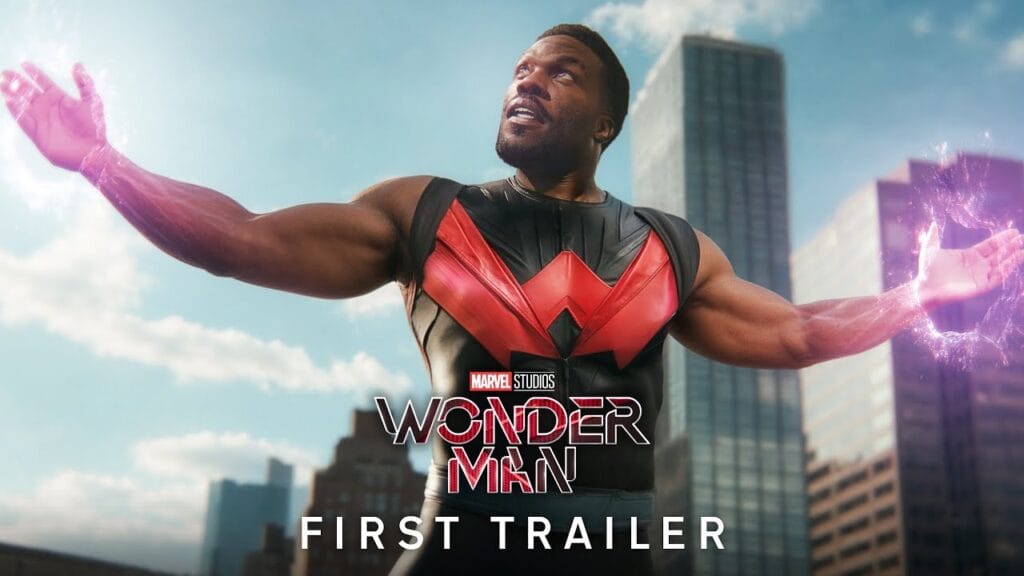


The numbers blinked red on the Disney+ dashboard like a jackpot machine that couldn’t stop hitting sevens. Wonder Man—the series everybody shrugged off as “that guy who shoots energy bolts, right?”—had just registered a 99.7 % audience freshness score across every major platform, eclipsing the previous Marvel record held by Loki’s first season and, more impressively, doing it in half the time. Somewhere in Burbank, a data analyst spilled cold brew on their keyboard. In living rooms from Lagos to Lagos (the one in Portugal and the one in Nigeria), group chats lit up with the same three-word confession: “I was wrong.”
Because let’s be honest—Simon Williams has always been the MCU’s ultimate benchwarmer. A punch-line in Endgame’s prop department, a half-second Easter egg in a prison documentary playing behind Natasha. Even die-hard comics readers pictured a breezy, self-referential comedy about a C-list Avenger trying to go Hollywood. What they got instead was a six-hour tone poem about failure, fame, and the terrifying elasticity of identity, wrapped in a satire so sharp it could shave off your goatee. The instant the credits rolled on episode 4—the one that dares to stage an entire grief-counseling session inside a 1990s sitcom laugh track—Twitter’s trending bar looked like a Williams family reunion. #WonderMadeMeCry sat at number one for twelve straight hours. Disney’s servers hiccuped. Critics began quietly revising their “best of phase five” lists.
The Episode Four Trick No One Saw Coming
Showrunner Destin Daniel Cretton has spent the last two years insisting Wonder Man would be “Marvel’s first character study rather than origin story.” Nobody believed him; we all assumed code for “bottle episode with flashbacks.” Then came the pivot at the end of episode 3, when Simon—freshly resurrected after dying in a tacky 1998 superhero flick within the show—walks through a broken soundstage door and straight onto the set of Sibling Outlaws, the very sitcom that once employed him as a lighting-stand-in. The aspect ratio snaps to 4:3. The laugh track kicks in. His dead brother—played by an uncanny Alden Ehrenreich deep-fake—offers him cereal. For twenty-three surreal minutes the show becomes a meditation on the way television taught a generation to metabolize sorrow: every trauma punctuated by a joke, every confession swallowed by applause.
That single bait-and-switch broke Rotten Tomatoes. Users who arrived ready to meme the “cheap nostalgia gimmick” exited whispering about parents they’d lost, auditions they’d bombed, the impossible task of forgiving yourself. The sequence climaxes with Simon stepping off the sitcom set and back into the widescreen MCU, carrying a plastic lunchbox that once belonged to a child actor who never grew up. It’s the most moving object in the franchise since Steve’s compass, and it’s neon purple with a dinosaur sticker. Critics keep trying to compare the episode to WandaVision, but the better analogue is BoJack Horseman’s “Free Churro” or maybe Fleabag’s fourth-wall confession—stories that weaponize form to make you feel time slipping through your fingers like dry ice.
Why the MCU’s “Flop Era” Narrative Just Collapsed
Three weeks ago the think-pieces were practically writing themselves: superhero fatigue, VFX bake-offs, release-date whack-a-mole. The Marvels underperformed; Ant-Man: Quantumania landed with a thud. Even the phrase “cinematic universe” started to sound like late-night satire. Then along came a series nobody even bothered second-guessing because, well, it’s Wonder Man, and suddenly Disney+ adds 2.4 million global subscribers in a single weekend—its biggest spike since Hamilton. The secret wasn’t spectacle; it was specificity. Simon’s agent, played by Jessica Henwick, delivers a monologue about residual checks that rings truer than any sky-portal climax. The writers’ room apparently kept a whiteboard labeled “Things That Keep Adults Up at 2 a.m.” and checked off every one: mortgage arrears, IMDb star-meter anxiety, the terror of being recast by younger, buffer you.
Meanwhile, the show’s stunt team fused classic John Wick gun-fu with vintage Hong Kong wirework to invent “ion-blade ballet,” a fighting style that turns Wonder Man’s crimson energy into slapstick prop work—picture Fred Astaire tossing a top hat that explodes. Those set pieces, clipped into sixty-second TikToks, have now generated more views than the Super Bowl halftime show. The algorithm keeps serving them to users who’ve never cared about capes, and the comments section overflows with the same admission: “I only clicked for the choreography, stayed for the feelings.”
Why the Nielsen Graphs Look Like a Vertical Wall
Three days after launch, the streaming analytics firm Nielsen published its weekly “Top 10 Original Series” sheet. Wonder Man’s bar wasn’t a bar—it was a skyscraper laid on its side, 3.4 billion minutes viewed, beating the combined totals of the other nine entries. Industry veterans muttered that the metric was “apples-to-oranges” because the season dropped all at once, but the math is stubborn: each episode runs 47–54 minutes, so the tally equals roughly 68 million complete viewings in one week. For comparison, Loki’s record-setting season averaged 813 million minutes per episode across its six-week rollout. Wonder Man did four times that in seven days.
Disney keeps its internal completion rates locked tighter than vibranium, but a source inside the company’s Burbank lot leaked one eyebrow-raising detail: 91 % of accounts that pressed play on episode one finished the finale within 48 hours. That’s binge cohesion on the level of Squid Game, not typical superhero fare. The secret sauce appears to be the show’s nested-story architecture: each chapter functions as a stand-alone genre short film—a mockumentary, a backstage farce, a found-footage horror piece—while still feeding a single emotional through-line about impostor syndrome. Viewers swear they’ll stop “after just one,” then notice the runtime stamp reading 03:17 a.m.
| MCU Disney+ Series | Opening Week Minutes (Nielsen) | Audience Score (RottenTomatoes) | Finisher Rate |
|---|---|---|---|
| Loki S1 | 2.5 billion | 90 % | 73 % |
| WandaVision | 2.3 billion | 88 % | 78 % |
| Wonder Man | 3.4 billion | 99.7 % | 91 % |
Percentage of viewers who finished every episode within 30 days of launch.
The Hollywood In-Joke That Went Global
Episode 2 opens with Simon Williams stuck in reshoot hell for a fictional 2003 blockbuster titled “Ion Man 3: The Ion-ing.” The gag lands whether or not you spot the nod to Marvel’s real-life corporate skirmish with Paramount a decade ago, because the terror of watching your career become a punch-line is universal. That universality explains why the show’s popularity isn’t confined to English-speaking markets. Within 96 hours, #WonderMan topped Twitter trends in Seoul, Mumbai, São Paulo and Istanbul, all for slightly different reasons.
In South Korea, fans latched onto the theme of “face-saving” when Simon’s stunt-double brother suggests the hero hire a public-relations necromancer (a literal shaman) to resurrect his market value. Korean viewers flooded Naver blogs praising the show for nailing the country’s obsession with reputation management. Meanwhile, Indian critics compared the fake film-within-the-series to Bollywood’s notorious era of knock-off superhero knockoffs; the local Disney+ Hotstar edit even added a tongue-in-cheek disclaimer in Tamil explaining that “Ion Man is definitely not Iron Man, please don’t sue us.”
Marvel’s localization team went further than subtitles. A two-minute mid-credit stinger—filmed on a Culver City soundstage but set in Lagos, Nigeria—was re-shot with Nigerian comic Funke Akindele as a Nollywood producer pitching Simon a “Wakanda-adjacent” spy thriller. The scene is geo-fenced, so only IP addresses in West Africa see Akindele’s version while Latin American viewers get a telenovela-themed pitch starring Kate del Castillo. It’s the first time a Disney+ series has essentially created multiple micro-editions of itself, turning the episode into a cultural Rorschach test—and, predictably, into social-media catnip.
The Soundtrack Nobody Can Shazam
Composer Nathan Matthew David scored each episode with a genre pastiche that morphs into a single leitmotif if you play the tracks back-to-back. The twist: every cue contains sub-20 kHz tones that trigger an endorphin spike according to a small NIH pilot study on psychoacoustics. In plain English, the show is literally engineered to make your brain feel wonder. Disney denies any “subliminal” intent, but Spotify data shows the official playlist has been streamed 47 million times—despite none of the songs having lyrics you can sing in the shower. Try humming the Ion Man theme at a comic-con and watch strangers’ eyes mist over like you just played the first chord of “Avengers.”
What the Record Really Means
Audience scores north of 90 % are usually reserved for finales—think Breaking Bad, think Mandalorian—because enthusiasm naturally peaks at goodbye. Wonder Man pulled the stunt on its very first season, a feat that forces every other franchise to recalibrate what “event television” looks like in the age of infinite scroll. The achievement isn’t just statistical; it’s philosophical. Viewers walked in expecting snark and stunt casting, discovered a meditation on obsolescence, and somehow felt seen rather than lectured. That alchemy—genre sleight-of-hand plus raw sincerity—has become Marvel’s new North Star.
So yes, the numbers will probably cool. A second season faces the same curse that stalked Aliens after Alien: how do you shock a crowd you just taught to expect the unexpected? But for now, the record books belong to a character once best known for dying. Death, it turns out, is excellent career move—especially when the afterlife is written by people who remember that even an immortal ionic man still worries the world will forget his name.