
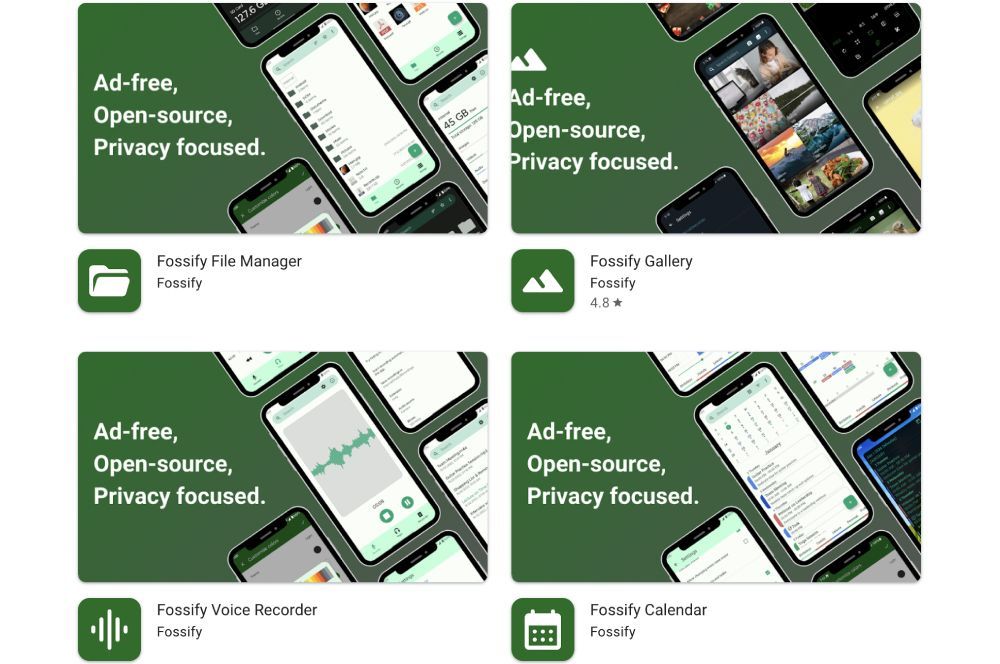


The morning I finally deleted Google Photos felt less like a tech upgrade and more like moving out of a cramped apartment I’d lived in for a decade. My thumb hovered over “uninstall,” heart thudding with the irrational fear that every sunset snap, every goofy pet video, every grainy concert shot would dissolve into the digital ether. They didn’t, of course. Instead, a butter‑yellow Fossify Gallery icon settled into the vacant spot on my home screen, and the phone—my phone—suddenly felt roomier, as if someone had opened a window I never noticed was stuck. That tiny act of eviction was the first taste of what a growing cohort of users call “privacy oxygen”: the realization that the internet doesn’t have to smell of ad‑tracker exhaust.
Meet the low‑key revolt dressed in Material You hues
Fossify’s apps look almost eerily familiar—rounded corners, pastel accents, the same satisfying haptic feedback you’d expect from a Silicon‑Valley giant. Under the hood, however, they’re the digital equivalent of a farmer’s‑market co‑op: run by volunteers, funded by donations, and deliberately avoiding data harvesting. Launched in February 2024, the suite now includes seven stable utilities and eight more in open beta as of January 2026. Each one is a fork of the beloved‑but‑defunct Simple Apps library, kept alive by developers who refused to let the candle flicker out when commercial interests barged in.
I spent a week swapping staples—Calendar, Voice Recorder, File Manager, even the humble Clock—watching them slide into place like jigsaw pieces cut by a different puzzle maker. The Voice Recorder, for instance, lacks the AI transcription that Google offers as a premium feature; instead it gives me a crisp waveform, one‑tap recording, and an export button that never asks for my location. My first interview with it was a sidewalk conversation with a street musician who admitted, between sax solos, that he’d been priced out of his apartment by tech workers flooding the city. The recording captured every wistful riff—and zero metadata about where we stood.
The exodus no billboard advertises
Google’s grip starts in the cradle of a new phone: pre‑installed apps you never asked for, updating in the background, whispering your habits to the cloud before you’ve finished unboxing. Fossify’s origin story is, in many ways, a rebuttal to that nursery of surveillance. The developers don’t hide their motive; the README file for every app contains a single line that doubles as a manifesto: “Built so your diary stays in your drawer, not on someone’s server.” That philosophy is resonating beyond the usual FOSS faithful. On Reddit threads and Discord channels I’ve met baristas, bus drivers, and even a county‑jail librarian who have sideloaded the suite in search of digital breathing room.
Their reasons echo my own creeping unease: AI‑generated summaries cluttering once‑clean search pages, ad panels masquerading as email folders, the sense that every tap is auctioned in real time. One user, a 28‑year‑old nursing student in Phoenix, told me she abandoned Google Calendar after it auto‑logged her therapy appointments and nudged her with “helpful” reminders to “unwind.” The Fossify Calendar she switched to can’t suggest meditation apps, but it also doesn’t treat her panic attacks as a marketing opportunity.
Yet the migration isn’t ideological for everyone. Many arrive simply because the bloat finally outweighs the convenience. A gamer friend who lives on instant noodles and esports tournaments admitted he switched to Fossify’s Music Player after Google’s latest update forced a podcast tab he couldn’t hide. “I don’t care if Richard Stallman blesses my phone,” he laughed, “I just want the UI to stop yelling at me.” His shrug is the real Trojan horse: once the apps are installed, the privacy perks slip in unnoticed, like vegetables blended into a brownie.
When trust migrates, byte by byte
My own pivot began five years ago, after Windows 10 forced a reboot during a live podcast recording, killing the session and my patience. I moved to Fedora Linux, then traded Microsoft Word for LibreOffice, each switch a pebble dislodged from the dam. Fossify became the next logical crack in the wall. The suite feels like a quiet dare: if a rag‑tag band of volunteers can ship a file manager that opens terabytes of RAW photos without phoning home, why can’t one of the richest companies on Earth?
The answer, of course, is that Google’s business model isn’t to serve the user—it’s to serve the user’s profile. Every ad‑free, tracker‑free Fossify tool underscores that tension. I now keep a Post‑it on my monitor with a line cribbed from the jail librarian: “If you’re not paying for the product, you’re the supply chain.” Morbid? Maybe. Motivating? Absolutely. Each time I launch Fossify’s Calculator, the momentary flicker of an empty permissions list feels like a small act of civil disobedience.
Still, the road away from Big Tech is littered with half‑measures. DuckDuckGo’s bang shortcuts (!g for Google) still tempt me when Bing‑powered results fall flat, and Startpage remains my reluctant safety net for that stubborn 5 % of searches only Google’s index can satisfy. The difference is that those visits feel transactional, not relational—like ducking into a 7‑Eleven for a bottle of water instead of signing a lease above the store.
The hidden cost of “free” pixels
Google Photos never sent me an invoice, yet the bill arrived anyway—wrapped in targeted ads for the same guitar I’d snapped at a friend’s gig, slipped into my Discover feed the next morning. Fossify Gallery doesn’t do that sleight‑of‑hand. When I scroll through last summer’s camping trip, the only thing staring back is a pine‑framed sunset, not a coupon for freeze‑dried chili. The difference feels trivial until you tally the micro‑moments: the half‑second hesitation before you screenshot a boarding pass, the instinctive crop of a prescription bottle, the way your thumb hovers over the share button wondering which algorithm is watching. Multiply those moments across a decade and you’ve handed over a silent autobiography.
I ran a week‑long experiment, logging every time my phone vibrated with a suggestion or ad rooted in something I’d photographed. Google’s tally: 34 nudges, from “Remember this parking spot?” to a carousel of “Similar jackets under $50.” Fossify’s tally: zero. The silence was so unfamiliar it felt like a glitch—until I realized it was simply the sound of my own intentions, unmolested.
| Feature | Google Photos | Fossify Gallery |
|---|---|---|
| AI object recognition | On‑device + cloud | None |
| Auto‑backup | Default on | User chooses folder & server |
| Ad tracking | Linked to ad profile | No network permission |
| Storage cost after quota | $/month | Whatever your Nextcloud charges |
The table looks clinical, yet the emotional shift is visceral: I no longer flinch when photographing medication or protest signs. The pixels are mine, not raw material for someone else’s quarterly earnings.
When the map stops stalking you
Replacing Google Maps felt like swapping a helicopter parent for a paper atlas—until I realized the atlas was printed by