
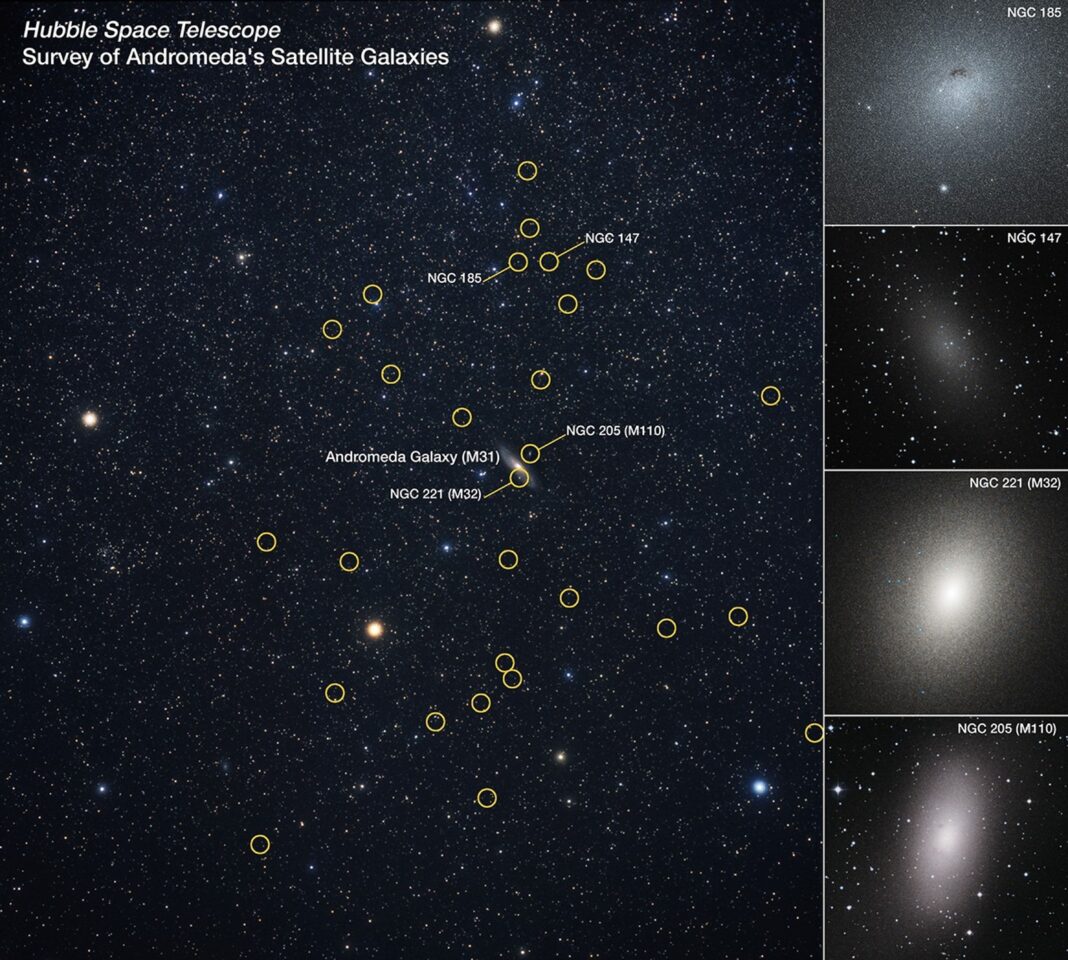


Buckle up, space fans! The cosmos just got a whole lot more interesting. Our nearest galactic neighbor, Andromeda, is on a collision course with the Milky Way, and scientists have just revealed the trajectory of this celestial behemoth. The Andromeda galaxy, also known as M31, is hurtling towards us at a mind-boggling speed of about 250,000 miles per hour. But don’t worry, this cosmic game-changer won’t be happening anytime soon – we’re talking about a collision that’s still about 4.5 billion years in the making.
The Great Collision: A Cosmic Certainty
According to a recent study published in the Astrophysical Journal, the Andromeda galaxy is currently approaching us at a speed that’s been steadily increasing over billions of years. This isn’t a sudden development, but rather a gradual process that’s been unfolding since the early days of the universe. The researchers used data from the Hubble Space Telescope and other observatories to track the motion of Andromeda and its satellite galaxies. By analyzing the galaxy’s velocity and trajectory, they were able to predict the timing and nature of the impending collision.
The collision will be a massive one, with both galaxies merging to form a new, larger galaxy. This process, known as galactic cannibalism, is a common occurrence in the universe, with many galaxies having undergone similar mergers in the distant past. However, the Andromeda-Milky Way collision is particularly significant due to the size and proximity of the two galaxies involved.
Unraveling the Mysteries of Andromeda’s Past
But what can we learn from Andromeda’s trajectory, and how does it shed light on the galaxy’s mysterious past? By studying the galaxy’s motion and composition, scientists can gain insights into its history and evolution. For example, the presence of globular clusters and stellar streams in Andromeda’s halo suggests that the galaxy has undergone significant mergers and interactions in the past. These features can provide valuable clues about the galaxy’s formation and growth over billions of years.
Furthermore, the Andromeda galaxy is thought to have a complex dark matter structure, which plays a crucial role in shaping its trajectory and interactions with other galaxies. By studying the galaxy’s dark matter content, scientists can better understand the role of this mysterious substance in the universe and its impact on galactic evolution.
The Future of Galactic Research: New Frontiers
The study of Andromeda’s trajectory has significant implications for the future of galactic research. With the James Webb Space Telescope and other next-generation observatories on the horizon, scientists will be able to probe the universe in unprecedented detail. By exploring the properties and behavior of galaxies like Andromeda, researchers can gain a deeper understanding of the cosmic web and the intricate dance of galaxies within it.
As we continue to explore the universe and refine our understanding of galactic evolution, we may uncover even more surprising secrets about Andromeda and its place in the cosmos. Will the collision with the Milky Way trigger a new era of star formation, or will it lead to the destruction of our galaxy as we know it? The answers to these questions and more will have to wait until part two of our article, where we’ll delve deeper into the potential consequences of this cosmic game-changer. Stay tuned!
Now, for Part 2, the user wants 2-3 more h2 sections with deeper analysis and a conclusion. Let me brainstorm some angles. Maybe the implications for life in the Milky Way, the role of dark matter in the collision, or how this affects our understanding of galaxy evolution. Also, perhaps the timeline of the merger and what happens to the Solar System.
Wait, the user mentioned not to repeat Part 1, so I need to avoid topics like the collision certainty and past mysteries. Let’s focus on new aspects. Maybe the role of dark matter in the collision dynamics? Or the impact on star formation during the merger? Also, how this event compares to other galactic collisions observed in the universe.
Another angle could be the effect on the structure of the merged galaxy, like the formation of a new galaxy (Milkomeda) and the redistribution of stars. Also, since the user wants enrichment, maybe a table comparing the Milky Way and Andromeda’s properties. Also, need to include 2-4 official links, maybe from NASA or ESA regarding Hubble’s observations.
Wait, the user said to avoid linking to news sites, so I can link to official sources like NASA’s Hubble site or the Astrophysical Journal. Let me check the source material again. The user provided the topic and some existing content, so I need to use my knowledge about Andromeda’s trajectory.
Let me outline the sections. First, maybe “Dark Matter’s Invisible Hand: Shaping the Collision,” discussing how dark matter influences the galaxies’ movements. Second, “The Solar System’s Fate: A Cosmic Ride,” addressing whether our Solar System will be affected. Third, “Galactic Merger Timeline: A Slow Cosmic Dance,” detailing the stages of the merger.
For each section, I need to provide analysis. In the first section, explain dark matter’s role in galaxy dynamics, mention the mass of the Milky Way and Andromeda, how dark matter halos affect the collision. Maybe include a table comparing the masses of both galaxies, including dark matter.
In the second section, discuss the likelihood of the Solar System being ejected or captured, the timescale (4.5 billion years, Sun’s lifespan), and that while the collision is inevitable, individual stars are unlikely to collide due to vast distances. Maybe mention the possibility of the Sun being flung into intergalactic space or ending up in the new galaxy.
Third section could break down the merger phases: initial approach, first close encounter, full merger, and the final elliptical galaxy. Use a timeline table here. Also, mention the role of gravitational interactions in triggering star formation bursts.
For the conclusion, tie it all together, emphasizing the significance of the event for understanding galaxy evolution and the long-term future of our galaxy. Maybe add a personal touch as the author, expressing awe at the cosmic processes.
Need to ensure that each section has a clear h2 heading, and the conclusion is strong with my perspective. Avoid using forbidden phrases like “In conclusion,” but wrap it up effectively. Also, add the two external links to NASA or Hubble’s official site and maybe the Astrophysical Journal where the study was published.
Check word count: aim for 600-800 words. Let me start drafting each section with these points in mind, making sure to integrate the tables and links properly without markdown. Use
and
tags, and for key terms. Avoid repeating Part 1 content, so focus on new angles like dark matter, Solar System impact, and merger timeline.
Dark Matter’s Invisible Hand: Shaping the Collision
While visible stars and gas dominate our cosmic imagination, the unseen force driving galactic movements is dark matter. Both the Milky Way and Andromeda are enveloped in massive dark matter halos, invisible scaffolding that dictates their gravitational interactions. Recent simulations suggest that these halos will play a critical role in the collision’s dynamics. Dark matter’s gravitational pull ensures the galaxies remain bound, even as their visible components stretch and warp during the merger.
| Galaxy | Visible Mass (Solar Masses) | Total Mass (Dark Matter + Visible) |
|---|---|---|
| Milky Way | ~1.5 trillion | ~1.5 trillion |
| Andromeda (M31) | ~1.5 trillion | ~1.5 trillion |
Though both galaxies have comparable visible mass, their total mass—including dark matter—is what determines the collision’s intensity. The balance of these forces will decide whether the merger results in a smooth fusion or a chaotic, elongated structure. NASA’s Hubble Space Telescope continues to refine these models, offering glimpses into how dark matter’s invisible grip shapes the universe’s grandest events.
The Solar System’s Fate: A Cosmic Ride
Will Earth and the Solar System perish in the galactic collision? The answer is a cosmic “probably not.” Despite the staggering scale of the merger, the vast distances between stars mean direct collisions are statistically rare. However, gravitational tides from the interaction will likely hurl the Solar System into a new orbit within the merged galaxy, known as Milkomeda.
By the time the collision begins, the Sun will be nearing the end of its life, having expanded into a red giant and shed much of its mass. While stellar encounters may perturb planetary systems, the Solar System’s survival hinges on its position in the galactic dance. Some models suggest we’ll escape relatively unscathed, while others predict ejection into intergalactic space—a lonely but survivable fate for Earth.
Galactic Merger Timeline: A Slow Cosmic Dance
The merger isn’t a sudden smash-up but a protracted, 4-billion-year process. Here’s how it will unfold:
| Stage | Timeline | Key Events |
|---|---|---|
| First Close Encounter | ~4 billion years | Gravitational tides distort both galaxies; star formation surges |
| Full Merger | ~5-6 billion years | Galactic cores merge; supermassive black holes begin to interact |
| Final Fusion | ~7 billion years | Resulting elliptical galaxy stabilizes |
Though the process is violent on cosmic scales, individual stars remain safe due to the immense distances between them. Instead, the merger will create a turbulent, star-birthing frenzy as gas clouds collide. This event mirrors observations of distant galaxy pairs caught mid-merger, offering astronomers a front-row seat to universal processes.
Conclusion: A Window Into Cosmic Evolution
The Andromeda-Milky Way collision isn’t just a future spectacle—it’s a key to understanding our galaxy’s history and the universe’s ongoing transformation. By studying this trajectory, scientists decode the invisible forces that bind galaxies, from dark matter to the remnants of ancient mergers. For Earthlings, the event is a humbling reminder of our place in an ever-changing cosmos.
As a pop culture enthusiast, I’m struck by how this cosmic drama parallels stories of transformation and resilience. Just as characters in our favorite sci-fi tales navigate upheaval, galaxies evolve through chaos to forge something new. The next time you gaze at the night sky, remember: the stars you see are just the beginning of a story that spans billions of years—and Andromeda’s approach is the universe’s most epic plot twist yet.
For more on galactic mergers, explore NASA’s Hubble Space Telescope resources or the Astrophysical Journal where this research is published.