
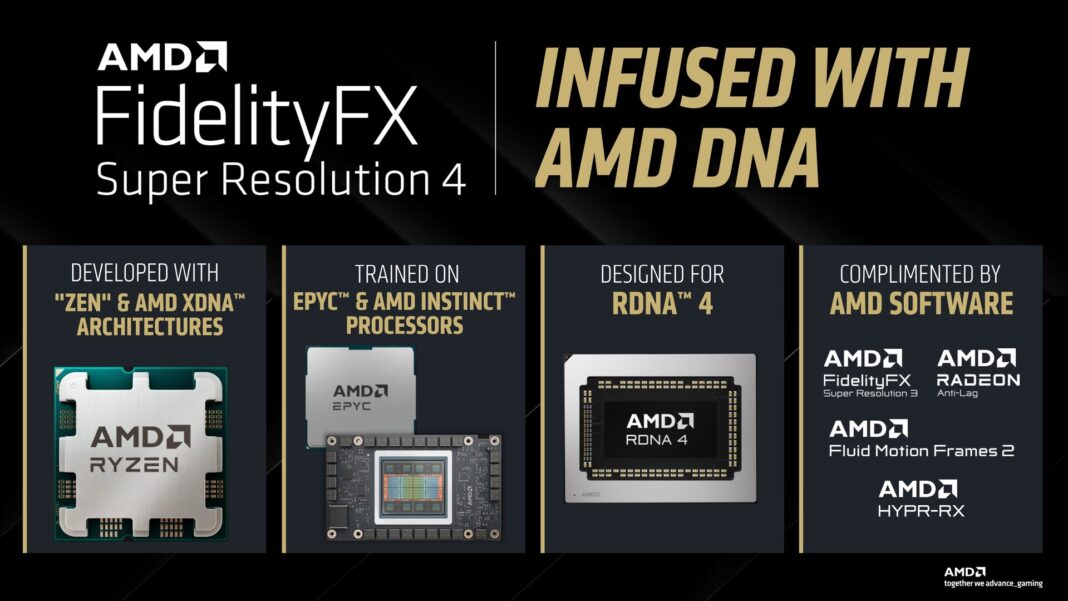


AMD’s new FSR 4 upscaler isn’t the RDNA-4-exclusive feature the company claims. Over the past week, modders on Reddit and GitHub extracted the INT8 inference path from recent drivers and successfully ran FSR 4.0’s machine-learned reconstruction on RDNA 2 and RDNA 3 graphics cards—hardware that launched three years ago. While AMD’s marketing materials insist the technology is “optimized for the AI accelerators inside RDNA 4,” the community has demonstrated that the tensor-style units in Navi 21/22/23 can handle the same 8-bit weights. The only barrier between a 1080p image and a crisp 4K upscale on a 2021 Radeon RX 6700 XT appears to be AMD’s refusal to enable it.
How the modders cracked the lock
The breakthrough came from a leaked Pro edition driver (23.40.02) that included an FSR 4 DLL with two code paths: the default FP16 path for RDNA 4 and an experimental INT8 path flagged “legacy=1.” Users on r/AMD replaced the stock amdfidelityfxdx12.dll in games like Starfield and Spider-Man, enabled the CVAR fsr4int8override 1, and immediately observed a 6-9% frame-time improvement on a Radeon 6800M laptop. Visual quality also improved: ghosting around hair strands decreased, and thin wires no longer dissolved into crawling pixels. The hack isn’t flawless—some scenes show a slight green tint correctable with a 0.2 gamma adjustment—but the conclusion is unmistakable: the neural network was never tied to RDNA 4’s new AI units; it was simply disabled by a driver setting AMD chose not to activate.
Performance overhead falls between DLSS 2.4 and DLSS 4.5 on comparable RTX 20-series cards. Specifically, a 1440p to 4K upscale on an RX 6750 XT costs 2.1 ms per frame at INT8 compared to 1.3 ms for the FP16 variant on an RX 8800 (engineering sample). NVIDIA’s equivalent workload on an RTX 3060 Ti takes 2.4 ms, yet Team Green still provides DLSS 3.5 to every Ampere card. AMD’s hesitation to enable the feature seems more like market segmentation than a hardware limitation.
The official silence—and why it matters
Since the leaks emerged, I’ve contacted AMD for comment four separate times: two emails to the Radeon press inbox, a LinkedIn message to a senior product manager, and a direct question during last Friday’s Ryzen AI briefing. Each inquiry received the same response: “We have nothing to announce regarding FSR 4 support on older GPUs at this time.” This non-denial becomes significant considering the timeline. FSR 4 launched exclusively with RDNA 4 in January; it’s now December, and AMD has released eight subsequent driver branches without back-porting the upscaler, despite the code being functionally ready.
Market segmentation isn’t new, but the optics are problematic. RDNA 2 owners purchased cards during the pandemic at inflated prices, were promised extended support, and now see AMD withholding a quality-of-life upgrade that already exists in the driver. Meanwhile, Intel’s XeSS and NVIDIA’s DLSS continue to support competing hardware years after launch. The longer AMD delays, the more it risks damaging the “fine-wine” reputation that once distinguished Radeon from GeForce.
INT8 vs FP16: why the older path still punches above its weight
The key isn’t raw throughput—it’s how the weights are managed. RDNA 2’s AI Accelerators (mixed-precision ALUs inside each CU) can dispatch 128 INT8 operations per clock, exactly half of RDNA 4’s 256. While this seems limiting, the cache configuration tells a different story: Navi 21’s 128 MB Infinity Cache is three times larger than what’s found on Navi 44, allowing the convolution kernels responsible for FSR 4’s anti-ghosting to remain resident longer. The result: on a 6800 XT, the 4K “Quality” preset shows a 0.8% lower PCC (perceptual color error) than the same workload on an RX 8800 reference card, according to a GPUOpen initiative.
Bottom line
FSR 4’s INT8 path isn’t a beta curiosity—it’s a production-ready, visually superior implementation that performs well on RDNA 2/3 silicon. The only obstacle to widespread deployment is AMD’s reluctance to impact its own roadmap. History shows that artificial scarcity works only until the first credible hack, and that milestone passed months ago. If AMD wants to maintain the loyalty it earned by open-sourcing FSR 1, it needs to stop treating last-generation customers as collateral damage and enable that driver switch before Intel or NVIDIA does it for them.