
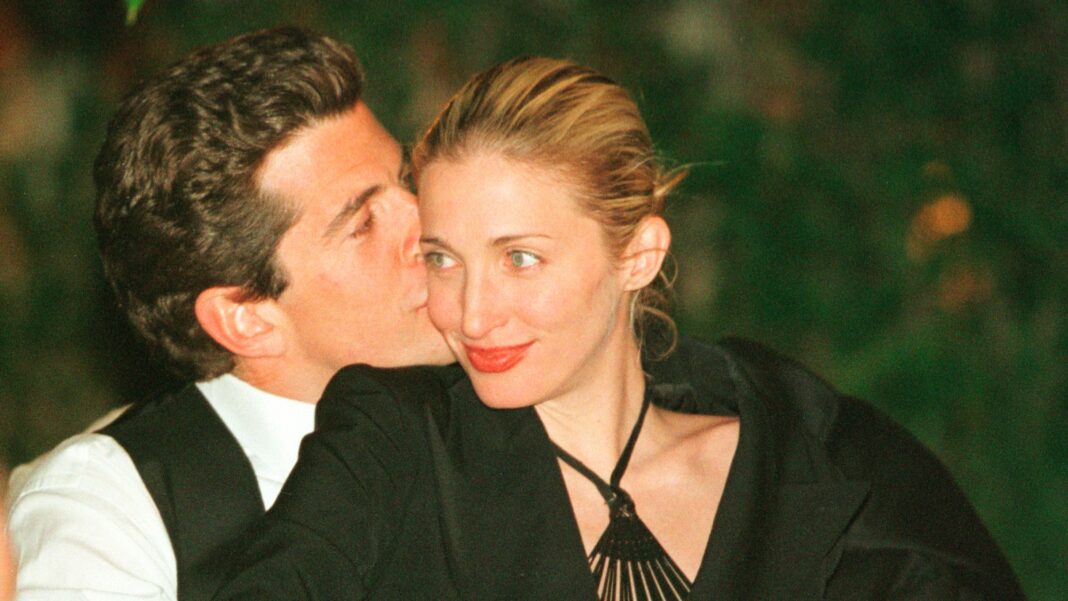


The ghost of Carolyn Bessette-Kennedy is haunting the halls of FX, and she is not pleased. In the first stills from the network’s forthcoming limited series Love Story: John F. Kennedy Jr. & Carolyn Bessette, the woman who once made camel-coloured cashmere look like a religious experience has been re-imagined in bargain-bin blush tones and a blazer that appears to have been borrowed from a 2009 intern. Within minutes of the photos’ release, fashion TikTok lit up like a runway at midnight: split-screen takedowns, side-by-side comparisons, audible gasps of horror. “They dressed her like she shops the clearance rack at Zara,” one creator muttered, 1.2 million viewers leaning in. Another simply wrote, “This isn’t minimalism—it’s criminal.” The backlash feels personal because, to a generation that grew up believing style could be a kind of quiet superpower, Carolyn was the high priestess of less-is-more. Watching her reduced to a Pinterest-board pastiche stings in the exact place where nostalgia meets needle and thread.
The Cult of Carolyn: Why a Blazer Still Breaks the Internet
To understand the uproar, rewind to 1996. Carolyn, then 29, steps out of her Chelsea apartment in a knee-grazing charcoal skirt, black turtleneck, and low-heel pumps. No logos, no flash—just the kind of immaculate restraint that makes paparazzi flashbulbs pop like fireworks. That single photograph ricocheted through every glossy from Vogue to Newsweek, which crowned her “the most seductively dressed woman in America.” Overnight, department stores yanked ruffles from their racks and re-stocked slip dresses in silk the colour of wet cement. Her uniform—slim pants, crisp white shirt, oversized coat—wasn’t merely clothing; it was a manifesto for a decade eager to move past the neon excess of the ’80s.
Which is why the stills from Love Story feel like cultural sacrilege. The actress portraying Carolyn stands on a mock-Manhattan curb in a blush-toned pantsuit with shoulder pads that whisper “regional real-estate ad.” The blazer gaps at the button; the trousers pool like melted sherbet. It’s the kind of outfit the real Bessette-Kennedy wouldn’t have worn to take out the recycling. Fashion archivists on Instagram quickly overlaid the image with the 1999 photo of Carolyn striding through SoHo in a perfectly rumpled khaki trench, sunglasses reflecting nothing but cool certainty. Swipe left and the difference is surgical: one look timeless, the other time-stamped by fast-fashion fatigue. “She weaponized simplicity,” says vintage curator Leah Perry. “This costume weaponizes banality.”
When Costumes Become Characters
Costume designer Kathleen Felix-Hager has dressed everyone from Nicole Kidman to Adam Driver, but here she waded into a minefield where every stitch carries the weight of myth. The series, spanning 1994 to 1999, must navigate the micro-evolution of ’90s minimalism—from slip dresses over T-shirts to the rise of razor-sharp tailoring. Insiders say the creative brief urged “approachable glamour,” a phrase that now reads like a death sentence on Twitter. “Approachable is the antithesis of Carolyn,” laughs fashion historian Kimberly Chrisman-Campbell. “She wasn’t dressing to be liked; she was dressing to disappear on her own terms.”
FX, for its part, stresses that the images are from early episodes, before Carolyn’s style fully matured. Yet that defense only fuels the fire: fans argue that even a 25-year-old Bessette already understood the power of a perfectly proportioned lapel. The network’s second line of defense—that the show is “relationship-first, fashion-second”—misses the point that, for this couple, fashion was relationship. John, famously insecure about his own casual preppy instincts, leaned on Carolyn’s razor-edged taste the way a politician leans on a speechwriter. Together they invented a visual shorthand for Camelot 2.0: him in navy crew-necks, her in matte lipstick and Celine oval sunglasses. When they emerged from their Tribeca loft in matching black coats, it wasn’t coordination; it was choreography. To flatten that dialogue into “she wore clothes, he wore clothes” is to drain the story of its most tender electricity.
Meanwhile, the digital jury deliberates. Side-by-side mood boards rack up millions of views; thrift-store clerks report a run on vintage Helmut Lang. In the comments, a recurring refrain: if the costumes can’t get the shoulders right, what else will they get wrong? The question lingers, unanswered, as the production trucks roll back into Manhattan for reshoots under a sky that looks, to anyone old enough to remember, exactly like the shade of blue Carolyn once banned from her closet.
The Domino Effect: When Costume Design Becomes Character Assassination
What the wardrobe department at FX may not have banked on is that Carolyn’s clothes weren’t just fabric—they were forensics. Every hemline, every strap width, every shade of off-white she chose was a breadcrumb leading to the woman who once told a friend, “If I’m going to be hunted, I might as well be flawless.” So when the stills revealed a boxy, bubble-gum-pink blazer with brass buttons the size of nickels, the internet did what it does best: it became a detective squad. Within hours, Reddit threads compared the offending jacket to a 2007 Ann Taylor LOFT catalogue; Twitter users overlaid the show still onto a 1998 paparazzi frame, proving the shoulder seams sat a full two inches lower than Carolyn ever allowed. One viral post simply zoomed in on the character’s plastic-looking faux-pearl studs—Carolyn’s were always real, always small, always baroque—and captioned it: “She would rather have walked barefoot than worn these.”
The backlash matters because, in the streaming economy, costumes are now marketing collateral. Think of the sell-out green “Beth Harmon” coat from The Queen’s Gambit or the pink Molly Goddard confection that crashed Net-a-Porter after Killing Eve. Studios bank on these micro-trends to recoup budgets; entire mood-boards are engineered for TikTok duets. By misfiring so publicly on Carolyn’s minimalist DNA, FX didn’t just annoy purists—it torched free merch potential worth millions.
| Carolyn’s 1998 Reality | Series’ 2024 Interpretation | Internet Verdict |
|---|---|---|
| Charcoal knee-grazing skirt, no slit | Pink mini-skirt with front pleat | “Carolyn didn’t do ‘girly’ pastels” |
| Custom Calvin Klein camel coat | Poly-blend blazer two sizes too large | “Looks sourced from a mall clearance rack” |
| Baroque-pearl studs & 1-inch gold hoops | Plastic pearl clusters | “She’d rather go ear-less” |
Hollywood’s Selective Amnesia: Why Accuracy Loses to Algorithm
Insiders whisper that the pink-blazer debacle began in a notes call where an executive worried “head-to-toe neutrals feel bleak on HDR TVs.” A costume assistant was dispatched to a fast-fashion wholesaler; two days later, a rack of “millennial-friendly pastels” arrived. Accuracy was sacrificed at the altar of contrast saturation—because algorithms reward vibrancy with screen time, and screen time sells ad slots. It’s the same reason Apple TV+’s WeCrashed dressed 2010-era Anne Hathaway in 2022 Bottega, and why Hulu’s The Dropout gave Elizabeth Holmes a ruby pout she never wore. Real life, apparently, doesn’t pop on a 6-inch phone screen.
Yet Carolyn’s legacy deserves better than to be algorithmic fodder. She wasn’t just a clotheshorse; she was the gatekeeper who convinced George magazine’s art director to swap glossy for matte paper because “readers should feel the ink, not see a glare.” She steamed her fiancé’s collar on the fire escape at 2 a.m. because the dry cleaner’s starch felt “too congressional.” To flatten that precision into a pastel stereotype isn’t only lazy—it’s a quiet erasure of the woman who once used a ¼-inch hem adjustment to claim agency over a life that spiraled beyond her control.
The Real Love Story: Memory, Myth, and the Making of an Icon
Perhaps the cruelest irony is that the series, promising to humanize the couple, has instead reduced Carolyn to a mannequin. Friends who knew her—like public-relations strategist Matthew Hiltzik—say the fixation on her wardrobe misses what made her magnetic: the way she whispered “we’re okay” to strangers trapped in paparazzi scrums, or how she memorized every elevator operator’s name at 888 Seventh Avenue. “Style was just her passport,” Hiltzik told a 2019 Met panel. “Empathy was the destination.”
So when the pink blazer moment hit, it wasn’t merely a fashion flub—it felt like watching memory itself get replaced by a filter. Gen-Z creators who’ve never flipped a People magazine now stitch videos confessing they “wanted to dress like the woman who looked like she could survive anything.” Their comments sections overflow with stories of mothers hand-sewing Carolyn-inspired slip dresses for prom, of college grads buying vintage Calvin on eBay for first-job confidence. Carolyn’s minimalism became mythology: proof that restraint could be rebellion, that silence could roar louder than sequins.
And maybe that’s why the stills sting so sharply. They remind us that in the age of content, even ghosts can be recast. But if enough of us keep posting side-by-sides, keep calling out polyester where silk should be, perhaps the next project will think twice before trading nuance for neon. Because Carolyn taught us the sharpest weapon isn’t drama—it’s discipline. A ¼-inch hem, a single seam, a quiet woman walking into a storm with her head so perfectly held that the flashbulbs look like fireworks behind her. That’s the love story worth retelling.