


Steven Spielberg just made E.T. look like a stuffed animal. In the first Super-Bowl spot for his 2026 science-fiction thriller Disclosure Day, the director who once gave us a cuddly alien with glowing fingertips pivots hard: a chrome-bright flying saucer punches through storm clouds, something that looks like a stag tilts its antlers toward the camera, and a voice-over from Emily Blunt warns that “the world will never sleep again.” One viewing and Twitter’s UFO side of the internet combusted faster than a Close Encounters mashed-potato mountain. Spielberg’s first foray into aliens since 2018’s Ready Player One isn’t interested in friendship bracelets—he’s weaponizing our modern paranoia about what’s really buzzing Navy pilots and popping up on infrared feeds. The result? A chilling teaser that already feels like the definitive cinematic statement on 2020s “disclosure” culture.
From Reese’s Pieces to Pure Paranoia
Let’s be honest: we’ve been living in a golden age of flying-saucer gossip. Congressional hearings, declassified Navy videos, online sleuths freeze-framing every shimmering speck—the public appetite for alien answers has hit what Spielberg calls “critical mass.” That’s catnip for a filmmaker who’s been obsessed with the cosmos since he used a handheld telescope to spy on Jupiter from his Arizona backyard. Disclosure Day drops us into a White House war room where officials must decide whether to tell Earth’s eight billion residents that something with antlers, wings, and a serious case of shapeshifting envy is headed our way. Josh O’Connor plays a speechwriter tasked with crafting the ultimate “we come in peace—maybe” address, while Colman Domingo’s four-star general pushes for a more… kinetic solution. If Close Encounters was a cosmic symphony and E.T. a suburban bedtime story, this is Spielberg’s horror lullaby—only the lullaby is screamed through a bullhorn at 2 a.m.
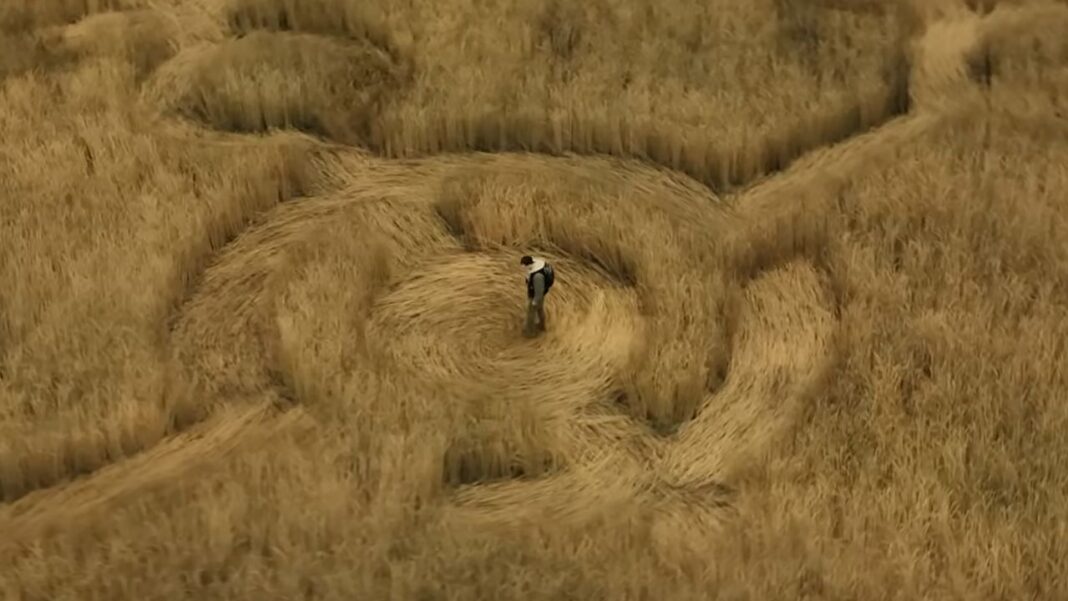
And those aliens? They’re not your greys-with-giant-eyes cliché. The teaser only gives us flashes: a bird that folds into liquid mercury, a stag whose hooves leave crop-circle sigils in a wheat field, a silhouette that mimics a child’s swing-set before snapping upright into something tall, jointed, and very wrong. Production designer Rick Carter (yes, the Oscar winner behind Lincoln and The Fabelmans) hinted to Variety that the creatures borrow from Native American skin-walker myths and Scandinavian folklore. Translation: Spielberg wants us terrified of the animal kingdom itself. After all, what’s scarier than realizing the creature in the woods might be both extraterrestrial and your friendly neighborhood buck?
The Writer Who Knows the Dino DNA of Suspense
Behind the mayhem is Jurassic Park scribe David Koepp, the pop-culture mad scientist who once made us fear a T. rex in the rear-view mirror. Koepp’s script reportedly pivots on a single, delicious question: What happens when the government admits UFOs are real and everyone on Earth has 48 hours to process it before the visitors arrive? Think Independence Day meets The Social Network—a global scramble played out on cable news tickers, TikTok conspiracies, and doomsday Reddit threads. Early set photos show Blunt’s press-secretary character sprinting across the National Mall as push-notifications explode on her phone reading “OBJECT CONFIRMED NON-TERRAN.” Koepp’s knack for blending technobabble with human panic gave us velociraptors in a kitchen; this time he’s turning the entire planet into that kitchen, and the raptors know how to open doors.
Insiders who’ve read an early draft whisper that the third act unfolds in real time, United 93-style, as governments debate whether to broadcast the alien greeting frequency or scramble F-35s. Spielberg, ever the optimist, allegedly insisted on keeping a sliver of hope—apparently there’s a scene where a child’s Crayon drawing of a stag gets beamed back with corrections, suggesting communication is possible. Still, Koepp’s warning to test readers: “Keep the lights on; these things learn by imitation, and they’ve been watching us since the Bronze Age.” If that line doesn’t give you goosebumps, you’ve clearly never stared at a deer a little too long during a twilight jog.
The Spielberg Touch: Why His Aliens Always Feel Personal
There’s a reason Spielberg’s extraterrestrials linger in the collective cortex long after the end-credits scroll. He never starts with tentacle sketches or concept-art mandibles; he starts with childhood loneliness. E.T. was the imaginary friend he wished for during his parents’ divorce; Close Encounters was the backyard light show he day-dreamed about while scanning Arizona skies. With Disclosure Day, the wound is more civic: a grown-up fear that the institutions we trust might be as clueless as the rest of us. That emotional breadcrumb trail—loneliness, wonder, institutional vertigo—explains why his creatures, even at their most grotesque, feel like psychic x-rays rather than VFX show reels.
Insiders who’ve peeked at dailies tell me the antlered entity glimpsed in the teaser is only “layer one.” Without spoiling the biomechanical surprises, Koepp’s script reportedly gives Spielberg license to stage a War of the Worlds-level set piece inside the Situation Room, complete with shapeshifting that weaponizes the viewer’s own reflection. Translation: the aliens weaponize you—your memories, your grief, your Google search history. It’s the logical escalation for a filmmaker who once turned a gentle finger-glow into pop-culture scripture; now the miracle is laced with malware.
2026’s Perfect Storm: Paranoia, Politics, and Post-Truth Panic
Pop culture doesn’t exist in a vacuum; it needs oxygen, and the 2020s have been pumping pure propane into the UFO discourse. Congressional hearings, tic-tac videos, and TikTok #UFOTok feeds have primed audiences to treat alien headlines like overdue weather reports. Spielberg, ever the pop-culture barometer, is simply surfing the zeitgeist before it detonates into full-blown societal indigestion. Disclosure Day lands in June 2026—months after a mid-term election cycle that’s already shaping up to be a social-media knife fight. Expect protest placards quoting Blunt’s trailer line the way Jaws quotes still pop up on beach towels every July.
| Spielberg Era | Societal Mood | Alien Function |
|---|---|---|
| 1977 Close Encounters | Post-Watergate disillusion | Cosmic reassurance |
| 1982 E.T. | Reagan-era family values | Emotional therapy |
| 2005 War of the Worlds | Post-9/11 vulnerability | Terror metaphor |
| 2026 Disclosure Day | Post-truth paranoia | Institutional dread |
The symmetry is delicious: each alien visitation mirrors the neurosis of its moment. If the 1970s needed a cosmic lullaby and the 2000s needed a survivalist jolt, the 2020s apparently need an extraterrestrial audit of our entire epistemology. Spielberg’s genius is that he doesn’t lecture; he embodies. By letting the unknown infiltrate the most classified room on Earth, he literalizes our fear that no seat-belted briefing or blue-ribbon panel can save us from the data-driven chaos outside.
Can Spielberg Still Out-Terror Jordan Peele?
Let’s address the elephant—or should I say stag—in the room. Modern sci-fi horror has gotten viciously sophisticated. Jordan Peele turned a pair of scissors into a cultural lightning rod; Arrival weaponized linguistics; Nope made a cloud carnivorous. Spielberg’s challenge is to remind audiences that the granddaddy of blockbuster wonder can still curdle blood with the best of them. Early whispers suggest he’s borrowing from the Jaws playbook: minimal screen time, maximal psychological erosion. One crew member bragged that the full alien form won’t be revealed until minute 107, a restraint almost unheard of in the TikTok-attention era.
Meanwhile, the tech toolbox has evolved. Industrial Light & Magic is prototyping a hybrid of Practical-AR: physical antler puppets filmed on set, then augmented in real time with AR glasses so actors aren’t reacting to a tennis ball on a stick. The result? Terror that feels tactile, not pixel-painted. If Peele’s horror is cerebral and Denis Villeneuve’s is existential, Spielberg’s aims for the viscera—he wants your knees bouncing like the cup of water in Jurassic Park.
And yet, the emotional through-line remains vintage Spielberg: a fractured parent-child dynamic. Josh O’Connor’s speechwriter isn’t just wrestling with syntax; he’s parsing how to tell his teenage daughter that the sky she Instagrams is about to file a restraining order against humanity. Somewhere in that personal stake lies Spielberg’s secret sauce—his aliens are never about aliens; they’re about the fragile, fallible humans squinting up at them.
Final Orbit
So will Disclosure Day be the film that finally topples E.T. from the ultimate Spielberg pedestal? Probably not. Nostalgia is a stubborn shield. But it doesn’t need to. All it has to do is scar the summer of 2026 with the possibility that our leaders might be as blindsided as we are, that the next knock on the door could come from something wearing your own face. If the Super-Bowl spot made us jump, the full feature might just make us listen—to the static between radio stations, to the hum above our backyards, to the stories we tell ourselves so we can sleep at night.
Spielberg once invited a wrinkled botanist into our hearts; now he’s inviting our dread into the White House. Pack a security blanket and maybe—just maybe—don’t watch the skies alone.