
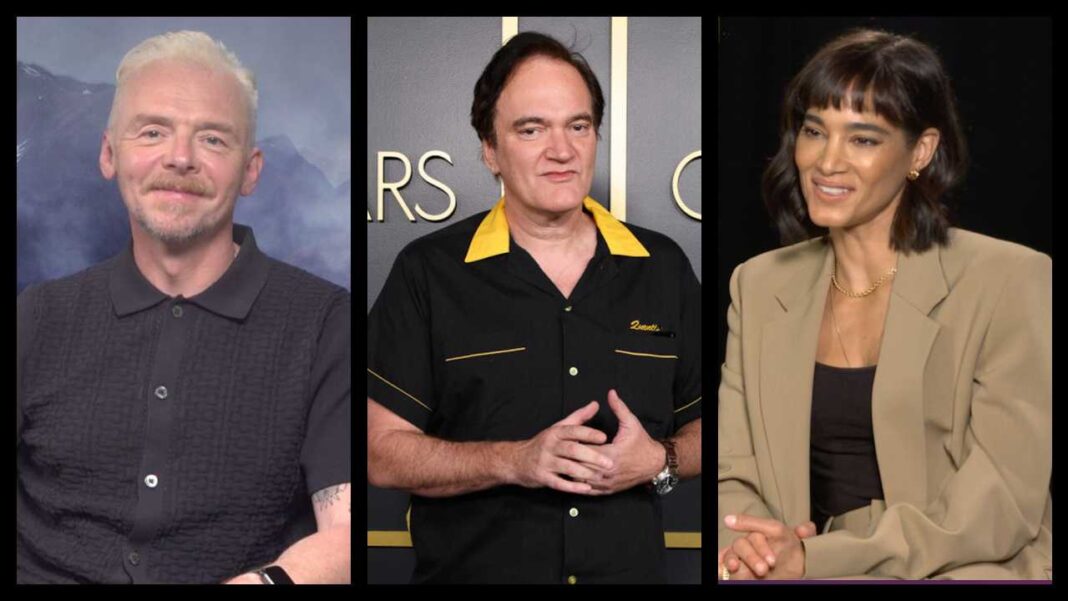


Title: Tarantino Returns to Acting After 28 Years—and He’s Unrecognizable
Content:
The last time Quentin Tarantino stepped in front of the camera as someone other than “Quentin Tarantino,” Bill Clinton was still in his first term and the phrase “streaming wars” sounded like a bad B-movie. Twenty-eight years later, the man who rewrote the rules of modern cinema has slipped back into the spotlight—quietly, almost invisibly—inside a candle-lit Normandy château where the only thing louder than the creak of old floorboards is the echo of his own absence. When the first production still from Only What We Carry leaked last week, film Twitter thumbed past the A-list leads and stopped cold on a silver-haired figure in a tweed coat, half-moon spectacles low on the bridge of his nose. “That can’t be Tarantino,” one viral post gasped. But it is. And he’s never looked less like the kinetic showman who once danced barefoot in a Royale-with-Cheese diner booth.
The Role That Lured Him Back
Director Élodie Brisson swears she never planned to bag Hollywood’s most elusive cameo. She simply needed a publisher who could believably haunt the drafty corridors of a manor-turned-writers-retreat, a man whose voice carried both erudition and the gravel of someone who has read too many war memoirs. “I scribbled ‘Julian’s publisher’ in the margins and kept hearing Quentin’s cadence,” Brisson told me over crackling Zoom from Paris, her own walls lined with yellowing film posters. “Not the public persona—the other one, the obsessive cinephile who hoards rare 35 mm prints and speaks about Leone the way monks chant psalms.”
The screenplay reached Tarantino on a rainy evening in Tel Aviv, where he was lecturing on Spaghetti-Western morality. He read it once, set it down, read it again after midnight, and by sunrise had emailed Brisson a single line: “This man understands that books are blood.” Three weeks later he was pacing the château’s library, practicing French pronunciation between drags of cherry-vanilla e-cigs, insisting cast and crew call him “Monsieur Léger”—the character’s surname—rather than his own. Sofia Boutella, who plays Charlotte Levant, a war-correspondent-turned-ghostwriter, says she didn’t recognize him the first day. “I saw this soft-spoken librarian type rearranging antique typewriters. Then Simon elbowed me: ‘That’s QT.’ My brain glitched.”
A Reunion Hidden in Plain Sight
If Tarantino’s return feels like a magic trick, the encore is the Star Trek Beyond reunion nobody asked for yet everybody suddenly needed. Simon Pegg’s Julian Johns is a celebrated but broken memoirist who hasn’t left the château since a roadside bomb outside Mosul shredded his nerve endings and his marriage. Pegg mines the role for tremors of gallows humor—think Trainspotting meets The Diving Bell and the Butterfly—but it’s the chemistry with Boutella’s Charlotte, the ex-lover assigned to coax the book out of him, that gives the drama its pulse.
The two last shared the screen dodging aliens on the USS Franklin; now they trade barbs over espresso so strong it could etch glass. “We didn’t rehearse the arguments,” Pegg laughs, still hoarse from the previous day’s shoot. “Sofia would whisper some fresh betrayal seconds before take, and I’d react like she’d kneed me in the spleen.” Brisson shot their sparring in lingering 35 mm Steadicam loops, letting shadows pool like ink. The result, early footage suggests, is a two-hander that crackles with the same rhythm Tarantino loves to dissect in his video essays—only here he’s the restrained presence in the corner, the man who signs contracts instead of squeezing triggers.
And yet, says cinematographer Guillaume Hupperts, the director’s shadow is everywhere. “Quentin stayed on set even when he wasn’t called. He’d mutter ‘Move the eye-line two inches, kid, and you’ll see the whole scene flip.’” Hupperts tried it; the frame suddenly sang with menace. “He can’t help but direct, but he never stepped on Élodie’s toes. It’s like watching a shark volunteer to be aquarium glass.”
From Dusk till Dawn to Dawn in Normandy
Of course, the trivia-hungry corner of the internet keeps circling back to 1996: the year Tarantino played Richie Gecko, a vampire-thumping preacher’s-kid with George Clooney’s arm slung around his neck. That performance—equal parts motor-mouth and raw nerve—became a cult curio precisely because he never chased another one. “Acting was always dessert,” Tarantino told a Cannes roundtable back in 2009. “Directing is the full meal, and I’m greedy.”
So why surrender the anonymity he’s spent decades polishing? People close to the project whisper that the pandemic rattled him. He turned sixty alone in a Los Angeles rental, binge-watching Nouvelle Vague classics and re-reading Sartre’s Iron in the Soul. Somewhere between lockdowns he started missing the communal fever of a set, the smell of gaffer-tape adhesive, the hush before someone calls “Action.” When Brisson’s letter arrived, it offered not just a character but a continent where nobody expected Quentin Tarantino—soft-spoken, bespectacled, hair the color of bay leaves gone to ash.
Still, he set conditions: no press while filming, no trailer bigger than the actors’, no mention of previous box-office tallies on call sheets. The crew obliged, even when he demanded an entire room be filled with vintage Gallimard paperbacks so he could “listen to them breathe.” Costume designer Lucie Mallet found him browsing a Caen flea market at dawn, haggling over cufflinks that once belonged to a Resistance printer. “He wanted the ghosts,” Mallet shrugs. “We all just tried to keep up.”
The Transformation No Stylist Could Fake
Inside a pop-up trailer that smelled of bergamot and old parchment, Tarantino surrendered his signature black-and-white sneakers to the costume department like a man relinquishing a passport. When he re-emerged twenty minutes later, the swagger had been replaced by a stoop that looked as if it had grown inside him for decades. Cinematographer Guillaume Schiffman, huddled over his monitor, whispered a single word—“Bergman”—and the crew understood. The grey hair wasn’t a wig; it was Tarantino’s own, grown out since the Tel Aviv rain and coaxed into a distinguished frost by a colorist who once worked on François Mitterrand’s campaign portraits. The half-moon spectacles, however, are a relic: the same pair he wore while editing Pulp Fiction, excavated from a drawer labelled “1994 taxes.”
Brisson’s camera lingers on him the way one studies a stranger on a train you suddenly realize you once loved. In the film he shelves books with arthritically slow fingers, each spine aligned as if it were a vertebra in literature’s own crooked back. “Action” is barely audible before he’s already living inside the hush of a man who has forgotten what applause sounds like. Between takes he refuses chairs, preferring to lean against the walnut paneling, eyes closed, breathing the dust of 19th-century encyclopedias. Simon Pegg told me, half-admiring, half-alarmed, “I’ve seen Daniel Day-Lewis stay in character; I’ve never seen a director stay in silence.”
The Scene That Required No Second Take
Midway through the shoot, Brisson scheduled the confession sequence for the château’s attic—a single 11-minute shot that threads through trunks of yellowing letters and lands on Julian’s publisher admitting he never read the war memoir that made his fortune. The morning was cold enough to frost the camera lenses; crew members wore the same fingerless gloves Tarantino once mocked in Reservoir Dogs. He insisted the attic stay unheated. “Truth,” he muttered, “doesn’t live at twenty-two degrees Celsius.”
They rolled once. A beam of Normandy sunlight slipped through the rafters like a nosy ghost, settling on his cheekbones while he delivered the line: “I was too busy selling courage to notice I’d run out of my own.” Brisson froze playback, certain the light would never repeat itself. It didn’t need to. The take was printed, wrapped, and sent to the lab before lunch. Later, when editors synced the footage, they discovered the sunbeam flared exactly on the word “courage,” then vanished—a cosmic underline no CGI could replicate. The editor, superstitious, refuses to roll back through it more than twice a day.
| On-Screen Element | Practical Effect vs. Digital | Take Count |
|---|---|---|
| Sunbeam on cheekbone | Natural light | 1 |
| Silver hair | Tarantino’s own | N/A |
| Dust motes | Fullers earth shaken from rafters | 3 |
| Voice tremor on “courage” | Actor choice | 1 |
What He Carried Away
When wrap was called, Tarantino asked not for a director’s chair or a bottle of Orangina, but for the dog-eared copy of the script. He scrawled one annotation across the title page—“Memory is the only special effect that ages in both directions.” Then he slipped out a side door, coat collar high, spectacles pocketed, leaving the château to its usual hush. Crew members swear the library smelled faintly of cherry-vanilla for days afterward, though no one admitted to vaping indoors.
He hasn’t accepted another role since, telling Cannes journalists merely, “I said what Julian’s publisher needed to say; anything else would be showing off.” Yet dailies suggest we may see something rarer than another Tarantino performance: a Tarantino performance with no safety net of irony, no wink that lets the audience off the hook. If he never acts again, this will stand as a quiet rebuttal to the myth that his art is built only on bravado. Sometimes the loudest statement a showman can make is to lower his voice until the world leans in—and realizes it’s been leaning away for decades.
I keep returning to that leaked still: the silver hair, the stooped shoulders, the man who once screamed “Say ‘what’ again!” now whispering a line about unread books. Somewhere between those two extremes lies the real Quentin Tarantino—archivist, illusionist, and, for one fleeting Normandy shoot, a character humble enough to let a sunbeam steal the scene. If you squint at the image long enough, you’ll swear the spectacles reflect not the camera, but a younger version of himself, notebook in hand, learning that the most radical thing an artist can do is simply listen to the quiet.