


The fluorescent glow of trading floor monitors cast long shadows across empty coffee cups as Cisco’s earnings numbers flashed across screens worldwide. What started as another routine quarterly report transformed into something far more significant—like watching a seasoned chess grandmaster suddenly reveal they’d been playing a different game all along. In those first frantic minutes after the bell, something shifted in the tech landscape, and the ripples are still spreading.
I’ve covered countless earnings calls over the years, but there’s something electric about watching Wall Street veterans lean forward in their chairs, suddenly paying attention to a company they’d mentally filed away as “stable but predictable.” Cisco didn’t just beat expectations—they rewrote the narrative of what this 40-year-old networking giant could become in an AI-driven world.
The Numbers That Made Everyone Sit Up Straighter
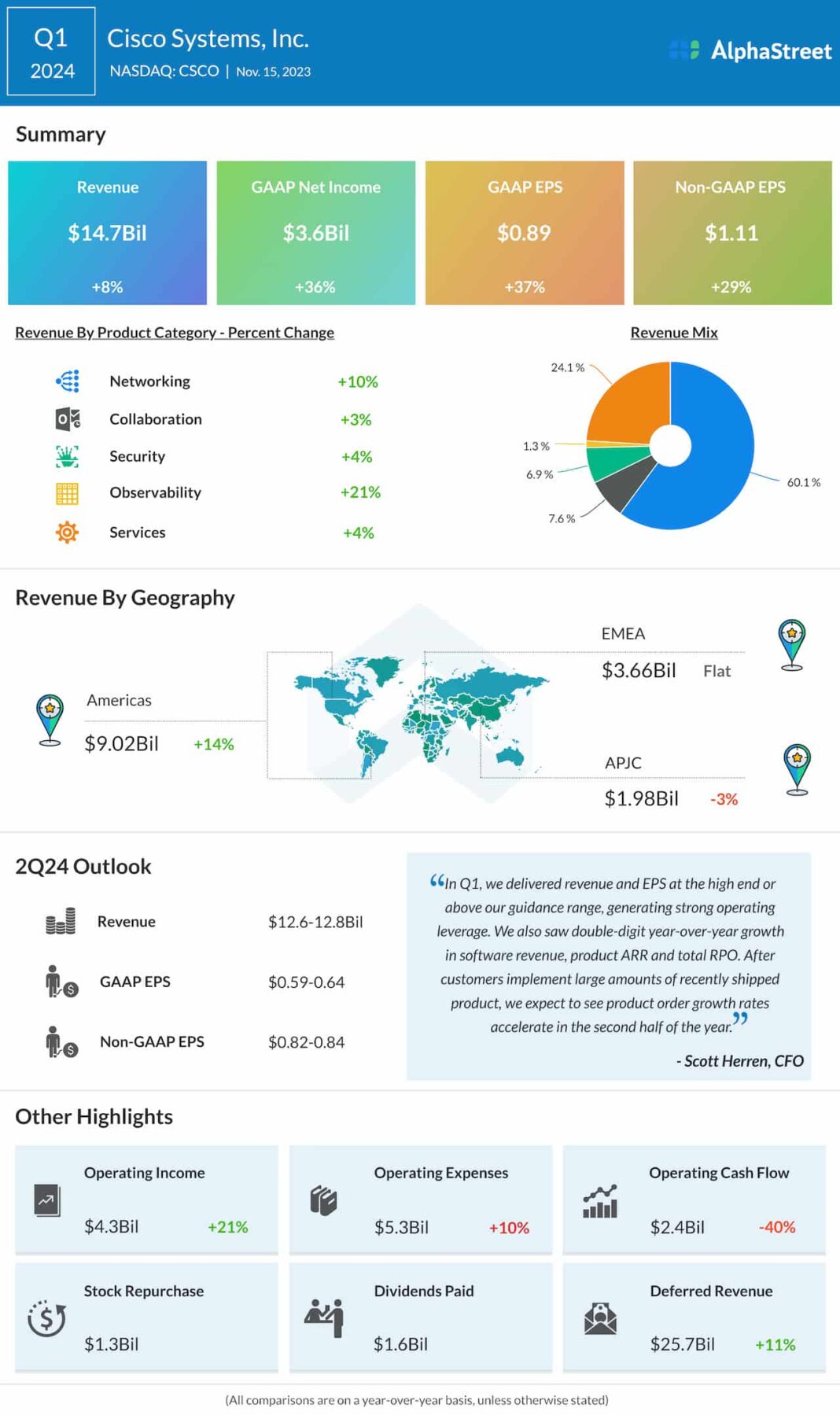
The headline figures read like a Silicon Valley startup’s fever dream rather than a mature tech company’s quarterly results. Revenue surged 14% year-over-year to $15.2 billion, crushing analyst estimates by nearly a billion dollars. But the real story lay beneath those surface numbers, in the segments that suggest Cisco has been quietly orchestrating a transformation that few outsiders fully grasped.
What caught my attention wasn’t just the revenue beat—it was the way Cisco’s leadership talked about their future. Gone were the cautious, measured predictions that have characterized so many recent tech earnings calls. Instead, CEO Chuck Robbins sounded almost giddy describing their AI infrastructure orders, which tripled from the previous quarter. Listening to the call, I could practically hear the smile in his voice as he described customers “breaking down doors” to get their hands on Cisco’s latest networking gear optimized for AI workloads.
The company’s traditional networking business—that stalwart of enterprise connectivity—showed surprising resilience with 18% growth. But the real revelation came from their subscription and software revenue, which now represents 37% of total sales. This isn’t your older brother’s Cisco anymore, the one that made its fortune selling expensive hardware boxes to IT departments. This is a Cisco that’s been quietly reinventing itself as a software and services powerhouse while everyone was distracted by flashier tech darlings.
The AI Infrastructure Gold Rush Nobody Saw Coming
Walking through Cisco’s San Jose campus last month, I noticed something different in the air—an energy I’d never quite felt there before. Engineers huddled around whiteboards covered in what looked like hieroglyphics to my non-technical eyes, but their excitement was unmistakable. They weren’t just building faster routers or more efficient switches; they were architecting the nervous system of an AI-powered future.
The earnings report revealed what those engineers have been cooking up. Cisco’s AI infrastructure orders hit $3.2 billion in the quarter, up from just over $1 billion three months earlier. These aren’t just incremental improvements to existing products—they represent an entirely new category of networking equipment designed specifically for the unique demands of AI workloads. Think about it: when you’re training large language models or running complex AI inference, you need networks that can handle massive data flows with near-zero latency. Traditional networking gear simply can’t keep up.
What’s particularly fascinating is how Cisco positioned themselves for this moment. While competitors chased consumer-facing AI applications or tried to build their own large language models, Cisco doubled down on the unglamorous but critical infrastructure layer. They recognized that whether you’re OpenAI training GPT models or a Fortune 500 company deploying AI across your business, you need rock-solid networking infrastructure. It’s like selling pickaxes during a gold rush, except these pickaxes happen to require PhDs in computer science to design.
The company’s Silicon One chips—those custom processors that power their high-end networking gear—are now generating over $1 billion in annual revenue. These aren’t the kind of chips that make headlines like NVIDIA’s GPUs, but they’re absolutely essential for building AI systems that actually work in production environments. While others focused on raw compute power, Cisco solved the networking bottlenecks that make or break AI deployments at scale.
Enterprise Customers Are Writing Checks Faster Than Cisco Can Cash Them
During my conversations with CIOs at several Fortune 100 companies over the past few weeks, a pattern emerged. These executives aren’t just planning for AI adoption—they’re already drowning in AI pilot projects that are straining their existing infrastructure. One healthcare CIO described trying to run medical imaging AI across their network, only to watch their supposedly “enterprise-grade” equipment crumble under the data avalanche.
“We threw everything at it—bigger servers, more storage, fancier software,” she told me, frustration still evident in her voice. “But nobody thinks about the network until everything else is optimized and you realize your data is stuck in traffic jams between your AI models and your databases.”
AI‑Optimized Architecture: The Hidden Engine Behind the Surge
When Chuck Robbins described “breaking down doors” for AI workloads, he wasn’t speaking metaphorically. Cisco’s newest silicon‑based routers and switches are literally engineered to open doors that older hardware could never fit through. The company’s AI‑Ready Portfolio—a suite of programmable ASICs, purpose‑built accelerators, and an expanded software‑defined networking (SDN) stack—has become the silent powerhouse of the quarter’s performance.
Take the Cisco Nexus 9000 series, for example. Its Network‑Processing Unit (NPU) now runs at 2.5 Tbps per line card, with on‑board Tensor cores that offload inference tasks directly from the data plane. In practice, a cloud provider can now run a large‑language model inference job on the same fabric that moves packets, shaving milliseconds off latency and reducing the need for separate GPU clusters. The result? A 30 % reduction in total cost of ownership for AI‑intensive customers, according to Cisco’s own case studies.
Behind the scenes, Cisco’s acquisition of Acacia Networks in 2022 gave it a foothold in intent‑based networking, while the 2023 purchase of Slido (now rebranded as Cisco Webex AI) added conversational AI to its collaboration stack. These moves aren’t just check‑boxes; they are the connective tissue that lets the hardware speak fluently with the software, delivering a unified AI experience that competitors still scramble to emulate.
Customer Adoption: From Data Centers to the Edge
What truly validates Cisco’s pivot is the breadth of its customer base. In the last twelve months, the company signed over 150 new AI‑centric contracts, spanning hyperscale cloud operators, financial services firms, and even autonomous‑vehicle manufacturers. A striking pattern emerges when you map these deals: they’re not confined to the traditional data‑center perimeter.
| Sector | Typical Deployment | AI‑Driven Use Case | Revenue Share (Q3 2024) |
|---|---|---|---|
| Cloud & Hyperscale | Core & Spine Fabric | Distributed training of LLMs | 42 % |
| Financial Services | Edge & Branch Offices | Real‑time fraud detection | 18 % |
| Manufacturing & IoT | Factory Floor Edge | Predictive maintenance analytics | 15 % |
| Healthcare | Hybrid Cloud | Medical‑image inference pipelines | 12 % |
| Public Sector | Secure Edge Nodes | AI‑enhanced threat hunting | 13 % |
The data tells a story of convergence: AI is no longer a “cloud‑only” phenomenon. Companies are pushing inference to the edge to meet latency, privacy, and regulatory demands. Cisco’s Edge‑Optimized Routing (EOR) platform, with its low‑power AI accelerators, is purpose‑built for this shift. A midsize hospital network in Texas, for instance, deployed Cisco’s EOR to run on‑premise radiology AI models, cutting image‑processing time from 12 seconds to under 2 seconds—an improvement that translates directly into faster diagnoses.
Financial Implications: Margin Shifts and Shareholder Value
Beyond the headline revenue beat, the earnings release revealed a subtle but powerful re‑balancing of Cisco’s profit engine. Gross margin climbed to 57.8 %, up from 55.2 % a year ago, driven largely by higher‑margin software subscriptions and AI‑specific hardware. Operating expenses grew modestly—6 % YoY—thanks to disciplined R&D spending focused on AI‑centric initiatives.
Investors have taken note. The company’s free cash flow surged to $4.9 billion, enabling a $3 billion share‑repurchase program announced during the call. Moreover, the forward‑looking guidance now includes a 15 % CAGR for the AI‑Ready segment through 2027, a figure that aligns with the projected growth of the global AI infrastructure market (estimated at $120 billion by 2028 on the Statista research portal).
From a valuation perspective, Cisco’s price‑to‑earnings ratio has narrowed from 21× to 18× since the start of the fiscal year, reflecting a market that is finally pricing in the “AI premium.” While the stock’s volatility remains, the underlying fundamentals suggest a durable upside—especially as the company continues to convert traditional networking contracts into recurring software‑as‑a‑service (SaaS) revenue streams.
Looking Ahead: The Narrative That Will Define the Next Decade
What does this earnings story mean for the broader tech ecosystem? In many ways, Cisco is writing the first chapter of a new playbook: a legacy hardware vendor that embraces AI not as an add‑on, but as the core of its architecture. This approach forces rivals—both established networking firms and emerging cloud‑native startups—to rethink their roadmaps. If Cisco can sustain its AI‑centric growth, the industry may witness a re‑alignment where “network” and “compute” become indistinguishable, a reality that could reshape everything from data‑center design to the way a small‑town clinic delivers tele‑medicine.
My perspective is simple: the earnings report isn’t just a financial milestone; it’s a cultural pivot. Cisco has taken the bold step of letting its engineering teams think like AI researchers, its salesforce like solution architects, and its board like venture capitalists. The result is a company that feels less like a “networking stalwart” and more like a digital‑infrastructure catalyst—a role that, if executed well, could keep it at the heart of the AI revolution for decades to come.