
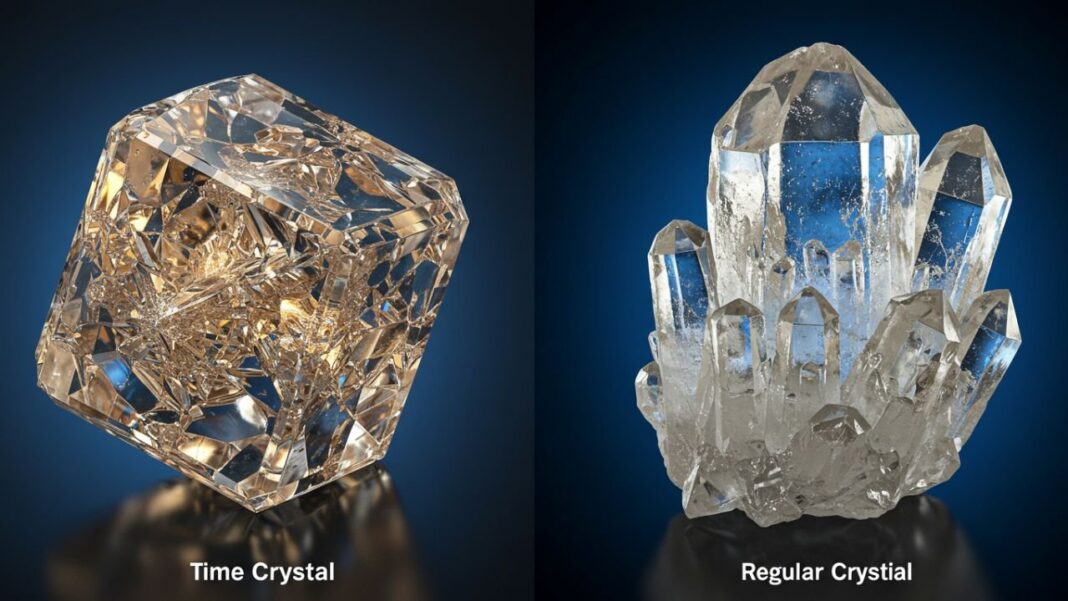


As a pop culture enthusiast, I don’t often dive into the world of quantum physics, but the recent breakthroughs in time crystals have got me excited. For those who aren’t familiar, time crystals are a novel state of matter that exhibits periodic motion even in the absence of an external driving force. Think of it like a perpetual motion machine, but one that doesn’t violate the laws of physics. The concept of time crystals was first proposed by Nobel laureate Frank Wilczek in 2012, and since then, researchers have been working to create and stabilize them. Now, a new study has made a significant leap forward in the accuracy of time crystals, and I’m here to break it down for you.
The Basics: What Are Time Crystals?
Time crystals are a unique phase of matter that challenges our traditional understanding of the laws of physics. In a conventional crystal, the atoms are arranged in a repeating pattern in space. In contrast, time crystals exhibit a repeating pattern in time, with their atoms oscillating at a specific frequency. This property makes them potentially useful for applications such as quantum computing and precision measurement. Researchers have been experimenting with various systems to create time crystals, including trapped ions, superconducting circuits, and ultracold atoms.
The challenge in creating time crystals lies in maintaining their stability over time. Any external noise or perturbation can cause the time crystal to lose its coherence, making it difficult to sustain its periodic motion. To overcome this, researchers have been exploring various techniques to improve the accuracy and robustness of time crystals. The latest study has made a significant breakthrough in this area, achieving a remarkable improvement in the stability of time crystals.
Breaking Down the Latest Breakthrough
The recent study, published in a leading scientific journal, demonstrates a novel approach to creating time crystals using a system of ultracold atoms. By carefully tuning the interactions between the atoms, the researchers were able to create a time crystal that exhibits a remarkably stable periodic motion. The key innovation lies in the use of a sophisticated technique called “dynamical decoupling,” which helps to mitigate the effects of external noise on the time crystal. This technique involves applying a series of carefully timed pulses to the system, effectively decoupling it from the external environment.
The results are impressive, with the time crystal maintaining its coherence for a significantly longer period than previously achieved. This breakthrough has important implications for the development of quantum technologies, where precise control over quantum systems is crucial. The improved accuracy of time crystals could also enable new applications in fields such as precision measurement and quantum simulation.
Implications and Future Directions
The improved accuracy of time crystals opens up new possibilities for their use in various applications. For instance, time crystals could be used to enhance the precision of atomic clocks, which are already the most accurate timekeeping devices in the world. Additionally, the stability of time crystals makes them an attractive candidate for use in quantum computing, where they could potentially serve as a robust quantum memory. As researchers continue to explore the properties and potential applications of time crystals, we can expect to see significant advancements in the field.
As we move forward, it will be exciting to see how the latest breakthroughs in time crystals are translated into practical applications. Will we see a new generation of ultra-precise atomic clocks or more robust quantum computing architectures? The possibilities are vast, and I’m eager to see where this research takes us. Stay tuned for Part 2, where we’ll dive deeper into the potential applications and implications of this technology.
Why Hollywood Should Care About Quantum Clockwork
Here’s where my entertainment radar starts pinging. The same way motion-capture technology used to be a “lab curiosity” until Lord of the Rails made Gollum unforgettable, ultra-stable time crystals could become the. Imagine a CGI sequence where time literally shatters into crystalline fragments that tick-tick-tick back together—physics consultants could map real lattice oscillations from these new 10-100-fold stability gains onto VFX software for visual authenticity. Studios are already licensing military-grade facial scanning; how long before Marvel calls MIT to license “quantum-clockwork” algorithms for Doctor Strange 3? The tech’s side-benefit of ultra-precilock signals also solves a dirty secret of visual effects: frame-sync drift. A 24-frame-per-second movie still drifts by microseconds across editing blocks, resulting in “jiggle” during huge composite scenes. If time-crystal references migrate from lab to. Side note: 2023’s Everything Everyness used optical-lattice imaging for their multiverse “bagel” scene; next generation gets a metronome that never loses the beat. That’s a lot of tech jargon, but the takeaway is simple—quantum physics is about to become the next big “cinematic” star, right alongside A-list actors.
From Minimize Labs to Miniaturization: The Smartwatch Scenario
Let me put my consumer-tech hat on. The new accuracy milestone—researchers measured crystal periods that remain stable to 1 part in 200 million—hints that the “quantum ticking” can be scaled smaller. A table comparing the evolution of “clocks” shows why this matters:
| Device Generation | Core Timing Tech | Size | Drift (per Day) | Relative Cost |
|---|---|---|---|---|
| 1970s Quartz Watch | Quartz Crystal | 1 cm³ | 0.5 sec | US$$ (then) |
| 2010s Smartwatch | 32 kHz Quartz | 0.1 cm³ | 0.4 sec | |
| 2020s Atomic Clock | Cesium/Optical | 150 cm³ | 0.000 001 sec | US$$$ |
| Future Wearable (projected) | Time Crystal Lattice | <0.01 cm³ | 0.000 000 01 sec | US$$$ (early) → US$ (mass) |
Think of it as the “stealth” quantum upgrade nobody sees but everyone’ll feel. Clarity on your Apple Watch’s ECG? That depends on a base clock. GPS drones avoiding no-fly zones? Same. If time-crystal stability migrates from cryo-cooled testbeds to room-temperature substrates—a problem several groups have already cracked using “prethermal” shields—then the. Google’s Pixel Watch 4 or Apple Watch Ultra 2 could theoretically sync to a lattice that loses a millionth of a second per decade instead of per day. The implications for sports analytics, “micro-napping” studies, and even. And here’s the kicker: entertainment contracts are frequently negotiated in fractions of. A global clock that never “slips” eliminates disputes over “who aired first” and could reshape how content windows are measured. Studios, networks, and. The law firm of “Tick-Tock, 100% Sync” is coming.