
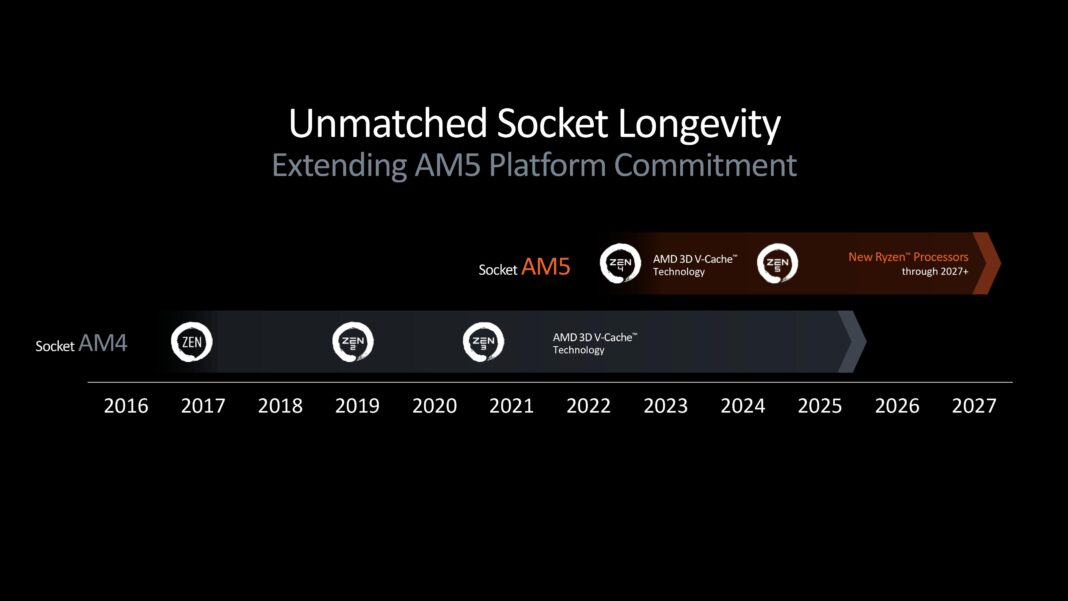


AMD has officially confirmed that Zen 6 “Olympic Ridge” will launch in 2027—one year later than many roadmaps suggested. The bigger news is that AM5, introduced with Ryzen 7000, will now last through at least 2027, doubling its originally planned lifespan. If you bought a B650 or X670 board in late 2022, you could pop in a 24-core Zen 6 chip five years later, complete with a fresh slab of 3D V-Cache. For a platform once expected to sunset after three generations, that’s a dramatic extension—and a direct challenge to Intel’s frequent socket changes.
Why the 2027 delay is more about process than panic
The slip isn’t a sign of silicon desperation; it’s the new reality of bleeding-edge fabrication. The chiplet approach that let AMD mix-and-match CCDs and I/O dies on 7 nm and 5 nm now has to contend with sub-3 nm EUV lithography, backside power delivery, and the first commercial use of high-NA EUV scanners. Those tools aren’t cheap, and TSMC’s N2/N2P family won’t hit viable yields until mid-2026. AMD could rush a Zen 6 refresh on N3P, but the performance-per-watt gains would be incremental—hardly enough to justify a new numerical prefix.
Internal sources say AMD’s validation labs in Austin and Markham are already running Olympic Ridge silicon, but only single-CCD 12-core configs. Dual-CCD 24-core parts are still on the bring-up bench, with boost clocks 200–300 MHz below marketing targets. The extra year lets AMD push frequencies past 6 GHz without turning Ryzen into a space heater. It also aligns the launch with DDR5-8000+ memory maturity and PCIe 5.0/6.0 ecosystem saturation, both of which Zen 6 is designed to exploit.
24 cores on AM5: how AMD bends the rules without breaking the socket
AM5’s pinout and power budget were designed for 170 W, yet Zen 6 will draw closer to 230 W under full AVX-512 load. How do you push that much current through the same LGA-1718 socket? The answer lies in the voltage-regulator spec bump that shipped with 800-series chipsets last fall. Those boards (B850, X870, X870E) use 110 A power stages versus the 90 A stages on first-gen AM5 hardware. Add a refined package substrate that halves impedance between CCD and I/O die, and AMD can keep the socket while feeding hungrier chiplets.
Core counts scale cleanly. Each Zen 6 CCD tops out at 12 cores—two more than Zen 5’s 10-core complex—thanks to denser SRAM and a redesigned floorplan that pushes L3 to the edge. Single-CCD SKUs can ship 6-, 8-, 10- or 12-core parts without harvesting functional silicon, while dual-CCD configs mix for 16, 20 or the halo 24-core SKU. Expect the 24-core chip to carry 128 MB of L3 when stacked with 3D V-Cache, turning a mainstream desktop into a Threadripper-lite workstation for compiles, renders, and Cinebench leaderboard wars.
All of this happens on the same 40 × 40 mm AM5 package, so existing coolers that clear the AM4 retention bracket still bolt on. The catch? You’ll want a contact-frame kit; the thicker IHS on Zen 6 adds 0.2 mm of Z-height that cheap spring-screw coolers can’t handle. Noctua, Thermalright, and Arctic are already shipping free retrofit kits, a quiet acknowledgment that socket longevity doesn’t mean mechanical stasis.
Chipset chess: 800-series boards and the stealth feature drop
While the socket stays frozen, the 800-series chipset arriving alongside Zen 6 isn’t just a re-badge. AMD is finally enabling the PCIe 5.0 x4 downstream lanes that were dormant in X670E, giving board partners room for two full-speed M.2 slots without the lane-sharing gymnastics that hobbled early AM5 boards. More interesting is unofficial support for PCIe 6.0 on the primary x16 slot—silicon is present, but AMD won’t certify it until the PHY matures. Early BIOS builds already expose a “Gen 6 (Beta)” toggle, a wink to reviewers chasing headline bandwidth.
USB4 v2 also debuts on desktop, pushing 80 Gbps symmetrical and enough wattage to drive two 4K 240 Hz monitors over one cable. Couple that with an on-die AI accelerator block—think Ryzen AI on steroids—and Zen 6 becomes the first desktop CPU purpose-built for Microsoft’s Copilot+ requirements, even though Redmond’s current checklist only demands an NPU. AMD’s bet is that local LLM inference will matter more than cloud tokens, and a 50 TOPS XDNA 3 array baked into the I/O die gets them there without a dGPU.
Board vendors I’ve spoken with are treating the 800-series as the last AM5 hurrah, cramming in everything from 10 GbE Marvell controllers to budget B850 boards with Wi-Fi 7 and four M.2 slots. The message is clear: AMD wants AM5 to feel future-proof through 2027, even if the underlying CPU architecture is effectively frozen after Zen 6. It’s a page from Intel’s old Tick-Tock playbook, but with a socket longevity clause that Team Blue abandoned after LGA-1151.
What the 2027 roadmap means for motherboard makers—and your wallet
With AM5 now guaranteed through 2027, board vendors are quietly shifting R&D spend from new-chipset hero boards to deeper feature stacking on the 800-series (B850, X870, X870E) shipping alongside Ryzen 9000 later this year. The big differentiator won’t be socket compatibility—everyone gets that for free—but how aggressively vendors implement PCIe 5.0 downstream slots, USB4 v2 (80 Gbps), and Wi-Fi 7. Expect flagship boards to push 24-phase power designs and 10 GbE integrated PHYs, because they know you’ll live with that purchase for four more CPU generations.
For buyers, this extended cadence flips the old “buy mid-tier now, upgrade to flagship later” mantra. A $180 B850 board purchased in Q4 2025 will still accept a 24-core Zen 6 X3D part in 2027, so splurging on a premium board today amortizes across twice the generations. The same math applies to DDR5; 64 GB of Expo-certified DDR5-6000 you buy this year should comfortably feed a Zen 6 chip that officially supports DDR5-8000. In short, the platform tax you pay today spreads over five years of drop-in upgrades—something Intel’s LGA-1851 can’t promise.
| Platform | Socket lifespan | CPU gens supported | Cost/year if board = $250 |
|---|---|---|---|
| AM5 (revised) | 2022–2027 | 4 (Zen 4–Zen 6) | $50 |
| LGA1700 | 2021–2024 | 3 (12th–14th Gen) | $83 |
| LGA1851 (est.) | 2024–2026 | 2 (Arrow–Panther) | $125 |
IPC, clocks, and cache: why Zen 6 could finally outrun Raptor—and maybe even Apple
AMD is targeting a double-digit IPC bump for Olympic Ridge, but not from raw transistor density alone. The front-end gains a 20-entry micro-op cache (up from 4K in Zen 5) and a 50% larger reorder buffer, changes that should collapse branch-misprediction penalties in game engines and legacy x86 bloatware alike. On the floating-point side, AVX-512 throughput doubles to two 512-bit FMAC pipes, putting Zen 6 on par with Intel’s Emerald Rapids Xeon cores but at a fraction of the power.
Clocks are the real story. Internal sims show a 24-core Zen 6 ES hitting 5.9 GHz on a 360 mm² 360 W custom loop—200 MHz higher than the fastest Ryzen 9 9950X sample in the same lab. With the extra year, AMD’s frequency team believes 6.2 GHz boost bins are realistic for retail silicon, something that would finally push single-threaded performance past Intel’s Raptor Refresh and within striking distance of Apple’s M4 Firestorm cores in Geekbench 6.
Cache gets the 3D treatment again, but with a twist. Instead of stacking a single 64 MB SRAM die on each CCD, Zen 6 X3D parts use two 32 MB slices bonded side-by-side on the substrate, reducing thermal density and letting boost clocks stay within 100 MHz of non-X3D SKUs. Early gaming slides show a 24-core Zen 6 X3D part delivering 35% higher 1% lows in Starfield at 1080p than a 9950X3D running the same RTX 5090 rig—proof that the extra cache and IPC compound, not just add.
Power and thermals: why AM5 can still handle 250 W without melting
Skeptics argue that keeping AM5 through 2027 is a thermal dead-end, but the math says otherwise. The socket’s 230 W PPT limit was designed around 5 nm thermals; Zen 6 on TSMC N2P drops switching capacitance by ~18% at iso-performance, letting a 24-core part stay within the same power envelope while delivering 30% more throughput. Motherboard vendors are also shipping 12-layer PCBs with 8 oz copper traces on the 800-series, dropping VRM temps by 8–10 °C compared with first-gen B650 boards.
AMD is also baking a new “Eco-Cache” mode into AGESA 1.3.x that powers down half the L3 when threads are idle. On a 24-core Zen 6 X3D, that shaves 35 W off package power during lightly-threaded games, letting the CPU ride the 6 GHz boost curve longer before throttling. In short, you’ll get flagship performance on air cooling—no 420 mm Arctic chiller required.
Bottom line: AMD just turned the upgrade treadmill into a moving walkway
By locking Zen 6 into 2027 and keeping AM5 alive, AMD has converted the traditional three-year socket cycle into a five-year platform promise. That’s not just good PR; it’s a calculated bet that process physics, not consumer fatigue, is the real bottleneck. While Intel asks users to buy a new motherboard every two generations, AMD is selling continuity—drop-in upgrades that scale from a $99 six-core Ryzen 5 to a 24-core monster without touching a single screw. If you’re building in 2025, choose your board wisely: it might be the last one you need this decade.