
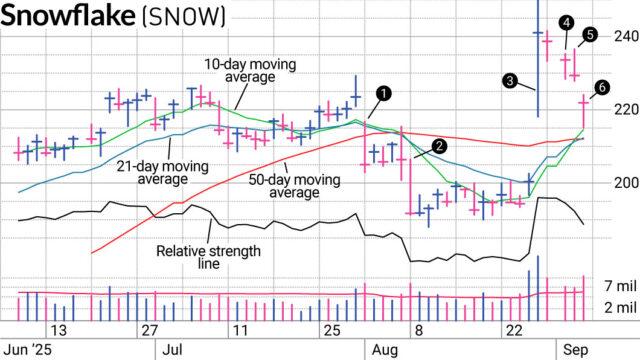


The data darling of Silicon Valley just served up a classic earnings plot twist that would make even the most seasoned streaming series jealous. Snowflake’s latest quarterly numbers dropped after Wednesday’s closing bell, and let’s just say the cloud computing crowd is experiencing some serious mood whiplash right now. While the company managed to squeeze past Wall Street’s expectations for their bottom line—a move that’s become their signature mic drop moment—it’s their forward-looking crystal ball that’s got investors clutching their pearls and reaching for the sell button faster than you can say “data warehouse.”
As someone who’s been watching this stock since it burst onto the scene like a tech unicorn in 2020, I can’t help but feel we’re witnessing the ultimate Silicon Valley coming-of-age story. The earnings beat? That’s so Snowflake. But the guidance miss? That’s the plot twist nobody saw coming from a company that’s been the poster child for pandemic-era tech excess. Trading was halted in after-hours action as the numbers made their way through the digital ether, and when those bids started flying, it looked like a Black Friday sale on SNOW shares—with everyone rushing for the exits instead of the entrance.
The Numbers That Started It All
Let’s talk turkey about those headline figures that had financial Twitter doing backflips. Snowflake posted adjusted earnings per share of 15 cents, comfortably clearing the analyst consensus of 11 cents like an Olympic high jumper. Revenue clocked in at a cool $734 million, up 32% year-over-year and slightly ahead of the $713 million that Wall Street’s finest had penciled into their spreadsheets. Product revenue—the metric that really gets tech investors’ hearts racing—jumped 34% to $698.5 million, proving that companies are still hungry for cloud-based data solutions even as the economy does its best impression of a roller coaster.
But here’s where our story takes a turn worthy of a Shonda Rhimes production. The company’s remaining performance obligations (RPO for those playing along at home), essentially future contracted revenue, grew just 10% to $3.72 billion. That’s like watching your favorite prestige drama suddenly introduce a laugh track—it just doesn’t feel right. For a company that’s built its entire brand on hypergrowth and the promise of infinite scalability, this deceleration feels like watching a Marvel superhero suddenly discover they have limits. The market’s reaction was swift and brutal, with shares plummeting faster than the latest Netflix series that got canceled after one season.
Guidance That Landed With a Thud
Now we arrive at the real drama, the moment that had analysts scrambling to update their models and investors questioning everything they thought they knew about software valuations. Snowflake’s guidance for the upcoming quarter landed with all the grace of a lead balloon, projecting product revenue between $716 million and $721 million. The midpoint of $718.5 million fell short of the $742 million that Wall Street’s crystal ball gazers had been expecting, creating a gap wide enough to drive a truck through—or in this case, wide enough to wipe out billions in market capitalization.
For fiscal 2025, the company expects product revenue of approximately $3.55 billion, which while still representing growth of about 22%, marked a significant deceleration from the company’s historical pace. CEO Frank Slootman, who’s been steering this ship through increasingly choppy waters, attributed the softer outlook to “macroeconomic headwinds” and elongated sales cycles that have become the bane of enterprise software companies everywhere. It’s like watching your favorite streaming service suddenly announce they’re cutting back on original content—technically still growing, but definitely not the same growth story that had everyone binge-investing.
The consumption-based model that’s been Snowflake’s secret sauce is showing signs of strain as enterprise customers tighten their belts and scrutinize every cloud computing expense like they’re reviewing a restaurant bill. CFO Mike Scarpelli noted that customers are becoming more “cost-conscious,” optimizing their usage patterns in ways that directly impact Snowflake’s top-line growth. This isn’t just a Snowflake problem—it’s the new reality for the entire cloud infrastructure ecosystem, where the unlimited buffet of data storage and processing power is being replaced by a more measured, budget-conscious approach to technology spending.
The AI Reality Check Nobody Ordered
Here’s where things get spicy—and not in a good way. Snowflake’s management guided for product revenue growth of just 22% for fiscal 2025, a dramatic deceleration from the heady 34% we just witnessed. For context, this is the equivalent of watching your favorite prestige drama suddenly get replaced by a reality show reboot. The company that’s been selling investors on its AI-powered future is now facing the same harsh reality hitting every tech darling: enterprise customers are tightening their belts faster than a celebrity trainer can say “cleanse.”
CEO Frank Slootman, who’s been the equivalent of a tech rock star since taking the helm, sounded almost apologetic on the earnings call, acknowledging that customers are optimizing their cloud spend “more aggressively than anticipated.” Translation? The unlimited buffet of data storage and analytics tools is over, and CFOs are suddenly counting calories like they’re preparing for beach season. The company’s remaining performance obligations—a fancy metric that basically measures contracted future revenue—grew just 16% to $3.7 billion, missing estimates and suggesting that the sales pipeline isn’t exactly bursting at the seams.
The Competitive Tectonic Shift
While Snowflake has been busy perfecting its data cloud narrative, the competitive landscape has been shifting like tectonic plates beneath its feet. Databricks has been eating market share for breakfast, lunch, and dinner, positioning itself as the cooler, more flexible alternative for companies who want to avoid vendor lock-in. Meanwhile, cloud giants Amazon Web Services, Microsoft Azure, and Google Cloud have been beefing up their own data warehousing solutions, essentially telling customers: “Why buy the premium brand when you can get the store brand that works just fine?”
| Company | Latest Quarter Revenue Growth | Focus Area | Key Advantage |
|---|---|---|---|
| Snowflake | 32% | Data Cloud | Multi-cloud flexibility |
| Databricks | 50%+ | Lakehouse Architecture | Open-source foundation |
| AWS (Amazon) | 13% | Redshift | Integrated ecosystem |
| Google Cloud | 35% | BigQuery | AI/ML integration |
The irony? Snowflake built its entire empire on being the Switzerland of data—neutral territory where companies could store and analyze information regardless of their cloud provider. But in a world where every tech giant is building walls around their gardens faster than you can say “walled ecosystem,” that neutrality suddenly feels less like a superpower and more like a vulnerability.
What This Means for the Cloud Party
Let’s call this what it is: the end of the “growth at any cost” era for enterprise software. Snowflake’s guidance haircut isn’t just a company-specific oopsie—it’s a canary in the coal mine for the entire SaaS ecosystem that’s been living high on the hog since 2020. When your customer base includes everyone from Fortune 500 giants to startups burning through VC cash like it’s going out of style, an economic downturn hits from every angle.
The company’s net revenue retention rate of 128% might sound impressive (and it is), but it’s down from the 150%+ levels that had investors seeing dollar signs and rainbows. Customers are still using Snowflake’s platform—they’re just being smarter about it, which is corporate speak for “they’re not throwing money at us like drunken sailors anymore.”
What’s particularly brutal is that Snowflake’s entire valuation thesis was built on the assumption that data would only become more valuable and companies would need ever-increasing amounts of storage and compute power. The AI revolution was supposed to accelerate this trend, not complicate it. Instead, companies are discovering that they can be more selective about their data infrastructure investments, and the “land and expand” playbook that worked so beautifully during the boom times suddenly looks about as effective as a chocolate teapot.
As I write this, Snowflake’s stock is down roughly 20% in after-hours trading, wiping out billions in market cap faster than you can refresh your portfolio app. The company’s forward price-to-sales ratio, once the stuff of Silicon Valley legend, is compressing faster than a zip file. For a stock that traded at 40-50x sales during its peak pandemic glory days, watching it approach more earthly multiples feels like witnessing the fall of a tech empire in real-time.
But here’s the thing: Snowflake isn’t going anywhere. The company still has nearly $4 billion in cash and marketable securities, giving it plenty of runway to navigate this turbulence. The question isn’t whether they’ll survive—it’s whether they’ll ever reclaim that growth story that made them the belle of the Wall Street ball. In a world where AI is supposed to be eating everything, Snowflake’s reality check might just be the wake-up call the entire tech sector needed. The cloud party isn’t over, but it’s definitely moved from an open bar to a cash bar, and everyone’s suddenly remembering they have work in the morning.