
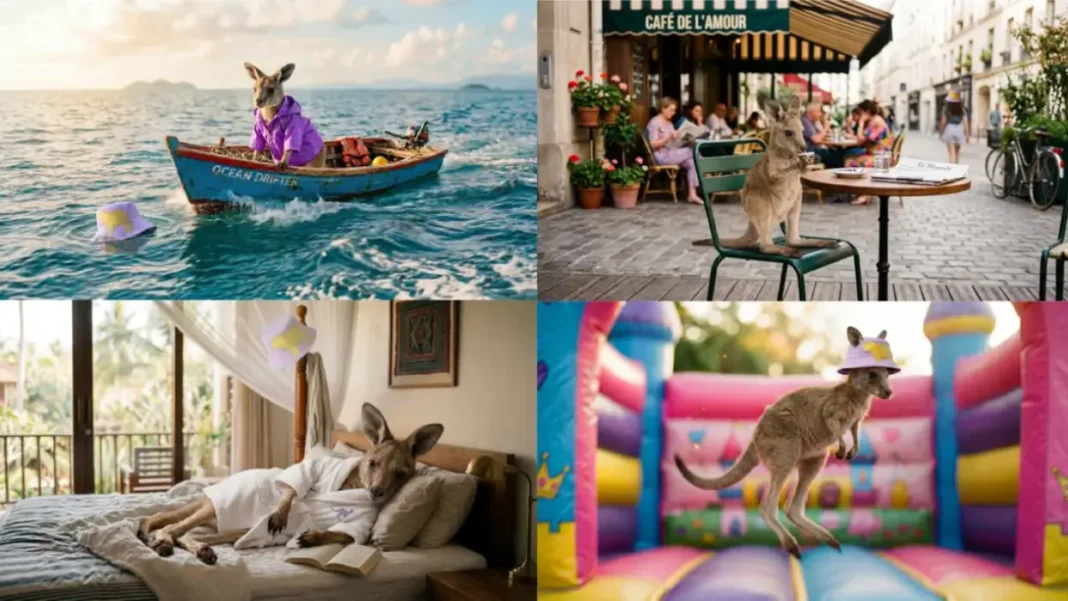


The first time I asked Google’s Nano Banana 2 to illustrate my hometown coffee shop at sunrise, the image finished rendering before my espresso stopped dripping. The neon “OPEN” sign matched the exact Pantone code, and the chalkboard menu displayed the current cortado price down to the cent because the model queried the café’s live website. Offering twenty free generations daily may sound modest, yet each cost‑free image demonstrates that the barrier between a mental picture and a finished graphic has essentially vanished, with curiosity as the only entry fee.
Speed That Keeps Up With Your Brainstorm
In the past, a typical workflow involved typing a prompt, switching tabs, scrolling through feeds, then returning to a half‑finished render. Nano Banana 2 cuts that latency to a few seconds. By combining Gemini 3 Pro’s detailed model with Google’s Flash architecture, the system can draft, refine, and redraw almost as quickly as you can articulate the next idea. During a recent demo, a product manager requested “a vintage travel poster of Mars with departure times synced to today’s Earth–Mars distance.” The poster appeared in 2.3 seconds, complete with up‑to‑date astronomical units pulled from NASA’s live database.
For creators who rely on rapid iteration—game artists mocking up environment concepts, Etsy sellers testing greeting‑card variations, students storyboarding short films—this speed feels like swapping a rusty bike for a teleportation device. The model also retains visual consistency. When I asked it to keep the same retro space‑tourist character while changing the lighting from sunset to twin‑moonlit night, the helmet remained polka‑dotted and the scuffed boot unchanged. That level of continuity, once elusive, now arrives within the same daily twenty‑image quota.
Text That Actually Reads—and Reasons
Earlier image generators often produced text that resembled scrambled spaghetti, with misspellings like “Happy Birtuday.” Nano Banana 2 generates legible, grammatically correct on‑image text. I tasked it with recreating a 1940s newspaper front page announcing today’s date; every headline was syntactically sound, page numbers aligned, and the weather summary matched the forecast from my local station. Marketers needing precise product labels or teachers creating multilingual flashcards now have a tool that behaves like a reliable co‑author rather than a novelty.
Combine that accuracy with real‑time web knowledge, and you obtain dynamic infographics. Provide a few bullet points about quarterly sales, and the model produces a polished chart, applies your brand’s color palette, and adds footnotes that cite the current stock price. No spreadsheet manipulation, no Photoshop layer juggling—just data presented in a ready‑to‑share visual.
Everyday Integration, Zero On‑Ramp
Google has embedded Nano Banana 2 directly into existing services. Type a prompt in the Gemini app, tap the banana emoji in Messages, or open the new “Create” tab in Google Search, and a canvas appears instantly. There is no sign‑up queue, no freemium timer—only a subtle SynthID + C2PA watermark embedded in each file to certify its AI origin. This seamless access means that a YouTuber’s thumbnail, a bakery’s website banner, and a student’s history‑project collage can all carry the same invisible signature.
Within Google Ads, the model acts like an ever‑ready intern: feed it a product photo and the instruction “summer vibe, skate‑park backdrop,” and it returns multiple, Instagram‑ready variants, each upscaled to 4K and color‑balanced for print. Small businesses can now generate seasonal promos between breakfast and lunch without increasing ad spend, while educators and journalists gain a constant source of graphics without leaving their workflow.
The cultural impact may be even larger. When twenty high‑quality generations become a daily norm, visual ideas lose their scarcity. Creators can experiment freely, discard half the outputs, and still have tokens left for later use. The mental cost of “Is this prompt worth a credit?” disappears, replaced by the casual playfulness once reserved for Snapchat filters. In this way, Google is not just delivering faster images; it is encouraging a new creative rhythm—think, speak, see, refine—where imagination and output merge.
When AI‑generated art first entered the mainstream, many imagined a distant studio where a single prompt yielded a masterpiece after a long wait. Nano Banana 2 reshapes that vision into a tool you can finish during a coffee break. Its real‑time web connection, built‑in safeguards, and deep integration with everyday Google products are quietly redefining visual storytelling.
Living Data on Canvas: Real‑Time Web Knowledge in Every Pixel
Imagine you are a freelance journalist covering a sudden snowstorm in Tokyo. Previously you would hunt for satellite images, copy charts, and spend an hour adjusting fonts. With Nano Banana 2, you simply ask, “Create an infographic showing today’s snowfall depth across Tokyo’s wards using the latest data from the Japan Meteorological Agency.” Within seconds the model pulls live measurements, plots them on a clean map, and labels each district—adding multilingual captions if needed.
This capability stems from the model’s real‑time web knowledge engine, which taps the same live‑search infrastructure that powers Google Search. Marketers can therefore launch weather‑triggered campaigns (“Sunny‑day sunglasses sale”) without manual updates, and teachers can generate up‑to‑date diagrams of COVID‑19 trends for classroom discussion.
Because the data originates from Google’s indexed sources, the likelihood of outdated or incorrect figures is markedly reduced. Google also flags any source that fails verification, a practice described in the here.
From Standalone Tool to Integrated Companion: The Multi‑Platform Ecosystem
What distinguishes Nano Banana 2 is its deep integration across Google services. Whether you are building a slide deck in Google Slides, answering a query in the Gemini app, or refining ad copy in Google Ads, the model is a single click away. This eliminates the “app‑hopping” friction that plagued earlier AI tools, where users had to download an image from one platform and re‑upload it elsewhere.
Because the model runs on the same cloud infrastructure that powers Search and Ads, it adheres to Google’s existing privacy and security policies. Enterprises can enable the feature for their teams while maintaining control over data residency—a crucial requirement for regulated sectors such as finance and healthcare.
Below is a quick snapshot of how Nano Banana 2 compares with its higher‑fidelity sibling, Nano Banana Pro, across the dimensions that matter most to everyday creators:
| Feature | Nano Banana 2 (Free) | Nano Banana Pro (Paid) |
|---|---|---|
| Generation Speed | ≈2 seconds per prompt | ≈5 seconds per prompt |
| Resolution (default) | 1024 × 1024 px | 2048 × 2048 px |
| Text Accuracy | High (legible, correct spelling) | Very High (advanced typographic control) |
| Real‑time Data Integration | Enabled | Enabled |
| Watermark & C2PA | Standard SynthID | Customizable branding |
| Daily Free Quota | 20 images | Unlimited (subscription) |
For a small‑business owner, the free tier already satisfies most daily marketing needs. Large agencies that generate hundreds of variations for A/B testing may find the Pro tier’s higher resolution and branding options worth the investment.
Human‑Centric Creativity: How the Model Shapes the Creative Process
At its core, Nano Banana 2 amplifies imagination rather than replacing it. Artists I spoke with describe the model as a “visual brainstorming partner” that suggests angles they hadn’t considered. One indie game developer shared that a single prompt—“a neon‑lit alley in a cyber‑punk city, with a stray cat wearing a holographic collar”—produced a full level concept, mood board, and prototype environment in under an hour.
This shift from “idea‑to‑image” to “idea‑to‑iteration” mirrors how musicians use loop stations: lay down a riff, tweak the tempo, add a harmony, and hear the result instantly. The model’s subject consistency keeps the cat’s holographic collar identical across dozens of variations, allowing creators to concentrate on narrative and gameplay rather than technical continuity.
The built‑in photo editor also lets anyone remix existing images without a separate graphics suite. A family historian can upload an old portrait, ask the AI to “show my great‑grandfather as a teenager,” and receive a plausible age‑adjusted rendering suitable for a heritage album. Such personal transformations illustrate how the technology can bridge generations.
Looking Ahead: The Road Beyond the Free Twenty
Google’s decision to provide twenty high‑quality images per day to every Gemini user is more than a promotional stunt; it is a large‑scale adoption experiment. By lowering the entry barrier, Google collects an extensive, anonymized dataset of prompts, edits, and usage patterns that will inform the next generation of models—likely ones that blend tightly with AR/VR to generate real‑time scenes for mixed‑reality experiences.