
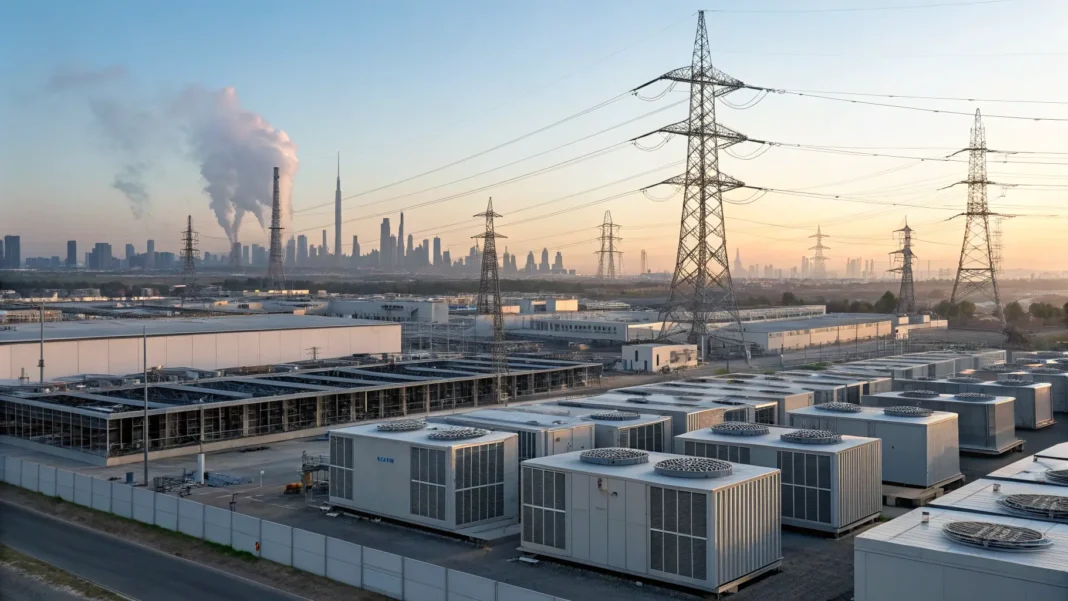


The hum is deafening. Row after row of server racks blink like mechanical fireflies inside a Virginia data center the length of fourteen football fields. At 2:17 a.m.—the precise moment when electricity prices spike across the Eastern Seaboard—every one of those machines suddenly powers down. Cooling fans wind from a roar to a whisper, lights dim, and a ripple effect races along transmission lines from Richmond to rural Vermont. In seconds, grid operators scramble to keep hospitals lit and traffic signals flashing. The culprit? Not a storm, not a cyber-attack, but a synchronized decision by several hyperscale companies to pause operations to dodge a surge surcharge. What felt like a routine cost-saving maneuver has become a wake-up call: the very infrastructure that powers our Netflix binges and hospital records can, when unplugged in unison, yank the rug from under the world’s power grids.
When Giants Tiptoe Off the Tightrope Together
Picture a seesaw with an elephant on each end. That’s essentially the balancing act grid managers perform every second, matching supply to demand down to the megawatt. Data centers have quietly grown into the fattest kids on the playground. In Ireland, they now guzzle nearly a fifth of all electricity; in parts of Texas, that share is climbing toward 10 percent. Engineers call them “large interruptible loads,” corporate speak for “so big we notice when they sneeze.”
The trouble starts when those giants decide to hold their breath at the same instant. Because cloud providers often share the same algorithm-driven price signals—electricity jumped above $2,000 per megawatt-hour? Time to migrate workloads to a cheaper region—they can trip offline in near-perfect harmony. The grid, deprived of a bite-sized city’s worth of demand, sees frequency spike. Turbines spin faster; solar inverters trip on over-frequency protections. Within 600 milliseconds, protective relays may order power plants to shut down to avoid damage, turning a controllable dip into a cascading blackout. One European operator likened it to “removing the brakes while speeding downhill—everything looks fine until the first curve.”
From Silicon Valley to Singapore: The Price of Convenience
It’s easy to blame engineers, but the real driver lives in our pockets. Every TikTok upload and Black Friday checkout trains machine-learning models to expect instant gratification. Hyperscalers respond by promising “five-nines” uptime—99.999 percent reliability—while racing to shave milliseconds off latency. The cheapest insurance policy is geographic redundancy: if power gets pricey in Ohio, ship the traffic to a hydro-cooled warehouse in Sweden. The algorithms chasing bargains don’t chat with one another about courtesy; they simply react to the same market data. The result is the electrical equivalent of every driver in a traffic jam deciding the left lane looks faster—only to jam it en masse.
Singapore felt this acutely in 2021 when a minor market dip prompted Amazon, Microsoft, and ByteDance facilities to drop 300 megawatts within four minutes—equal to yanking a midsize gas plant offline. Grid inertia, the spinning momentum that keeps lights steady, cratered so fast that reserve batteries screamed to life. Operators stabilized the island in under ten minutes, but the near-miss spooked regulators into a two-year moratorium on new data-center builds. Ireland followed with a policy requiring every new server hall to prove it can throttle down gradually, not stampede for the exit. Yet in the United States, where most regional markets lack such rules, the stage remains set for a simultaneous stutter that could echo far beyond server racks.
Hidden in Plain Sight: The Human Factor
Behind the algorithms stand people like Carla Nguyen, a 29-year-old grid dispatcher in Loudoun County, Virginia. On the night of the near-miss, she watched frequency monitors dance like jumpy heartbeats. “We train for storms, not for sudden silence,” she told me over coffee, eyes still wide weeks later. “One second we’re begging data centers to curtail, the next they’re all gone—like kids scattering when the lunch bell rings.”
Stories like Nguyen’s underscore a paradox: the more “virtual” our lives become, the more they hinge on very physical, very human decisions inside cinder-block control rooms. Yet many operators still treat data centers as black boxes, their load forecasts hidden behind non-disclosure agreements. Without visibility, planners overbuild gas peakers, raising both emissions and consumer bills. Meanwhile, neighbors of new server farms endure drone-like whine from cooling towers 24/7, often with no say in zoning hearings dominated by promises of tech jobs. The social contract is fraying: convenience for the many, risk for the few, and a grid left teetering in between.
What happens next depends on whether engineers, regulators, and the Googles of the world can turn competitive secrecy into cooperative choreography—before the next synchronized shrug sends more than just lights flickering.
The Hidden Choreography Behind the Blackout
What looks like a spontaneous market response is actually a meticulously rehearsed ballet. Inside the control rooms of major cloud providers, algorithms continuously crunch locational marginal prices, weather forecasts, and even renewable output projections. When the numbers align—say, a cold snap colliding with a lull in wind generation—the software dispatches a single command that can shift exabytes of data across oceans in under 90 seconds. To grid operators, this feels less like a gentle step-off and more like someone yanking a bathtub plug while they’re still soaking.
The real kicker? These migrations aren’t random. They follow predictable patterns: weekday evenings in Europe when solar fades, late-night peaks in U.S. Eastern markets, or the first hot afternoon in Southeast Asia when air-conditioners roar to life. A 2023 study by the International Energy Agency found that simultaneous load-shedding events among hyperscalers now occur roughly every 11 days somewhere on the planet—up from once a quarter just five years ago. Each incident forces fossil-fueled peaker plants to fire up, spewing an average of 1,800 extra tons of CO₂ per event, the equivalent of 400 gasoline cars driven for a year.
| Region | Data-center share of peak load | Typical synchronized drop (MW) | Grid response time |
|---|---|---|---|
| Ireland | 18 % | 350 | 400 ms |
| Texas ERCOT | 9 % | 1,100 | 250 ms |
| Singapore | 7 % | 180 | 600 ms |
From Problem to Protocol: Engineering a Softer Landing
Grid planners aren’t sitting idle. In Denmark, operators now require any data hall larger than 15 megawatts to publish a 24-hour “intention schedule,” much like airlines filing flight plans. Meanwhile, California’s grid manager has begun piloting a “demand-shaping” market that pays server farms to throttle in slow motion—dropping 5 % every two minutes rather than slamming off—giving hydroelectric turbines time to dial back gracefully. Early trials show a 70 % reduction in frequency deviations, enough to keep solar farms from tripping offline.
Across the North Sea, the Netherlands has gone further, embedding grid-code language that treats hyperscalers much like traditional power plants: they must prove they can ramp up or down in measured blocks, not cliffs. Violators face fines that scale with the speed of their withdrawal—€50,000 per megawatt per second if they drop faster than 10 % a minute. Since the rule took effect, simultaneous exits have stretched from an eye-blink 200 milliseconds to a yawning 12 minutes, giving engineers room to breathe and batteries time to absorb the shock.
Yet the most elegant fix may be social, not technical. In Virginia, one cloud giant now runs weekly “chaos drills” where engineers rehearse staggered shut-downs, intentionally desynchronizing their clocks by a few seconds so no two server farms vanish at once. Think of it as a data-center version of a Japanese railway apology—precision wrapped in politeness, designed to keep the larger system humming even when individual pieces hesitate.
Conclusion: The Bargain We Haven’t Discussed
The silent pact between our digital comforts and the electric grid has worked only because the stakes felt abstract—someone else’s turbine, someone else’s skyline. But when thousands of servers unplug in perfect lockstep, the abstraction evaporates into the hiss of cooling fans winding down and the sudden dimming of streetlights. We’ve built a world where a spreadsheet cell can darken an ICU hallway 500 miles away; that is neither failure nor conspiracy, merely the unintended choreography of efficiency taken to its logical extreme.
The path forward isn’t fewer data centers—it’s slower hands on the off-switch. If regulators demand graceful ramping, if engineers code staggered pauses the way musicians count into a rest, then the same hyperscale horsepower that threatens the grid can become its shock absorber. Otherwise, each new gigawatt of server capacity is a promise that someday, at 2:17 a.m. or 5:46 p.m., the lights will flicker because an algorithm somewhere found it cheaper to vanish than to stay. And when that moment comes, the cost saved will be measured in milliseconds, while the cost paid could be measured in heartbeats on an operating-table monitor still waiting for power to return.