
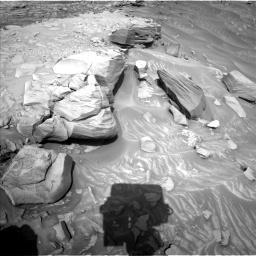


NASA’s Curiosity rover has reached a stable parking spot on Mars called “Laguna del Bayo,” where scientists expect to analyze the planet’s bedrock with exceptional precision. This location provides the secure platform needed for the rover’s scientific instruments to operate effectively, advancing our understanding of Mars’ geological history.
The Road to Laguna del Bayo
After years of traversing Martian terrain, Curiosity has arrived at Laguna del Bayo, a location that offers minimal risk of instability for deploying scientific instruments like the Alpha Particle X-Ray Spectrometer (APXS). This achievement supports the rover’s primary mission to study Martian geology and investigate potential signs of past life.
The journey required careful navigation through challenging terrain, with the rover avoiding rocks and steep slopes that could have compromised its safety. Using its advanced navigation system and guidance from NASA’s mission control team, Curiosity successfully completed the drive, demonstrating both the rover’s capabilities and the team’s expertise in planetary exploration.
Uncovering Mars’ Bedrock Secrets
The bedrock surrounding Laguna del Bayo appears to contain distinctive “boxwork” formations—networks of cross-cutting fractures that provide direct access to the planet’s geological composition. These features offer scientists a unique opportunity to examine Mars’ subsurface structure and potentially uncover evidence of past environmental conditions.
The Curiosity rover’s APXS instrument will analyze the chemical composition of these formations, helping researchers understand how Mars’ geology evolved over time. The data collected here could reveal whether the planet once had conditions suitable for microbial life, making this location particularly valuable for astrobiological research.
A New Chapter in Martian Exploration
Curiosity’s stable position at Laguna del Bayo enables the deployment of its drilling instrument to collect samples from the Martian bedrock. This capability allows scientists to study the planet’s geological makeup in detail, examining mineral compositions that formed billions of years ago.
As the rover begins its investigation of the boxwork features, researchers anticipate gaining insights into Mars’ ancient climate and the processes that shaped its surface. The analysis of these geological formations will contribute to our broader understanding of planetary evolution and the potential for life beyond Earth.
The Boxwork Enigma: Nature’s Geological Fingerprint
Curiosity’s cameras have revealed intricate honeycomb patterns in Laguna del Bayo’s bedrock that immediately captured scientists’ attention. These boxwork formations—resembling magnified leaf veins—represent more than geological curiosities. They preserve evidence of Mars’ transformation from a potentially habitable world to the frozen desert we observe today.
These formations likely developed through mineral-rich water depositing layers within existing rock fractures, creating natural cement that resisted erosion while surrounding rock weathered away. This process differs from typical water erosion patterns seen on Earth, suggesting unique environmental conditions on ancient Mars.
Preliminary APXS readings indicate these formations contain sulfates and iron oxides that require substantial liquid water to form. For astrobiologists, these minerals indicate past conditions that could have supported microbial life during Mars’ warmer, wetter periods.
A Window into Deep Time
At Laguna del Bayo, Curiosity sits at a geological intersection where multiple Martian epochs converge. The rover’s neutron spectrometer has detected hydrogen concentration variations beneath the surface, suggesting this area once hosted a complex hydrological system alternating between flowing water and frozen states.
This evidence indicates Mars experienced fluctuating climate cycles rather than a simple drying process. Changes in the planet’s axial tilt or volcanic activity may have driven these cycles, with each boxwork layer preserving mineral compositions that reflect ancient environmental shifts.
| Mineral Composition | Earth Formation Process | Martian Implication |
|---|---|---|
| Jarosite | Acidic, oxidizing waters | Potential biohazard but preserves organics |
| Hematite | Both water and dry processes | Climate indicator mineral |
| Gypsum | Evaporating water bodies | Long-standing water presence |
These mineral assemblages resemble Earth’s extreme environments—such as Chile’s Atacama Desert or Yellowstone’s hot springs—where life persists under harsh conditions. If microbes inhabit similar formations on Earth, extremophiles might have once lived at Laguna del Bayo.
Curiosity’s Legacy: Rewriting the Red Planet’s Story
As Curiosity systematically analyzes this geological laboratory, each measurement contributes to an emerging picture of ancient Mars. The rover’s drill will extract samples from boxwork formations, potentially revealing organic compounds preserved for billions of years—possible chemical fossils from an early biosphere.
This research extends beyond finding evidence of past life to understanding the cosmic context for life itself. Mars serves as a natural experiment showing what happens when a planet with early promise follows a different evolutionary path. Data from Laguna del Bayo will guide future missions, including the European Space Agency’s Rosalind Franklin rover, which will search deeper beneath the surface for protected groundwater niches.
Laguna del Bayo represents more than a parking location—it’s a vantage point to planetary history where rocks chronicle transformation and resilience. As Curiosity’s instruments examine these ancient formations, we see that exploration involves not just reaching destinations but uncovering stories that expand our understanding of our place in the cosmos.