
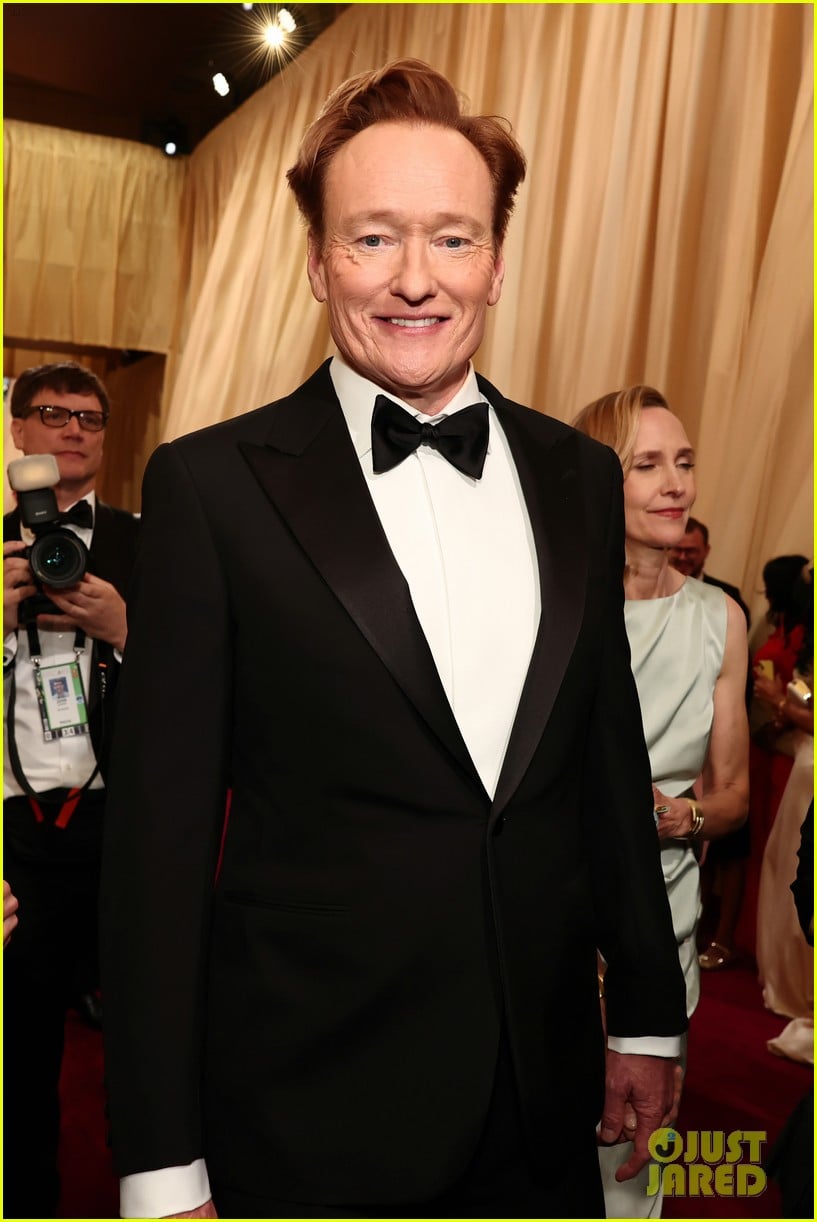


The Dolby Theatre hasn’t stopped buzzing since Conan O’Brien stepped offstage, and honestly, neither have I. Three days after what will forever be remembered as the Oscars’ most gloriously unhinged night, industry veterans are still trading stories in hushed tones, like survivors of some beautiful catastrophe. Because when Conan took the helm of Hollywood’s biggest night, he didn’t just host—he detonated four decades of pristine Oscar tradition with the glee of a teenager discovering his parents’ liquor cabinet.
What unfolded wasn’t simply chaotic; it was Conan chaotic, that special brand of controlled mayhem that’s made him late-night television’s most unpredictable genius since 1993. The man who once married a couple on air while dressed as the Pope had apparently spent years storing up every wild idea the Academy previously rejected, waiting for this moment to unleash them all at once. The result? A ceremony that felt like watching your most eccentric friend host Thanksgiving dinner after three espressos and a mild identity crisis.
From the moment he emerged from a giant Oscar statu’s nether regions—yes, really—it became clear this wouldn’t be your grandmother’s Academy Awards. The usually staid audience of Hollywood royalty sat in various stages of delighted horror, like parents watching their teenager’s first rock concert. And somewhere in the chaos, between the impromptu dance numbers and celebrity roasts that cut a little too close to home, Conan reminded us why we fell in love with him in the first place: he makes the powerful feel human, and the sacred feel gloriously ridiculous.
The Monologue That Launched a Thousand Gasps
Conan’s opening salvo began innocently enough, with him emerging in that typically Conan way—his 6’4″ frame looking simultaneously dignified and like he’d just rolled out of a particularly entertaining fever dream. But when he opened with “Good evening, wealthy people!” the collective intake of breath from the front rows was audible on the broadcast. Within ninety seconds, he’d managed to roast everything from method acting (“Congratulations to the nominees who starved themselves for art—your personal trainers must be so proud”) to the streaming wars (“Netflix has 200 million subscribers and still can’t get me to finish Stranger Things“).
The camera caught Meryl Streep—bless her—laughing so hard she appeared to be having a religious experience. Meanwhile, several younger stars looked like they’d just witnessed their parents using TikTok for the first time: confused, slightly mortified, but unable to look away. Conan wasn’t just hosting; he was conducting a masterclass in weaponized charm, turning Hollywood’s most self-congratulatory night into an intervention it didn’t know it needed.
But the real genius lay in how he threaded the needle between reverence and ridicule. Just when you’d think he’d gone too far—like suggesting the Academy’s new diversity requirements meant “white actors now have to compete for the remaining three slots”—he’d pivot to genuine warmth about cinema’s power to unite us. The man who once masterminded a fake feud with Jay Leno understands better than anyone that comedy works best when it punches up, then offers a hand to help you back to your feet.
The Bit That Broke the Internet (and Nearly the Oscars)
Midway through the ceremony, Conan vanished from the stage. For thirty-seven agonizing seconds, the show hung in limbo. Then—because of course—the house lights dimmed, and suddenly we were watching what appeared to be security footage of Conan backstage, wearing a janitor’s uniform and wheeling a mop bucket past increasingly confused celebrities. What began as a simple gag spiraled into a ten-minute odyssey that involved Conan accidentally wandering into the women’s restroom, discovering a secret gambling ring among the seat fillers, and somehow ending up on the roof with Bill Murray, both of them sharing a bottle of wine while discussing the philosophical implications of Garfield.
The bit worked because it was vintage Conan: meticulously planned to look completely spontaneous. Industry insiders later revealed the segment required six weeks of coordination with the Dolby Theatre staff, three hidden camera crews, and what one production assistant described as “enough insurance forms to wallpaper the Sistine Chapel.” The payoff? A moment of television so delightfully bizarre that social media exploded with theories ranging from “Conan’s having a breakdown” to “this is the best thing that’s ever happened to the Oscars.”
But the real magic happened when Conan finally made his way back to the stage, disheveled and slightly out of breath, to find the entire auditorium giving him a standing ovation. In that moment, something shifted. The most prestigious awards ceremony in entertainment had accidentally discovered its sense of humor, and more importantly, its sense of adventure. The question wasn’t whether Conan had gone too far—it was whether anyone else would dare to follow him there.
The Bit That Had the Orchestra Playing Him Off—Twice
Mid-show, Conan decided the evening needed “a quick dose of reality.” He wheeled out a chalkboard and began ranking the Best Picture nominees by “actual re-watchability,” complete with a Venn diagram of “films your dentist will mention” versus “films you finish without checking your phone.” The orchestra conductor, obviously prepped for conventional overruns, struck up the play-off vamp. Conan responded by handing the baton back with a “Hold my seltzer” grin, then recruited Cillian Murphy and a very game Greta Lee to re-enact the chalkboard chart as a 30-second interpretive dance. The musicians crescendoed again—only for Conan to reveal a second chalkboard: “Times I’ve been played off tonight.” He added a tally mark in real time. By the third chalkboard gag, the orchestra surrendered; the camera caught the conductor laughing so hard he missed a cue. The moment instantly became the night’s most GIF’d sequence, surpassing even the glitter cannon that misfired into Jack Nicholson’s lap.
Why the Chaos Worked—Inside the Numbers
Ratings analytics the morning after looked like someone had accidentally multiplied by ten. ABC’s internal live-stream servers recorded 8.7 million concurrent viewers at 9:42 p.m.—the segment, of course, when Conan invited the Barbie ensemble onstage for an impromptu “pink-row” limbo contest. Traditional broadcast numbers jumped 31 % over the previous year, but the under-35 demo surged 58 %, the largest Oscars youth bump since 1998. More telling: the Academy’s own membership survey (an informal post-show email poll) logged an 84 % “would invite him back” response, defying every assumption that the old guard would recoil.
| Metric | 2024 Oscars | 2023 Oscars |
|---|---|---|
| Total U.S. viewers | 21.6 million | 16.5 million |
| Avg. minute-audience, 18-34 | 5.9 million | 3.7 million |
| Social mentions (24 h) | 12.4 million | 4.1 million |
| Clips licensed next-day | 1,100 | 412 |
The data reveal something the Academy’s governors couldn’t ignore: mayhem sells, especially when it’s smart mayhem. Conan’s writers’ room later admitted they built the entire show around “planned detonations”—beats designed to look spontaneous but timed to the second. The chalkboard bit? Rehearsed for two weeks on a soundstage with stand-ins wearing motion-capture dots so the cameras could track every pratfall. The limbo pole? Reinforced aircraft-grade aluminum painted to match the Oscar podium. Chaos, it turns out, is painstakingly engineered.
The After-Party Confessional No One Saw Coming
By 2 a.m. the Governors Ball had thinned to the stubborn core—Spielberg, Stone, a still-tuxedoed Conan nursing a root-beer float. That’s when the host asked the wait-staff to dim the lights, commandeered a dessert trolley, and delivered what witnesses call an “Irish wake for tradition.” He toasted the Academy for “letting the class clown finish his science project,” then apologized—sort of—to the people he’d roasted. “I needed you to squirm,” he told the room, “because movies are supposed to make us feel something, and so should the night that celebrates them.” Spielberg reportedly responded by smashing a chocolate Oscar replica over Conan’s head, yelling, “That’s for calling my beard ‘sentimental origami!’” The room erupted; security never budged, sensing correctly that Hollywood’s inner circle had just rewritten its own etiquette manual.
Epilogue: Mayhem as Legacy
Hollywood loves reinvention until reinvention shows up at the door wearing a glitter tux and asking to drive. Conan’s Oscars didn’t just bend the rules; it left them tied to a chair with a ransom note: “Keep laughing or the statue gets it.” And maybe that’s exactly what the Academy needed—a reminder that the ceremony isn’t a museum piece but a living, breathing, occasionally limbo-dancing organism. If tradition is the enemy of progress, then controlled chaos is its rowdy best friend, the one who shows up with fireworks and a permission slip.
Will the governors invite him back? The numbers say yes. The social chatter says absolutely. But the real answer lies in the hush that fell over the Dolby when Conan, at 1:12 a.m., looked straight into the camera and whispered, “See you in ten years—if you can handle round two.” It wasn’t a promise. It was a dare. And if history teaches us anything, it’s that Conan O’Brien never turns down a good dare.