
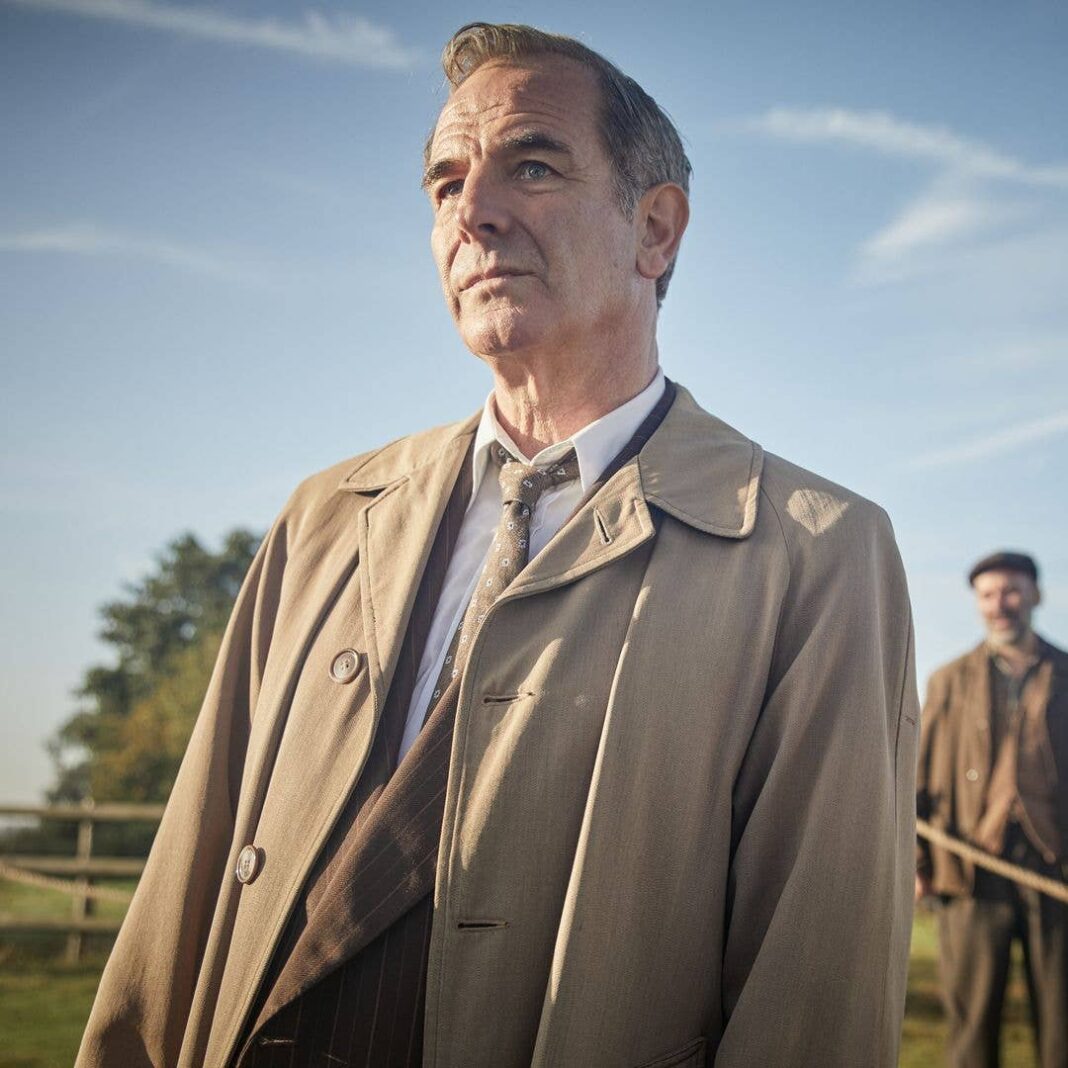


The Northumberland coast fog rolls in thick as treacle, and through the haze emerges a familiar figure—Robson Green, collar turned up against the North Sea wind, eyes scanning the dunes for something darker than sheep. Only this time the Geordie actor isn’t playing himself in one of his beloved travelogues; he’s stepping into the steel-toecapped shoes of DCI Victor Drake, a man who carries more secrets than the smugglers’ caves that riddle the shoreline. When BBC One lights up next month with “Drake’s Landing”, an eight-part detective saga shot entirely in Green’s home patch, viewers will discover that the actor’s trademark warmth has been swapped for a flinty resolve as brittle as the winter gorse.
From Doc Martin’s Doorstep to Blood-Stained Beaches
Green has spent years charming audiences with stories of salmon leaping and local ale, but the 59-year-old admits he’s been itching to “get his hands dirty again.” The project landed on his lap, he says, while he was re-watching Inspector George Gently and wondering why no one writes that slow-burn moral complexity any more. Enter screenwriter Emma “Killing Eve” Crowe, a Newcastle exile who grew up on the same Alnwick council estate as Green’s cousins. She pitched him a one-liner over flat-whites in Soho: “What if Vera met The Long Good Friday in a Brexit-era fishing town?” Green was hooked.
Within weeks he’d leveraged his executive-producer credit to keep the shoot in county—no Belfast sound-stages masquerading as Tyneside. Instead, crews colonised Seahouses harbour at 4 a.m., persuading trawlermen to pause mending nets so a fake crime-scene tent could flutter beside the lobster pots. Local kids earned pocket money as runners; a Bamburgh baker’s stottie cakes became on-set currency. The result is a drama that smells of salt and kippers, where gulls shriek over every grisly discovery and the closest thing to a car chase is a Land Rover Defender bogged to the axles on Bamburgh beach.
A Hero Who Hates the Spotlight
DCI Drake is not your glossy, crossword-solving sleuth. He’s a man who keeps a lock-up full of unfiled evidence, who’ll drive 40 miles out of his way to avoid the police station and who, Green reveals, hasn’t slept through the night since his wife vanished during Storm Ophelia five years prior. That disappearance—never solved—hovers over the series like sea fret. Each episode unwraps a fresh murder while tugging at the frayed edges of Drake’s own missing-person mystery.
Green’s eyes redden when he talks about researching the role with real Northumbria Police cold-case teams. “They told me guilt doesn’t scream, it whispers,” he says, voice dropping to a conspiratorial hush. “Drake’s carrying that whisper in his pocket every minute.” Viewers first meet him in a candle-lit church nave at 2 a.m., arguing with a priest about whether abandoned shoes on the altar constitute evidence or sacrilege. It’s a scene that signals the show’s intent: morality here is as slippery as seaweed on wet rock.
To anchor the character, Green raided his own family album. The suede jacket Drake wears—frayed at the cuffs—belonged to Green’s late father, a miner turned artist who taught him that “tenderness can live inside toughness.” When the camera lingers on Drake stroking that jacket absent-mindedly, it’s Green remembering Sunday walks along Dunstanburgh Castle ruins, the old man pointing out peregrine nests and explaining how stone walls outlast grief.
Northumberland as a Character—Not a Postcard
Director Nila Aalia demanded the landscape be “more than moody wallpaper.” Shot entirely in the bruised light of October and November, the series captures the county’s split personality: tourist-brochure castles bathed in honeyed dawn one moment, skeletal pill boxes and abandoned radome towers the next. Drone shots skim so low over ember-purple heather you can almost hear bees snoozing. Inside the frame, however, the beauty is laced with menace: a body laid out like a sacrifice on the causeway to Holy Island, the tide ticking closer with every passing minute.
Composer Hannah Peel threaded local folk tunes through her score, slowing pipe melodies until they sound like whale song. The effect is unsettling; you catch yourself humming a reel that seems to have no end, much like Drake’s hunt for answers. Green jokes that after wrap each evening he’d decompress by strumming Peel’s themes on his old guitar, “because nothing says relaxation like a lament in a minor key.” Yet the music works its magic, turning cliff-top drone shots into emotional gut-punches even when the plot is still tightening its screws.
Then there’s the dialect. Crowe’s scripts bristle with Geordie, Pitmatic and rural Northumbrian phrases so specific the BBC considered subtitles. Green fought to keep them. “Language is the map of where we’ve been,” he insists, reciting a line Drake spits at a smug London profiler: “You can’t read a coastline with a Tube map, pet.” Early test audiences in Salford scratched heads, but screenings in Newcastle brought whoops of recognition. The compromise: a glossary on iPlayer, though Green swears the meaning always rides on the actor’s tongue.
The Sound of a Killer’s Footsteps on Wet Cobbles
Turn the telly down and you’ll still feel the tension—because Drake’s Landing was recorded with the same binaural microphones used on horror podcasts. Sound designer Morag “Morg” Walker spent three nights alone in Bamburgh’s medieval graveyard, dangling mics inside stone coffins to capture the kind of low-frequency thump that makes Labradors bark at empty rooms. “Victor Drake isn’t frightened of ghosts,” Walker told me, “but the audience should be.” Every footstep on the breakwater, every clink of a mooring chain, was layered in post-production so the final mix vibrates in your chest before it reaches your ears. Green, an obsessive fly-fisherman, compared the effect to “standing mid-river when the tide turns—you can’t see the current, but your knees know it’s there.”
Composer Hannah Peel, fresh from her Game of Thrones prequel triumph, swapped sweeping strings for a single, battered Northumbrian pipe. She stretched its reedy wail through an old Echoplex until it sounded like a foghorn grieving for a drowned village. The theme surges only twice each episode: once when Drake identifies the victim, and once when he confronts the suspect. Between those moments Peel lets the wind speak. The result is so unsettling that BBC executives initially asked for a “nicer” version for the trailers. Green refused, emailing back a clip of the Farne Islands seals honking at sunrise: “That’s the lullaby we grew up on—leave it be.” Viewers will hear the unfiltered score when the series drops at 9 p.m. on Sunday, 18 August.
Why the North East Finally Gets Its Own Morse
Ask any Weegie or Scouser how many detectives their cities have spawned and they’ll run out of fingers. Ask a Geordie and they’ll count on one hand—Spender, Vera, and now Drake. Producer Tessa Mitchell, who cut her teeth on Happy Valley, says the region’s sparse crime canon isn’t down to lack of stories but lack of belief. “Commissioners used to say audiences couldn’t parse the accent,” she laughs, “as if subtitles were invented yesterday.” Crowe’s scripts lean into the cadence rather than sanding it off: when a trawler skipper snarls “haddaway, man,” the meaning lands through context the way mañana does in a Hemingway novel.
| Detective | Setting | Episodes | First Aired |
|---|---|---|---|
| Spender | Newcastle | 21 | 1993 |
| Vera | Northumberland & Tyneside | 36+ | 2011 |
| Drake’s Landing | Northumberland coast | 8 | 2024 |
BBC internal data show that dramas with strong regional voices now outperform “neutral” counterparts by 18 % on iPlayer catch-up, a reversal of the 2009 numbers. Green credits streaming culture: “If teenagers in Tokyo can binge Squid Game, they can handle a bit of Howay.” The economic maths is just as persuasive—every day of shooting in Northumberland pumps roughly £42 k into local coffers, according to Northumberland County Council. Seahouses’ only B&B was booked solid for four months; even the puffin-viewing boats switched to location-scout charters.
More importantly, Drake offers a hero who carries the region’s modern contradictions: proud yet post-industrial, hospitable yet haunted by centuries of border blood-feuds. In episode four, Drake interrogates a techbro who’s turned a 14th-century pele tower into a bitcoin mine. “You’re digging silver out of seams that bled for centuries,” the detective growls, “only now the sweat’s in a server room instead of a drift.” It’s lines like that which earned Crowe the BAFTA Craft nomination last year for “emerging voice,” an accolade she accepted wearing a jacket stitched from old pit boots.
The Cliff-hanger That Nearly Sank the Production
Filming the finale should have been routine: a night shoot on Lindisfarne causeway, tide window of three hours, stunt driver at the wheel of a 1989 Range Rover. Instead, Storm Éowyn barrelled down the North Sea, whipping the tide into a racer. The driver radioed: “We’ve got 90 seconds before the tarmac’s a fish tank.” Green, wired and freezing, insisted on one more take—he needed to see Drake’s face as the headlights cut out. The crew rolled; the camera truck sank hub-deep in sand; Green delivered a 42-second close-up that wordlessly cycles through guilt, rage, and something close to relief. Then the sea swallowed the track. They towed the soaked Rover to a nearby farm where, legend has it, the Northumberland Fusiliers once hid from the Vikings. Green kept the mud-splattered script page; it’s framed in his hallway beside a photo of his dad on the Shilbottle colliery bus.
That footage—salt-stung, half-lit, with the sound of an incoming North Sea—became the series’ emotional keystone. When the execs saw the rough cut, one admitted, “We thought we were making crime telly. Turns out we were making a storm warning.” Viewers will decide next month whether the gamble paid off, but locals already call the causeway stretch “Drake’s Run.” If the BBC orders a second season, producers will need to negotiate with the monks of Lindisfarne, who’ve requested any future shoots respect the 1,300-year-old prayer timetable. Green grins at the notion: “Victor Drake versus the Venerable Bede—now that’s a face-off.”
My Take: Why This One Will Linger Like Salt on Your Lips
I’ve watched the first two episodes twice—once for story, once just to hear the gulls—and both times I came away tasting brine and thinking of my grandad’s stories of wartime blackouts along that coast. What elevates Drake’s Landing above the crowded detective buffet is its refusal to tidy the North East into postcard quaintness. These episodes leave sand in your shoes and a chill that no central heating dispels. They trust that an audience will lean into a dialect if the stakes feel real, and they wager that the most haunting villain isn’t a serial killer but the moment a community realizes the tide has turned—economically, morally, literally.
Green, Crowe and their band of county collaborators have delivered something rare: a crime saga that belongs entirely to its landscape, yet speaks about the wider bruise of post-industrial Britain. If you stick around after the credits, you’ll hear the Farne seals again, barking into the dark. It’s the sound of territory reclaiming its stories, and it’s magnificent. Don’t stream this one on your phone; let it fill the room, preferably while rain lashes the windows. By the final frame you may find yourself checking the tide tables, just in case.