
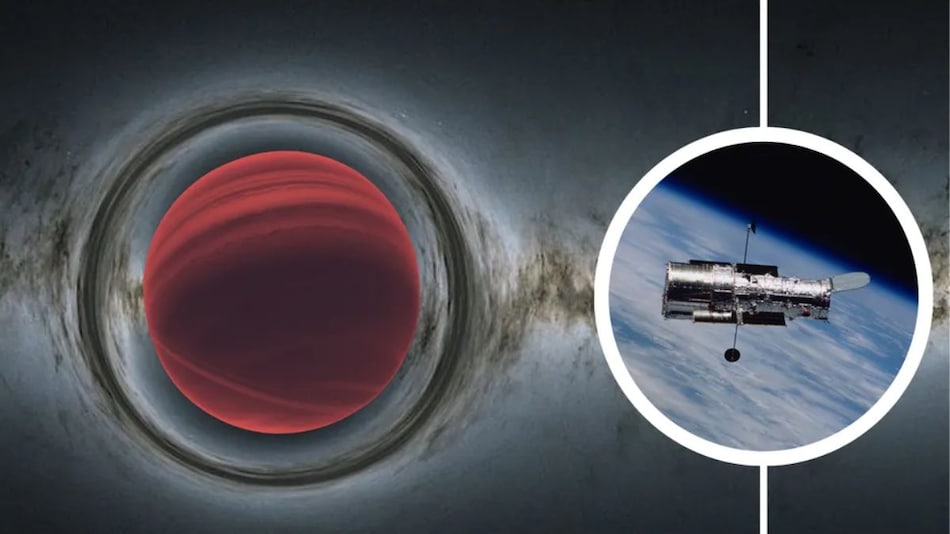


Space just got a whole lot more interesting—and I’m not talking about another celebrity asteroid making headlines. Astronomers have stumbled upon something that shouldn’t exist: a Saturn-sized rogue planet wandering through what scientists call the “Einstein desert,” a cosmic no-man’s-land where finding planets was supposedly impossible. This discovery isn’t just breaking the rules; it’s rewriting the entire playbook on how we hunt for these cosmic drifters. And trust me, after covering everything from celebrity meltdowns to streaming wars, watching scientists get this excited about a planet with no star to call home? That’s entertainment.
The “Einstein Desert” Isn’t So Empty After All
Let’s talk about this so-called “Einstein desert”—and no, it’s not where Einstein went to get away from paparazzi. This region of space has been frustrating astronomers for years because it’s proven nearly impossible to spot planets using the microlensing technique. Think of it like trying to photograph a celebrity through a frosted window; theoretically possible, but good luck getting anything worth publishing.
But here’s where it gets juicy: this Saturn-sized wanderer just proved everyone wrong. Located nearly 10,000 light-years away, this cosmic nomad is about one-fifth the mass of Jupiter, putting it smack in the middle of a size range that was essentially invisible to our detection methods. It’s like finding out there’s been a whole category of celebrities living off the grid in Hollywood—except instead of avoiding TMZ, they were avoiding detection by bending space-time itself.
The discovery is particularly mind-blowing because most rogue planets we’ve found before were either super-Jupiters on steroids or tiny Neptune-sized objects. This Saturn-sized middle child has been hiding in plain sight, proving that our cosmic neighborhood is way more crowded—and way weirder—than we ever imagined.
Microlensing: The Ultimate Paparazzi Move
Here’s where the science gets as dramatic as a season finale cliffhanger. Microlensing is basically the universe’s version of using a telephoto lens, except instead of zooming in on distant celebrities, astronomers are using the gravitational warping of space-time to spot planets that don’t orbit stars. It’s like catching a glimpse of someone famous in a reflection—except that reflection is bent light from a distant star, and the “celebrity” is a planet just floating through space like it owns the place.
What makes this discovery absolutely wild is that researchers managed to measure the mass of this free-floating exoplanet for the first time ever. Ground-based telescopes teamed up with the Gaia space telescope like an all-star detective squad, tracking the subtle bending of starlight to nail down not just the planet’s existence but its actual size. That’s like being able to tell someone’s exact weight from a blurry Instagram photo—except we’re talking about an object that’s been wandering the cosmos for potentially billions of years.
The fact that this planet exists at all is throwing astronomers into a frenzy. Rogue planets are supposed to be the cosmic equivalent of drummers who got kicked out of their bands—either they were too massive and chaotic, or they were too small to make waves. Finding one that’s perfectly Saturn-sized suggests there might be an entire population of these cosmic loners that we’ve been missing, just because our detection methods were too narrow-minded.
Why This Discovery Changes Everything
This isn’t just another space rock to add to the collection—this is potentially a game-changer that could revolutionize how we think about planetary formation. Scientists believe rogue planets either form like normal planets and then get ejected from their systems (imagine getting kicked out of your Hollywood Hills mansion for being too rowdy), or they form independently in interstellar space like cosmic rebels who never needed a star to validate them anyway.
The implications are staggering. If we can find one Saturn-sized rogue planet in the Einstein desert, how many more are out there? We’re talking about potentially thousands—or even millions—of these cosmic drifters that have been eluding detection because they don’t play by the rules of traditional planet-hunting. It’s like discovering that half of Hollywood has been living underground this whole time, and we only spotted them because someone accidentally walked into a paparazzi’s shot.
What’s particularly exciting for us space nerds is that this discovery proves our detection methods are finally sophisticated enough to spot these cosmic introverts. The convergence of ground-based observations with space telescope data has opened up an entirely new way of mapping our galaxy’s hidden population of starless planets. We’re essentially witnessing the birth of a new era in exoplanet hunting, and this Saturn-sized loner is just the opening act.
The Cosmic Detective Work Behind the Discovery
Here’s where this story gets as twisty as a prestige TV thriller. The international team behind this discovery pulled off something that makes Ocean’s Eleven look like a simple bank heist. They combined data from ground-based telescopes with the European Space Agency’s Gaia spacecraft—a space observatory that’s basically the Google Street View of our galaxy—to track down this cosmic phantom.
What’s absolutely wild is that this marks the first time astronomers have successfully measured the mass of a free-floating exoplanet. Previous rogue planet detections were like spotting someone famous in the distance—you knew they were there, but you couldn’t tell if it was Chris Evans or just some guy with a great jawline. Now we’ve got the cosmic equivalent of verified Instagram accounts for these wandering worlds.
The collaboration between Earth-bound telescopes and Gaia’s eagle-eye view from space created a perfect storm of detection capability. It’s similar to how entertainment journalists now combine social media sleuthing with traditional reporting—except instead of tracking down celebrity breakups, these scientists were hunting a planet that’s been playing hide-and-seek for billions of years.
Why This Discovery Changes Everything
Buckle up, because this is where the implications get more dramatic than a season finale cliffhanger. The discovery of this Saturn-sized rogue planet suggests that the “Einstein desert” might actually be teeming with planetary objects that we’ve simply been blind to. Think of it like discovering that Hollywood has an entire underground scene of A-listers who’ve been living incognito.
The fact that this planet exists at all challenges our understanding of planetary formation and evolution. Rogue planets this size were supposed to be about as common as humble Kardashians—statistically unlikely. Yet here we are, staring at proof that our cosmic neighborhood is packed with planets that don’t play by the rules, orbiting no star and answering to no gravitational authority.
What’s particularly tantalizing is that this discovery opens up a whole new category of worlds for us to explore. These rogue planets could potentially harbor subsurface oceans kept liquid by radioactive decay, creating habitable environments completely independent of starlight. It’s like discovering that life might exist in the cosmic equivalent of a basement apartment—technically homeless, but surprisingly cozy.
| Detection Method | Works Best For | Einstein Desert Blind Spot |
|---|---|---|
| Transit | Close-orbiting planets | Can’t detect without a host star |
| Direct Imaging | Young, hot planets | Rogue planets too cold and dark |
| Radial Velocity | Massive planets near stars | No star to create wobble |
| Microlensing | Previously: Super-Jupiters only | Now: Even Saturn-sized objects detectable |
The Future of Cosmic Discovery
As someone who’s watched the entertainment landscape transform from three networks to infinite streaming platforms, I can tell you we’re witnessing a similar revolution in how we discover cosmic objects. The Nancy Grace Roman Space Telescope, set to launch in the next few years, will be equipped with the cosmic equivalent of 4K cameras and could potentially spot thousands more of these rogue worlds.
We’re essentially living through the golden age of planetary discovery, where every new detection rewrites what we thought we knew about the universe. The “Einstein desert” turned out to be more like a cosmic Las Vegas—what happens there doesn’t stay there, and there’s way more action than anyone expected.
This Saturn-sized discovery isn’t just a scientific footnote; it’s a reminder that the universe is far stranger and more crowded than our Earth-centric view suggested. In a galaxy where planets can outnumber stars, and where worlds can wander forever without a sun to warm them, we’re the real outliers—creatures lucky enough to have both a star to orbit and the curiosity to look beyond it.
And honestly? If a planet can survive for billions of years without a star, drifting through the cosmic darkness completely alone, maybe there’s hope for the rest of us navigating our own journeys through the universe. After all, being a rogue doesn’t mean being insignificant—it just means writing your own rules in a galaxy that keeps surprising us with how wonderfully weird it can be.