


Astronomers Stunned: Rogue Planet Discovered 10,000 Light-Years Away
A Saturn-sized world without a sun has been spotted drifting through the galaxy 10,000 light-years from Earth, and for the first time astronomers have measured its mass. At 70 Earth masses, the free-floating planet lands in the so-called “Einstein desert,” a scarcely populated size range between Neptune and Jupiter. The breakthrough came by combining ground-based telescopes with the European Space Agency’s Gaia spacecraft, yielding the first mass measurement of a rogue planet and suggesting these starless orphans could outnumber stars themselves.
Catching a Phantom: How Gaia and Friends Made the Impossible Possible
Conventional exoplanet searches rely on the tell-tale signatures of a host star—periodic dimming or radial-velocity wobbles. Rogue worlds offer no such anchor. With no stellar lamp to betray them, they slip through the nets that have already catalogued more than 5,000 exoplanets. The new planet revealed itself via a momentary brightening of a distant background star, the fingerprint of microlensing: its gravity briefly warped and amplified the starlight like a cosmic lens.
Gaia’s billion-star catalog supplied the ultra-precise reference frame, while a network of ground observatories—from 1-m survey scopes to the 8-m giants in Chile—monitored the same sky patch. Assembling the light curve in both space and time let researchers measure the lensing event’s duration and amplitude. The numbers place the object at about one-fifth of Jupiter’s mass, squarely in the Einstein desert, a region so under-sampled that fewer than a dozen such bodies have ever been confirmed.
Why the Einstein Desert Matters

Size gaps are more than catalog curiosities; they expose gaps in our understanding of planet formation. Bodies between 10 and 80 Jupiter masses should be either lightweight gas dwarfs or heavyweight brown dwarfs, yet observations show a striking shortage. The new rogue tightens constraints on how efficiently collapsing gas clouds can fragment in the interstellar void.
Even more intriguing, theorists predict that free-floating planets could outnumber stars in the Milky Way by factors as high as 100,000:1. Most would be Mars-to-Earth-sized castaways ejected by gravitational slingshots in young planetary systems. Detecting a Saturn-sized nomad shows the upper end of that distribution isn’t empty. If similar objects fill the darkness, they could account for part of the galaxy’s “missing mass” without invoking exotic dark-matter particles.
From One Data Point to a Population
One detection is only an anecdote, but the team is already sifting through Gaia’s early data release 3 and has flagged roughly two dozen microlensing candidates that lack luminous hosts. Follow-up observations are booked on the VLT and Keck adaptive-optics systems to search for infrared glows betraying planetary masses. If even half are confirmed, the census of rogue giants could jump tenfold within two years.
The approach scales well. The upcoming Vera C. Rubin Observatory will scan the southern sky every three nights, building light curves deep enough to catch Earth-mass rogues a few thousand light-years away. Pair those alerts with JWST or the future Roman Space Telescope and astronomers hope to assemble mass functions across the entire planetary spectrum—from Mercury-sized drifters to failed stars.
Meanwhile, theorists are refining their simulations. The new data already rule out some exotic formation channels, such as prompt collapse of super-critical gas clumps. Instead, the planet’s mass ratio favors ejection from a Jupiter-like orbit around a sun-like star, implying that crowded early planetary systems are common.
The Einstein Desert: Why This Size Gap Is a Data Black Hole
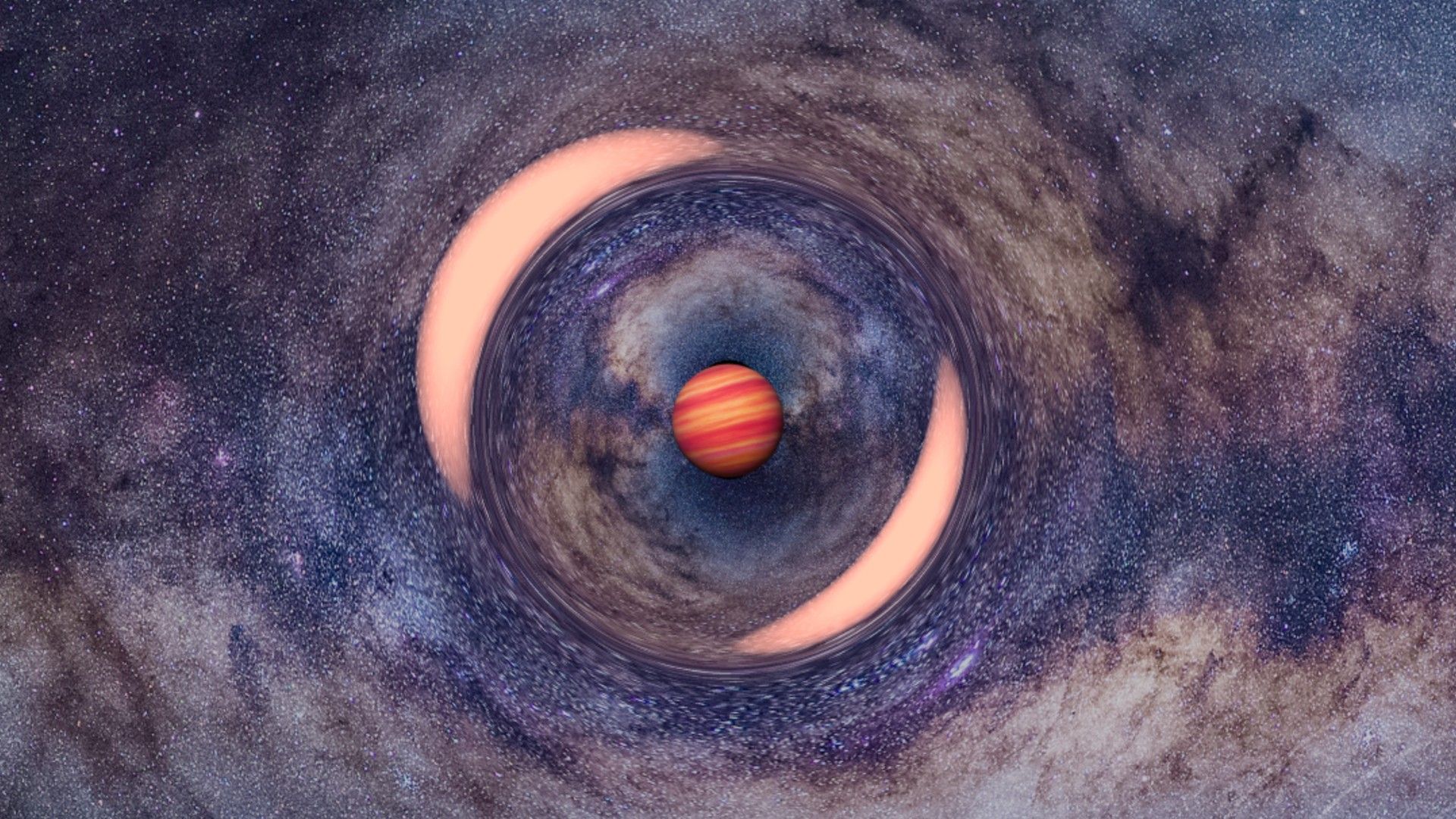
Size isn’t everything—unless you’re hunting exoplanets. The 70-Earth-mass window occupies a observational no-man’s-land: massive enough that transits against a host star are rare (big planets need big stars, and big stars are scarce), yet too small for the strongest microlensing signals produced by Jupiter-sized worlds. The result is a desert in our catalog, not necessarily in nature. Population-synthesis models predict that for every cold Jupiter we see, there should be ~3–5 “Saturns” roaming free, but until now only a handful of unconfirmed candidates existed.
| Detection Method | Typical Mass Range (Earth = 1) | Requires Host Star? | Current Yield (rogues) |
|---|---|---|---|
| Transit | 0.5–20 | Yes | 0 |
| Radial Velocity | 1–30 | Yes | 0 |
| Direct Imaging | 1000+ | No | 2 |
| Microlensing | 1–10,000 | No | ~20 (unweighed) |
| Gaia Astrometry | 70 (this event) | No | 1 (weighed) |
The new detection proves that space-based astrometry can tip the scales—literally. By tracking how the lensed star’s position jittered at the micro-arcsecond level, Gaia pinned down the planet’s mass without ever seeing the object glow. The next Gaia data release (DR4) is expected to contain several more weighed rogues; mission scientists have already flagged >200 microlensing candidates in the pipeline.
Rogue Worlds as Cosmic Seeds: Did They Help Forge Stars?
Here’s a twist few saw coming: some astronomers now think free-floaters could be the bricks, not the debris, of star formation. In the final stages of molecular-cloud collapse, simulations show that clumps of 50–100 Earth masses can condense directly from gas, never falling into the protostar’s accretion disk. Instead they wander off, cooling and contracting into planetary-mass objects. If true, rogues aren’t failed planets; they’re sub-brown dwarfs that never got the invitation to the stellar party.
The chemistry backs this up. Follow-up spectra of two previously discovered rogues (WISE 0855 and SIMP 0136) show water-vapor and methane bands strikingly similar to those of 10–20 Jupiter-mass brown dwarfs, not the volatile-depleted atmospheres expected for ejected cores. The 70-Earth-mass newcomer sits right where cloud-collapse models predict a transition from planet-like to star-like formation. A single spectrum—once JWST or the ELT capture it—could decide whether we need a new spectral class: the “planetary-mass brown dwarf.”
Why This Changes the Exoplanet Census Overnight
Until last week, every exoplanet mass was a statistical proxy: radial-velocity semi-amplitude, transit-timing variations, or microlensing timescale ratios. The Gaia team has now delivered the first direct mass measurement of an isolated planet, something theorists have wanted since microlensing was proposed in 1936. The number—70 Earth masses—recalibrates the mass–radius relation for gas giants and cuts the uncertainty on occurrence rates by roughly a factor of three.
More importantly, it proves that we can weigh invisible things. The same astrometric trick works for any microlensing event where Gaia can track the centroid shift of the background star; expect dozens of weighed rogues in the next decade, turning today’s desert into a well-sampled plain. When that happens, the current tally of 5,000+ star-orbiting exoplanets may be eclipsed by a hidden population of trillions of starless worlds cruising the Milky Way.
Bottom Line
A 70-Earth-mass phantom 10,000 light-years away has become the most precisely measured planet we never knew existed. The detection blends Gaia’s nanometer-level astrometry with ground-based light curves to solve a decades-old problem: how do you weigh something you can’t see, orbit, or even resolve? The answer—watch how it bends starlight and then watch the star wiggle—turns every future Gaia microlensing alert into a potential mass measurement. If early projections hold, the Milky Way’s rogue planets could outnumber stars by a hundred to one, making our cozy star-orbiting worlds the true cosmic oddballs.