
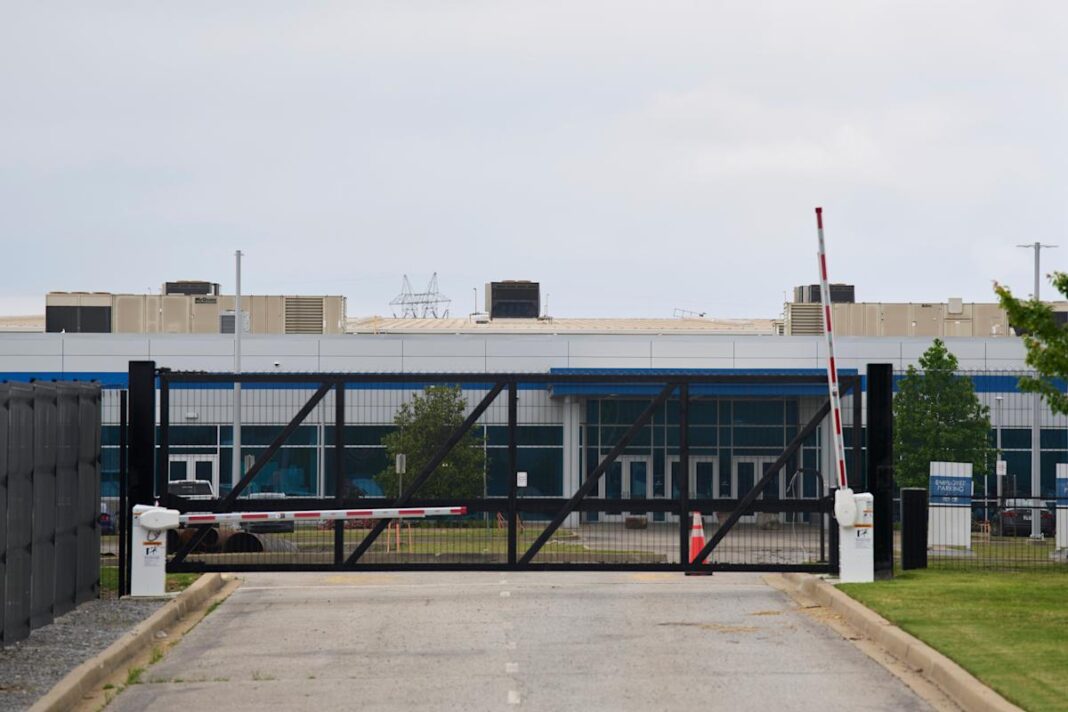


The first thing you notice driving down Stateline Road is how ordinary everything looks—strip malls, gas stations, the occasional deer crossing sign—until you hit a sprawling, 810,000-square-foot hulk of steel and concrete that used to ship sneakers for GXO Logistics. Today its loading docks are gone, the parking lot is cordoned off by ten-foot fencing, and the only clue to what’s happening inside is the low, constant hum that rattles your ribcage if you stand close enough to the new razor-wire. Elon Musk’s xAI just dropped $20 billion—yes, billion with a “b”—to turn this quiet Southaven warehouse into MACROHARDRR, the newest lobe of what will soon be the world’s largest supercomputer. Overnight, the Mississippi floodplain became the epicenter of the most aggressive AI infrastructure buildout in history, and nobody, from the waitresses at the nearby Waffle House to the environmental lawyers now circling the project, can quite believe it.
The $20-billion moonshot hiding in plain sight
Mississippi has seen its share of big promises—riverboat casinos, Japanese tire plants, the Nissan Canton assembly line—but nothing like this. The state’s previous private-sector record was a $1.7 billion aluminum mill; MACROHARDRR is more than eleven times larger, eclipsing every factory, refinery, or farm co-op in the state’s 207-year history. State officials whispered the number to legislators back in January, and half the room thought it was a typo. It wasn’t. The facility will anchor a 2-gigawatt compute cluster, tripling xAI’s current capacity and giving Musk the raw horsepower he needs to challenge OpenAI, Google, and other major players developing artificial general intelligence.
What makes the math work is a cocktail of tax breaks nobody else in the country can serve. Mississippi’s Data Center Incentive erases every penny of sales-and-use tax on the servers, switches, and liquid-cooling racks that will live inside the retrofitted warehouse. Local governments sweetened the pot with fee-in-lieu agreements that slash property-tax liability for decades. Factor in an on-site power plant xAI quietly acquired from a bankrupt utility, and the company gets electricity at industrial-scale rates without waiting for new transmission lines. Translation: the machines can be switched on the moment the last rack is bolted to the floor, humming away on cheap, captive electrons while competitors in California or Texas cool their heels on interconnection queues.
A quiet county braces for the AI hurricane
Drive fifteen minutes north and you’re in Memphis, home of blues and barbecue, but Southaven still feels like small-town Mississippi: Friday-night football, porch swings, neighbors who wave even when they don’t know your name. Now the city’s population of 55,000 is prepping for hundreds—possibly thousands—of new tech jobs, the first wave arriving in hard hats to retrofit the building, the second wave sliding into permanent gigs monitoring servers and training models. Real-estate agents talk about “Silicon Ridge,” a half-joking nickname for the rolling hills around Stateline Road where three-bedroom ranch homes have jumped 20 percent in value since March. At Desoto Central High, counselors are rushing to add cybersecurity courses and Python electives; local pastors are already praying, quite literally, that the newcomers remember to tip.
Yet not everyone is rolling out the red carpet. Over 900 residents have signed a Safe and Sound Coalition petition demanding xAI halt operations until environmental questions are answered. The NAACP and Southern Environmental Law Center warn that the on-site natural-gas plant, idled since 2019, could send nitrogen-oxide levels spiking across a region already tagged by the EPA as a “non-attainment” zone for ozone. “We’re being asked to trade our children’s lungs for somebody else’s moonshot,” says Dr. Yolanda Owens, a family physician who keeps a stack of asthma inhalers in her clinic fridge. State environmental officials counter that modern emissions controls will scrub the exhaust, but they’ve yet to release full modeling data, and local activists smell a rush job. Court filings could start flying as early as next month.
Inside the fence, though, the work never pauses. Crews in hi-vis vests stream through security turnstiles at dawn, lugging toolkits and coffee thermoses. They’re retrofitting 240 truck docks into sealed cold-aisles, installing enough fiber to stretch from here to Tokyo, and wheeling in rack after rack of Nvidia’s newest Blackwell GPUs—each one roughly the size of a dorm fridge and more powerful than the entire supercomputer that guided the Mars rovers. When the switch is finally thrown, sometime around the first frost, the building will draw twice the electricity of downtown Memphis’s skyline, and the only outward sign will be a faint shimmer of heat rising over the flat Mississippi roofline, as if the future itself were evaporating into the Delta sky.
The power plant nobody saw coming
Three weeks before the first concrete trucks rolled in, a quiet real-estate shell game ended with xAI’s shell company—Southaven Land Holdings LLC—buying the 40-year-old, oil-and-gas-fired DeSoto Power Station for an undisclosed sum. Overnight the rusting hulk on the eastern edge of the warehouse parking lot became the beating heart of MACROHARDRR. Instead of selling electricity back to the grid, the 480-megawatt plant will now feed Musk’s machines directly, bypassing congestion on the Tennessee Valley Authority’s aging lines and insulating the cluster from summer brownouts that have plagued Memphis data halls for years.
Environmental groups call it a dirty workaround. The plant hasn’t run at full tilt since 2013, and its cooling canals are laced with heavy-metal sediment. Yet state permits allow xAI to re-classify the site as “industrial self-generation,” a label that sidesteps newer EPA emission caps. In plain English: the supercomputer will be powered by a grandfathered relic that would never be licensed today. Local anglers still drop lines in nearby Coldwater River, unaware that the water temperature at the outfall could rise six degrees once the turbines spin back up. A table of projected impacts—compiled from filings xAI submitted to the Mississippi Department of Environmental Quality—tells the story:
| Impact metric | Pre-retrofit (2013) | MACROHARDRR projection |
|---|---|---|
| Annual CO₂ output | 1.2M tons | 3.4M tons |
| Daily water draw | 9M gallons | 14M gallons |
| NOx emissions (tons/yr) | 1,100 | 2,900 |
Company engineers counter that every megawatt generated on-site replaces one that would otherwise come from coal-heavy regional grids. They also promise 98 % uptime—critical for training trillion-parameter models that can’t afford a millisecond of flicker. Still, the trade-off is stark: the fastest AI on Earth may arrive with a smoke plume trailing over the cotton fields.
The human cost of infinite intelligence
Inside the fence, the future looks like a fluorescent aquarium. Rows of immersion-cooled racks glow turquoise through glass panels while robotic arms swap GPUs faster than pit-stop crews. Outside, the parking lot is still mostly gravel because only 42 permanent technicians have been hired—hardly the industrial renaissance locals were promised. Recruiters scour community-college robotics programs, but the skill bar is sky-high: applicants must pass a 180-question exam on CUDA memory topology and liquid-cooling chemistry. So far, zero DeSoto County residents have made the cut.
Meanwhile, housing prices in Southaven jumped 19 % since the announcement, pricing out school-bus drivers and warehouse pickers who kept the town running long before AI was a dinner-table word. At the First Baptist Church on Church Road, pastor Marcus Greene has started a Wednesday-night “tech ethics circle” that doubles as a support group for displaced workers. “We were told new jobs were coming,” he says, adjusting his glasses between verses. “They just didn’t say they’d be for people who already live in Palo Alto.”
The psychological vertigo cuts both ways. Newly arrived xAI staffers—mostly in their late twenties—rent entire floors at the Holiday Inn Express, work 14-hour shifts, then unwind at the only late-night spot still open, a neon-lit taco truck parked across Stateline. They speak in shorthand about learning rates and loss curves, oblivious to the stares from locals who once clocked out at 5 p.m. from the shoe warehouse and made it home for supper. Two worlds orbit the same patch of asphalt, each invisible to the other.
A wager the size of civilization
MACROHARDRR is not just another Musk moonshot; it is the table stake in a poker game whose pot is the next chapter of human cognition. With 2 gigawatts—enough to power every home in Jackson, Biloxi, and Gulfport combined—xAI will be capable of running continuous training runs that dwarf GPT-4’s compute budget by a factor of a hundred. The models that emerge could design fusion reactors, cure Alzheimer’s, or spin up trillion-dollar markets we don’t yet have names for. They could also vaporize whole occupations, flood the infosphere with synthetic realities, and concentrate decision-making power in the hands of whoever controls the off switch.
Mississippi, unaccustomed to shaping global destiny, now finds itself the unlikely gatekeeper. Legislators who green-lit the tax breaks speak proudly of “leap-frogging into the knowledge economy,” yet none could explain back-propagation if their lives depended on it. Environmental lawyers are scrambling to understand whether an air-quality lawsuit can halt a data center, a legal question no court in the state has ever faced. And on porch swings from Horn Lake to Olive Branch, neighbors debate whether the distant hum is the sound of progress or the rumble of an approaching storm.
Elon Musk has never been one for small bets. He re-landed rockets when the rest of us were still losing luggage at the airport, and turned electric cars into status symbols while Detroit scoffed. But MACROHARDRR feels different: the collateral isn’t just shareholder equity or even a planet’s climate—it’s the scaffolding of meaning itself. If the gambit pays off, Southaven may be remembered alongside Kitty Hawk and Cape Canaveral. If it falters, the same fenced acreage could become a monument to the moment we traded away our last bargaining chip with the future, one Mississippi summer when the cicadas sang louder than the cautionary voices, and the river kept rolling south, indifferent to either outcome.