
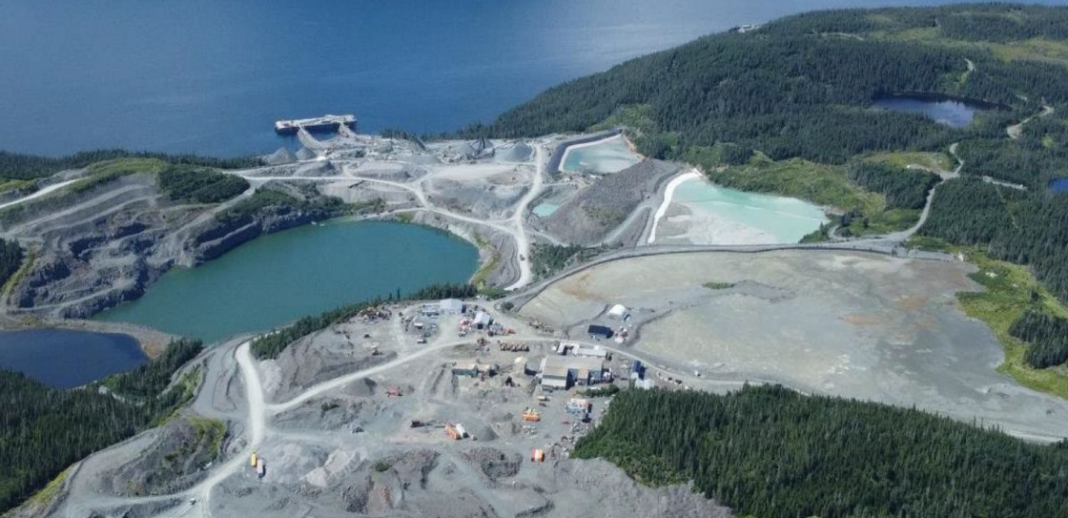


UBS’s quiet exit from FireFly Metals last Tuesday sent Perth’s mining investment circles into a spin. The Swiss bank didn’t just reduce its position—it completely exited, selling 28.4 million shares at 28¢, a sharp discount to the previous close of 32¢ and well below the 42¢ price just six weeks earlier. For a stock that had surged 180% since April on strong results from its Green Bay project in Newfoundland, losing a major European backer felt like a sudden power outage at peak hour.
The after-hours block trade was executed cleanly: a single transaction crossed with a local institutional buyer willing to accept a 12% discount. No research note, no investor call, no polite “portfolio rebalancing” statement. Just an empty space on the register where 6.8% of the company previously sat. When a Tier-1 broker exits this abruptly, the market immediately searches for problems. But having tracked FireFly since its 2022 reverse listing into Calidus, the move appears more about timing and risk management than any hidden issues—particularly with copper futures wobbling below US$4.60/lb.
Why UBS bailed now: a window into desk-level thinking
Portfolio managers don’t spontaneously liquidate 5-10% holdings in micro-caps. Typically, internal risk parameters trigger action: perhaps a VaR limit breach, an ESG flag, or more commonly, a directive to reduce exposure to Australian issuers under $500 million market cap. UBS’s Australian equities desk has been gradually reducing its small-resources exposure since May, reflecting a global shift away from exploration-stage companies toward cash-generating producers. FireFly, despite its exploration success, won’t produce copper until 2027 at earliest. In a market where money-market funds yield 5%, a non-cash-flowing copper explorer must compete with risk-free returns.
Currency factors also played a role. A Swiss-franc denominated portfolio that bought FireFly at A$0.18 in February still achieved a 55% currency-adjusted gain despite recent declines. When your base currency strengthens 8% against the Australian dollar in three months, locking in profits makes sense—especially if your commodities team is quietly reducing 2025 copper price forecasts. Traders call it “leaving something for the next guy”; UBS left a 28-cent entry point and walked away with gains secured.
The vacuum on the register: who caught the falling knife?
Market chatter suggests a domestic fund with a track record of contrarian positions in Canadian base metals stories—names like Sandfire and Galena feature in their history. The buyer executed through Morgans, which has covered FireFly since its IPO and knows every drill result intimately. This matters because it signals genuine conviction rather than opportunistic trading. Next week’s substantial shareholder notice will reveal the new holder, but the immediate message is clear: Australian smart money is comfortable buying European fear.
FireFly’s top-20 already reads like a WA mining hall of fame—Tolhurst, Leatherman, Creasy—so adding another local name actually tightens the register and reduces liquidity overhang. From a capital structure perspective, replacing a passive financial investor with an informed Australian specialist is positive. UBS was never going to participate in the upcoming $40 million placement for mill commissioning; a domestic fund might. The seller’s loss could become the company’s gain when management begins its September roadshow to fund a 5,000-metre underground drilling program. Less European hot money, more Australian patient capital—this kind of register reshuffle often precedes a re-rating when the next assay results arrive.
Copper sentiment and the clock on Green Bay
The broader copper market offers little support. LME warehouse stocks have risen for 19 consecutive sessions, the Yangshan premium is negative, and China’s State Reserve Bureau is rumored to be releasing strategic stockpiles. These factors feed directly into algorithmic models that desks like UBS use to value small-cap explorers. When the index turns down, quantitative models trigger sells; fundamentals about 30-metre intercepts at 2.3% Cu don’t reach the spreadsheet.
Yet in Newfoundland, FireFly is ahead of schedule. The company just secured a fixed-price EPC contract for its 1,800-tonne-per-day mill, with provincial environmental approval scheduled for Q4. If they deliver a reserve update above 1.2 Mt at 3% Cu-Eq before year-end, the stock will re-rate regardless of daily copper futures movements. UBS’s exit creates a window—probably four to six weeks—where soft European sentiment keeps prices subdued. After that, the story returns to grade, recovery, and margins. In copper exploration, time is measured in assay results, not analyst price targets.
What the register tells us about FireFly’s next dance partners
UBS’s departure leaves the top-20 register 6.8% lighter, but this doesn’t automatically create a liquidity drought. A quick scan of FireFly’s own shareholding page shows three Canadian funds—RBC Global, BMO Nesbitt, and TD Securities—still holding a combined 14%. More notably, Sprott Asset Management‘s physical-resources trust owns 9%, a vehicle that values grade over jurisdiction and rarely tolerates 0.6% Cu-equivalent projects. Their silence since UBS’s exit is revealing: Sprott has been averaging up since March, behavior you only see when management hints at exploration step-outs not yet announced.
Another pocket to watch is the 5% held by a Perth family office linked to Western Australia’s Department of Mines royalty pooling vehicle. These holdings are sticky—they don’t sell just because a Swiss bank exits. Combined, the register is shifting from fast-money European banks to slower, royalty-focused North American funds that value optionality in a volatile copper market. Put simply: the shareholders who bought UBS’s line are betting FireFly becomes a takeover target once resources exceed 1 Mt Cu-equivalent—something the latest Boundary Zone step-out holes suggest is only 3-4 rigs away.
Green Bay’s metallurgy: the hidden discount the market hasn’t priced
Investors love headline grades—3.2% Cu and 1.8 g/t Au looks spectacular in presentations—but Newfoundland volcanics present challenges. Copper hosted in chloritised basalt with 18% magnetite creates processing issues. This magnetite increases milling energy requirements, pushing the Bond Work Index above 19 kWh/t. FireFly’s 2023 preliminary metallurgy report (filed with Natural Resources Canada) shows rougher-scavenger recovery only tops 93% when grind size drops below 53 µm. For a 4 Mtpa plant, this means 62 MW of installed power in a province still using heavy fuel oil for peak demand.
| Metric | Green Bay 2023 PEA | Comparable BC Cu-Au Porphyry |
|---|---|---|
| Head Grade CuEq | 2.4 % | 0.42 % |
| Work Index (kWh/t) | 19.1 | 12.4 |
| Recovery Cu | 93 % | 88 % |
| Power Cost C$/lb Cu | 0.18 | 0.07 |
The table above explains why UBS’s risk desk likely ran a DCF at US$4.00/lb rather than spot US$4.55/lb and disliked the NPV sensitivity. Until FireFly secures a grid-connection deal with Nalcor Energy’s Churchill Falls surplus—unlikely before 2027—the project carries an embedded power discount that a 12% block-trade discount only partially reflects.
Copper macro: why traders are shorting the very metal FireFly needs
While FireFly’s drills turn, the copper curve has moved into contango for the first time since 2020. CME warehouse stocks rose 38% in eight weeks, yet LME cancelled warrants sit at 11%, the lowest since 2007. This divergence signals “metal is moving but not consumed,” a classic precursor to fund shorting. Traders aren’t betting against EV demand—they’re anticipating scrap from China’s 2020 construction boom hitting markets at US$4.20-equivalent. This scrap delta will likely keep spot prices under pressure through Q4, compressing junior equity multiples.
FireFly’s timing is therefore both excellent and terrible: a resource upgrade supporting 1 Mt Cu inventory potential, but macro headwinds shaving 0.7× off typical takeover EV/Resource ratios. The buyers who absorbed UBS’s stock understand this—they’re not paying for today’s copper price; they’re buying an option on 2026 scarcity when scrap supplies dwindle and the world still needs 600 kt of new mine supply for Net-Zero targets. Whether that option pays 50¢ or 80¢ on the dollar depends less on assays and more on whether Newfoundland can secure affordable power.
Bottom line: UBS exited because its risk limits hit thresholds set by Swiss regulators scrutinizing climate-transition exposures. The local and Canadian funds that absorbed the stock are betting that power grids, scrap flows, and geopolitical copper demand align before FireFly needs major construction funding. If correct, Tuesday’s block trade will mark the moment the stock quietly shifted from trader plaything to takeover candidate. If not, the 28¢ print will be remembered as a sophisticated exit just before sentiment turned.