
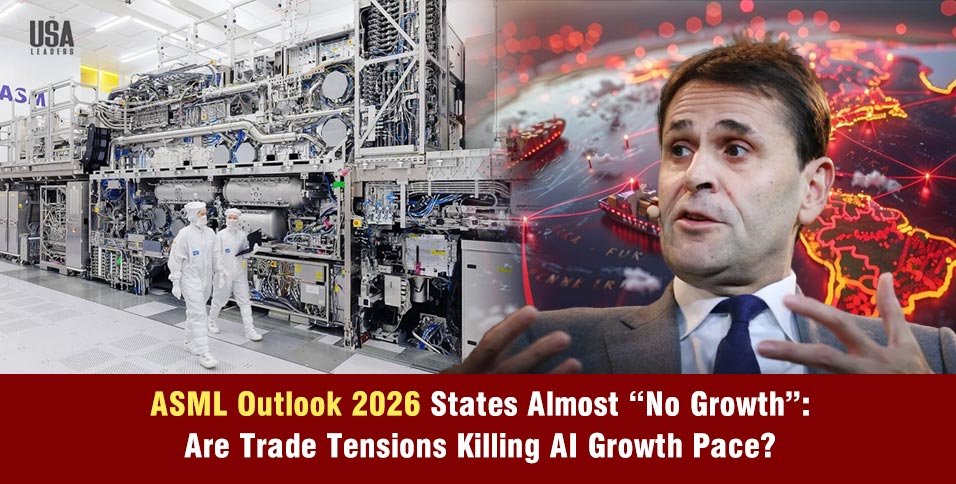


The chips are down—and somehow, they’re way up. Dutch lithography titan ASML just ripped up its 2026 forecast like a losing lottery ticket and handed investors a fresh one printed on pure AI gold. Overnight, the company hiked its mid-decade revenue target by roughly 30 %, hinting at a silicon tsunami that could make the current ChatGPT-fuelled frenzy look like a warm-up act. Translation: every startup dreaming of custom AI silicon, neural-network fridges, or sentient toasters just got a three-year green light to go wild, because the machines that print the brains of those machines are about to be in blistering demand.
ASML’s pivot isn’t some bean-counter’s spreadsheet fantasy. It’s the direct result of hyperscalers, auto giants and a thousand under-the-radar AI darlings stampeding toward bleeding-edge nodes. The only way to cram more transistors onto a fingernail-sized wafer is to use ASML’s extreme-ultraviolet (EUV) printers—room-sized beasts that cost more than a Beverly Hills mansion and are about as easy to buy as a private lunch with Beyoncé. With AI workloads doubling every six months and custom accelerators popping up like Spotify playlists, ASML’s order book is starting to look like the guest list for the Vanity Fair Oscar party: oversubscribed and outrageously lucrative.
A New Silicon Gold Rush—And ASML Sells the Pickaxes
Let’s be honest: most of us can’t tell a FinFET from a fishnet, but we all understand scarcity. ASML has it in spades. Only a few dozen of its next-gen High-NA EUV machines will roll off the line before 2026, each one capable of printing transistors so small you need an electron microscope just to gossip about them. Foundries are already jockeying for slots like Swifties battling for Eras Tour tickets. TSMC, Samsung and Intel have collectively pledged north of $200 billion in new fabs, and every single dollar of that CapEx eventually trickles up to Veldhoven, where ASML’s engineers are basically printing money by printing features.
For startups, this is the rare macro trend that feels almost too good to be true. AI chip designers no longer need to beg venture firms to fund a full node shrink; they can piggyback on the big dogs’ capex cycles and still get first-class silicon. Graphcore, Cerebras, Tenstorrent and a stealthy slew of ex-Apple, ex-Google teams are all racing to tape out 2 nm-class designs that will ride TSMC’s N2 node—enabled, of course, by ASML’s latest light shows. The Dutch company’s upgraded forecast is essentially a pre-order for an entire generation of AI hardware unicorns.
From Datacenter to Driveway: AI Everywhere Needs EUV Everywhere
The 2026 story isn’t just about hyperscalers stuffing more GPUs into black-box server halls. It’s about AI leaking into every crevice of consumer life: phones that generate movies in real time, EVs that learn your commute better than you do, AR glasses that translate street signs before your jet-lagged brain can blink. Each of those verticals craves specialized silicon that only EUV can birth. ASML’s new numbers bake in automotive, edge and mobile AI growing at 40 % CAGR—segments that barely registered on the company’s radar two years ago.
Startups salivating over the edge-AI pie should note the knock-on logistics. Securing capacity at an advanced foundry increasingly means locking in ASML tooling slots years in advance. Translation: if you’re a 12-person team in a Palo Alto WeWork hoping to sample 1.4 nm chips in 2026, you’d better start courting foundry partners yesterday. The silver lining? Foundries are themselves launching “AI accelerators” programs—shuttle runs, MPW (multi-project wafer) services and cloud-based design kits—so smaller teams can hitch a ride on ASML’s photonic coattails without shelling out the GDP of Luxembourg.
And then there’s geopolitics—because nothing spices up a supply-chain story like a U.S.-China tech cold war. Washington’s export bans have effectively made ASML’s most advanced machines contraband for Chinese fabs, tightening global supply even further. While that squeeze keeps ASML’s pricing power red-hot, it also pushes Chinese startups toward domestic alternatives, spawning a parallel ecosystem of “good-enough” litho tech that could undercut margins by decade’s end. For now, though, the West’s AI startup scene gets first dibs on the good stuff, and ASML’s revised forecast bakes in a premium for strategic scarcity.
Money Talks: ASML’s New Math
Numbers time: ASML now projects 2026 revenue of €44–60 billion, up from the prior €30–40 billion range. Gross margin is slated to hit 56–60 %, a full 400 basis-point jump that would make luxury-goods CEOs blush. Free cash flow could top €20 billion—enough to buy every startup in Y Combinator’s next batch and still have change for a small moonshot. Investors responded by pushing ASML’s market cap past Samsung’s, making it the most valuable tech firm outside the U.S. and handing the Dutch government a geopolitical trump card.
Behind those digits lies a subtle but seismic shift: ASML is no longer a cyclical equipment vendor tethered to smartphone upgrade cycles. It has become a structural AI infrastructure play, more akin to Nvidia than to Applied Materials. That’s why venture funds are quietly re-rating EUV-exposed startups—EDA tool makers, new-material plays, in-situ metrology nerds—at double-digit revenue multiples usually reserved for SaaS. If you’re building anything that touches a 2 nm wafer, congratulations: you’ve just been promoted to the hottest tier of venture real estate.
From Fab Floors to Hollywood Sets: How EUV is Shaping the Next Wave of Entertainment
When you see a blockbuster’s CGI‑laden battle scene or a streaming platform’s hyper‑realistic avatar, you’re looking at the downstream magic of ASML’s lithography. The Ministry of Economic Affairs and Climate Policy, treats export licences for EUV tools as a matter of national security, much like a Hollywood studio guards its script vaults. This “silicon curtain” has forced the U.S. and its allies to double‑down on domestic fabs, sparking massive subsidies for chip projects in Arizona, Texas, and even New Mexico.
Meanwhile, the European Union’s European Chips Act earmarks billions for next‑generation lithography, positioning the continent as a counterbalance to the Asia‑Pacific dominance of TSMC and Samsung. The cultural narrative is shifting: the next “Silicon Valley” may be a hybrid of Veldhoven’s cleanrooms and the creative studios of Berlin, where engineers and storytellers co‑write the future of immersive media.
Talent, Trends, and the “EUV Celebrity” Phenomenon
Just as actors become household names, the engineers behind High‑NA EUV are turning into the tech world’s A‑list. Universities are now offering “Lithography Arts” majors, and conferences are packed with keynote speakers whose slide decks get the same hype as a Grammy‑winning performance. The buzz is palpable enough that a recent Netflix docu‑series, “Silicon Dreams,” is slated to profile the lives of ASML’s design team, blending the drama of a reality show with the intrigue of a spy thriller.
From a trend‑spotting perspective, three forces are converging:
| Trend | Impact on Entertainment | Key Driver |
|---|---|---|
| AI‑Generated Content | Real‑time virtual actors, dynamic storylines | Custom AI accelerators built on High‑NA EUV |
| Immersive Live Events | AR concerts with pixel‑perfect holograms | Low‑latency, high‑bandwidth silicon |
| Personalized Gaming | On‑the‑fly graphics scaling per player | Edge AI chips fabricated with sub‑3nm nodes |
These trends are less about raw horsepower and more about the narrative possibilities they unlock. When a streaming platform can spin up a bespoke AI model in days, writers can experiment with branching scripts that adapt to viewer sentiment—a plot twist that feels as fresh as a surprise cameo.
Conclusion: Why ASML’s Surge Is the Pop Culture Moment We’ve Been Waiting For
ASML isn’t just printing chips; it’s printing the future of the stories we consume. The 2026 outlook upgrade is a cultural signal that the era of “big‑budget only” visual experiences is ending. With High‑NA EUV machines rolling out like limited‑edition sneakers, the next three years will see a cascade of AI‑powered creativity that blurs the line between tech and art. As someone who lives at the intersection of celebrity gossip and silicon gossip, I’m betting that the next red‑carpet buzz will be a director unveiling a film shot entirely on a custom AI chip forged in an ASML cleanroom. The takeaway? When the world talks about “the next big thing,” it’s probably a wafer away, and the headlines will read less “stock surge” and more “Hollywood’s newest star.”