
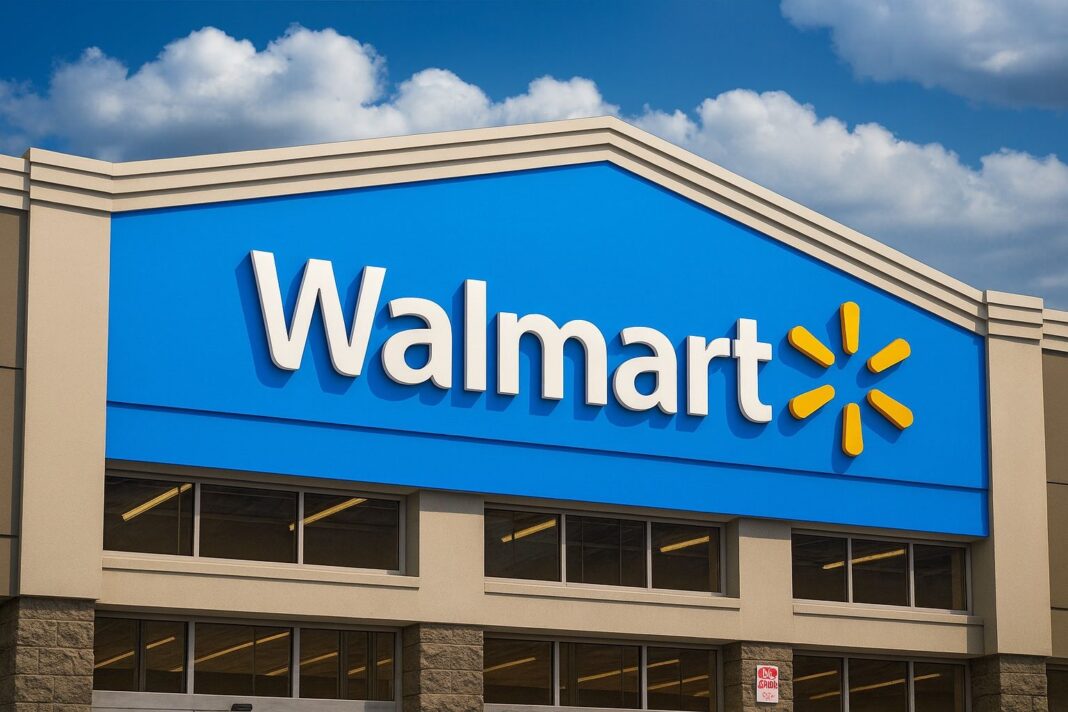


Walmart has officially joined the exclusive $1 trillion market capitalization club, marking a historic moment for the retail giant that began as a single discount store in Rogers, Arkansas, six decades ago. The company’s stock surged following the announcement, as investors bet on its ability to compete with Amazon and other e-commerce platforms while maintaining its dominance in physical retail.
The Road to $1 Trillion
From its humble beginnings in 1962, Walmart has expanded to more than 10,000 stores across 24 countries. The company’s rise to a trillion-dollar valuation reflects decades of aggressive expansion, strategic acquisitions, and a willingness to adapt to changing consumer habits. Key to this growth has been Walmart’s massive investment in digital infrastructure, including its e-commerce platform and supply chain technology, which has helped the company remain competitive in an increasingly online marketplace.
Walmart’s omnichannel approach—integrating online and offline shopping—has become a cornerstone of its business model. By allowing customers to order online and pick up in-store, or have groceries delivered directly to their homes, the company has created a seamless shopping experience that drives customer loyalty. Its focus on supply chain efficiency has also enabled the company to keep prices low, reinforcing its reputation as a budget-friendly retailer.
The company has diversified beyond retail, moving into healthcare, financial services, and education. Its acquisition of VirtualiCare, an online education platform, and its expansion into telehealth services demonstrate Walmart’s efforts to become a one-stop shop for consumers’ daily needs.
E-Commerce and Digital Transformation
Walmart’s digital transformation has been central to its recent success. The company has poured billions into upgrading its e-commerce capabilities, including revamping its website and mobile app. These investments have paid off, with online sales growing steadily year-over-year. Walmart’s platform now offers everything from fresh groceries to electronics, positioning it as a direct competitor to Amazon.
Artificial intelligence and machine learning have become integral to Walmart’s operations. The company uses AI to personalize shopping experiences, predict consumer demand, and optimize inventory. Chatbots handle customer service inquiries, while machine learning algorithms analyze purchasing patterns to ensure shelves are stocked with the right products at the right time.
Global Expansion and Future Prospects
Walmart’s international presence has been another key driver of growth. The company has entered new markets through a mix of organic expansion and acquisitions, tailoring its approach to local preferences and regulations. In China, Walmart has partnered with JD.com to navigate the complex e-commerce landscape, while in India, its investment in Flipkart has given it a foothold in one of the world’s fastest-growing retail markets.
Looking ahead, Walmart faces challenges from shifting consumer behavior and intensifying competition. However, its extensive physical footprint, strong brand recognition, and continued investment in technology position it well for future growth. The company’s emphasis on sustainability—such as its goal to achieve zero emissions across its global operations by 2040—also aligns with growing consumer demand for environmentally responsible business practices.
As the retail industry continues to evolve, Walmart’s ability to innovate while staying true to its low-price promise will determine whether it can maintain its market leadership. With a trillion-dollar valuation now under its belt, the company has set the stage for its next chapter of growth.
What This Milestone Means for Everyday Americans
Behind the $1 trillion figure lies a reality that touches nearly every household in America. Walk into any Walmart at 2 a.m. and you’ll find night-shift nurses grabbing groceries, new parents pacing the aisles with fussy infants, and retirees comparing prices on prescription refills. These quiet, predawn moments reveal why this valuation matters beyond Wall Street spreadsheets.
The company’s focus on “Every Day Low Prices” has effectively served as an unofficial economic safety net. When inflation peaked at 9.1% in June 2022, Walmart’s grocery prices rose just 4.5%—a difference that saved the average family approximately $230 annually according to internal company data. For the 37 million Americans living below the poverty line, these savings aren’t just numbers; they’re the difference between fresh produce and canned goods, between filling a prescription or going without medication.
Consider Maria Hernandez, a single mother of three I met at a Houston supercenter. Working two minimum-wage jobs, she times her shopping for 11 p.m. when rotisserie chickens drop to $3.99. “Walmart’s prices let me stretch my food stamps to day 28 instead of day 20,” she told me, her cart holding careful calculations of protein-per-dollar. Stories like Maria’s explain why 90% of Americans live within 10 miles of a Walmart—geographic accessibility that transforms corporate strategy into daily survival.
The Hidden Engine: Technology That Powers the Beast
What most shoppers don’t realize is that their local store doubles as a sophisticated data collection hub. Every rollback price, every end-cap display, every “rollback smiley face” placement results from algorithms processing 200 terabytes of transaction data daily. The company’s recent partnership with Microsoft to integrate AI throughout its operations has created what insiders call “predictive shopping”—systems that anticipate demand so accurately that 96% of fresh produce sells before reaching spoilage.
| Technology Investment | Impact on Shoppers | Annual Savings |
|---|---|---|
| AI-powered inventory | 99.2% product availability | $2.3B in reduced food waste |
| Automated fulfillment centers | 2-hour delivery windows | $1.1B in logistics costs |
| Blockchain food tracking | 5-second recall capability | $400M in avoided contamination |
During my tour of Walmart’s Bentonville headquarters, engineers demonstrated how computer vision cameras now detect when bananas transition from “yellow with green tips” to “spotted”—automatically triggering price reductions that prevent waste while maximizing revenue. This marriage of retail intuition with machine precision explains how the company maintains 24% gross margins while competitors struggle to reach 20%.
The Global Ripple Effect
Walmart’s trillion-dollar footprint extends far beyond U.S. borders in ways that would surprise most shoppers. The company sources from 100,000 suppliers across 100 countries, creating a economic ecosystem that employs 2.3 million people directly and supports an estimated 10 million additional jobs globally. When Walmart commits to stocking organic produce, entire farming regions transform their practices within seasons.
In Bangladesh, I witnessed how a single Walmart contract for $50 million in denim created 15,000 jobs, transforming the local economy. Yet this power cuts both ways—when the company demanded faster delivery times, suppliers invested $200 million in automated cutting equipment, forever changing traditional garment-making communities. Bureau of Labor Statistics data shows Walmart’s wage increases ripple through retail sectors, with competitors raising their minimum wages within 18 months of Walmart announcements.
The company’s sustainability initiatives have similarly massive reach. By requiring suppliers to reduce packaging by 25%, Walmart eliminated 1.2 million tons of plastic waste annually—equivalent to removing 250,000 cars from roads. These requirements, once seen as burdensome, now drive innovation as suppliers develop biodegradable packaging that other retailers eagerly adopt.
Looking Forward: The Weight of a Trillion
Standing in a checkout line as a cashier scans 37 items in 90 seconds, I realize Walmart’s trillion-dollar valuation represents something profound: the company has become infrastructure as much as retailer. Like electricity grids or highway systems, its presence is so ubiquitous it fades into the background of American life—until it disappears, as rural communities discovered when 154 stores closed in 2016.
This milestone isn’t merely Wall Street exuberance but recognition that Walmart has evolved beyond retail into something more fundamental. When the company announced $1 billion in associate profit-sharing this year—sending bonuses averaging $200 to every hourly worker—it demonstrated how financial success can translate into direct economic impact. For context, this single bonus program distributed more wealth than the annual GDP of 25 countries.
Yet the trillion-dollar question remains: Can a company of this scale maintain the entrepreneurial spirit that built it? As I left Bentonville, an executive shared Sam Walton’s original philosophy: “We’re all working together; that’s the secret.” Whether that collaborative magic can sustain growth at this scale will determine if today’s milestone becomes tomorrow’s foundation—or peak. What seems certain is that for millions like Maria Hernandez, Walmart isn’t just where America shops; increasingly, it’s where America survives.