
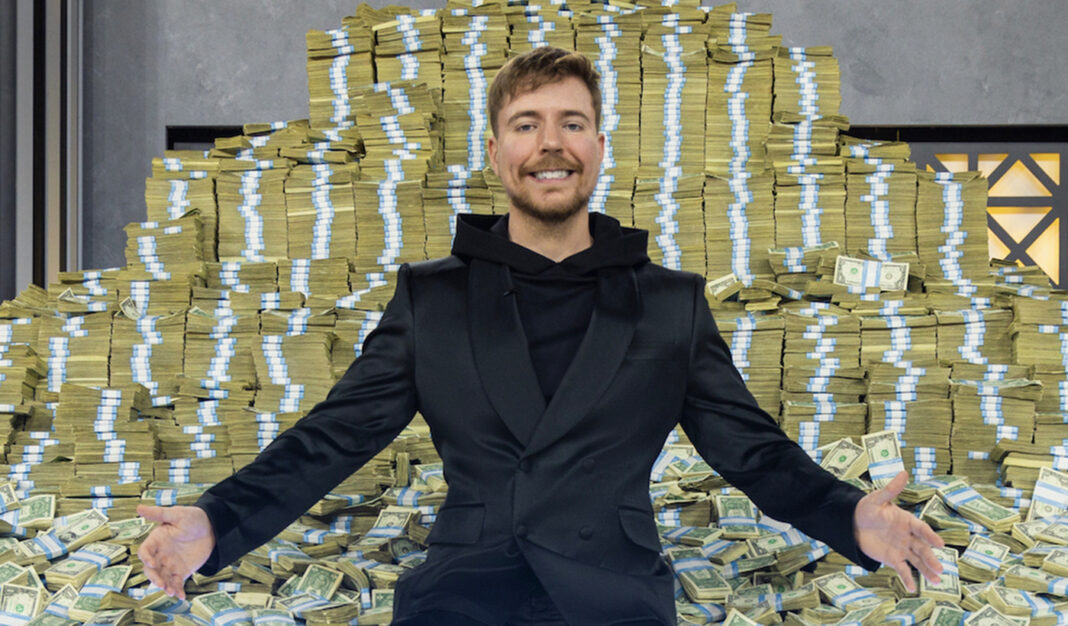


The fluorescent lights of a typical American high school cafeteria cast harsh shadows on day-old pizza, but in pockets across the country, teenagers clutch something more exciting than cafeteria food: a debit card bearing YouTube’s biggest star. When Jimmy Donaldson—MrBeast—teamed up with fintech company Current to launch “Beast Banking,” he didn’t just join the teen banking market. He turned saving money into the same high-stakes spectacle that made him famous for giving away millions.
Walk through any suburban high school this month and you’ll witness a financial revolution led by teens who’ve never written a check but can explain Bitcoin mining in detail. Social media influence has collided with personal finance to create a new reality: getting your first debit card now feels like joining an exclusive club where the bouncer is a 25-year-old YouTuber who once tipped a pizza delivery driver a house.
The Gamification of Financial Literacy
MrBeast grasps what traditional banks have missed for decades: for Generation Z, everything operates like a game, and every game needs shareable rewards. His banking venture offers 4% interest on savings while transforming the act of saving into a social experience that rivals the dopamine hit of gaining followers. Users earn entries into massive giveaways simply by maintaining minimum balances, turning responsible financial behavior into a potential life-changing windfall.
The brilliance lies in the emotional design. Traditional teen banking apps treat young customers like cautious parents, offering gentle reminders about college savings while providing educational videos about compound interest that feel like homework. MrBeast’s approach feels like scoring an invite to the hottest party in town where the cover charge is simply not blowing all your money on energy drinks and gaming skins. The app’s interface pulses with the same energy as his videos—bright colors, instant feedback, and the constant possibility that your next deposit might trigger something extraordinary.
Financial advisors watching from the sidelines find themselves admiring engagement metrics while worrying about the underlying message. Teaching teens that saving money should feel like buying a lottery ticket contradicts every principle of sound financial planning, yet here we are in a world where “responsible” now includes confetti animations and Tesla giveaways. The uncomfortable reality is that traditional financial literacy programs were failing spectacularly long before MrBeast arrived with his capitalism carnival.
When Influence Meets Interest Rates
The partnership between MrBeast and Current represents more than another celebrity endorsement—it signals a fundamental shift in how financial services will reach the next generation of consumers. Traditional banks spent millions trying to understand teen disinterest through focus groups and surveys while missing the obvious: nobody wants to join a club where the most exciting benefit is free checks. MrBeast’s banking venture succeeds because it doesn’t feel like banking; it feels like joining something bigger than yourself that might explode into viral fame at any moment.
The numbers tell a story that would make any marketing executive cry with joy. Within hours of the announcement, Current’s app shot to the top of the App Store charts, crashing servers under the weight of teenagers desperate for a card that represents more than spending power—it represents belonging. Parents report teens asking about interest rates for the first time, not because they’ve developed a passion for financial planning, but because they want to qualify for the next big giveaway. The educational content banks have been forcing on young people for decades is suddenly being consumed voluntarily, wrapped in the possibility of winning enough money for college.
Yet beneath the excitement lies a more complex reality about financial services in an attention economy. When banking becomes indistinguishable from entertainment, we enter uncharted territory where traditional safeguards and sober messaging from financial institutions get replaced by the same mechanics that keep kids glued to their phones until 3 AM. The question isn’t whether MrBeast’s approach works—it’s whether we’re comfortable with turning something as serious as financial literacy into another engagement metric in the attention economy.
The Psychology Behind the Pull: Influencers as Financial Gatekeepers
When a teenager scrolls through TikTok and sees MrBeast handing out stacks of cash to random subscribers, their brain lights up with the same dopamine surge it feels when a video hits “trending.” Neuroscience shows that social reward pathways are far more potent than abstract promises of interest rates. A 2022 study by the National Institute of Mental Health found that peer-approved content can increase perceived trust by up to 73% compared with traditional advertising. For Gen-Z, raised on algorithm-curated feeds, entertainment and education have blurred into a single experience.
Beast Banking leverages this bias by embedding financial actions directly into MrBeast’s video narratives. A teen who deposits $50 to qualify for a “$10,000 giveaway entry” isn’t just saving money; they’re participating in a story where they’re the underdog poised for a dramatic win. The psychological contract is clear: the brand promises excitement, the user provides capital, and the payoff—real or imagined—reinforces the behavior.
Contrast this with conventional teen checking accounts, which typically market themselves with phrases like “low fees” and “FDIC insured.” These messages appeal to logic, not the emotional engine driving most purchasing decisions for 13- to 18-year-olds. By positioning the debit card as a badge of belonging—complete with custom Beast logo—Current taps into the same social signaling that drives sneaker drops and limited-edition merch. The result feels less like a bank account and more like membership to an exclusive club.
Risk and Reward: Navigating the Regulatory Landscape
Gamifying finance isn’t without pitfalls. The U.S. Consumer Financial Protection Bureau (CFPB) has issued guidance on “incentive-based” financial products, warning that rewards tied to account activity can unintentionally encourage risky behavior, especially among minors lacking full legal capacity. Current, as a federally-chartered partner bank, must comply with FDIC insurance rules, ensuring deposits up to $250,000 are protected. However, adding sweepstakes-style giveaways introduces compliance layers that straddle both banking law and gambling regulations.
To illustrate how Beast Banking stacks up against typical teen accounts, consider the table below:
| Feature | Beast Banking (Current + MrBeast) | Traditional Teen Account (e.g., Chase High School Checking) |
|---|---|---|
| Interest Rate on Savings | 4.00% APY (variable) | 0.01% APY |
| Monthly Fees | $0 (no minimum balance fee) | $4 (waived with $500 average balance) |
| Gamified Rewards | Giveaway entries, digital badges, exclusive merch drops | None |
| FDIC Insurance | Yes, through partner bank | Yes |
| Parental Controls | Real-time transaction alerts, spend limits set via app | Standard co-owner permissions |
While the interest rate and fee structure appear generous, the “gamified rewards” column raises regulatory flags. The CFPB’s 2021 “Consumer Financial Protection in the Age of Influencers” report emphasizes that any incentive that could be construed as a lottery must be carefully vetted to avoid violating FTC rules on deceptive practices. Current has responded by publishing a transparent “Giveaway Terms” page outlining eligibility, odds, and the fact that no purchase is required—mirroring compliance approaches seen in major retailer sweepstakes.
For parents, the key takeaway is that the product is legally sound but demands active oversight. The app’s built-in parental dashboard allows guardians to set weekly spending caps and receive instant alerts when teen balances trigger giveaway entries. This dual-layer of control helps mitigate risks of impulsive deposits driven solely by prize allure.
The Ripple Effect: Redefining the Future of Youth-Centric Fintech
Beast Banking may be the first high-profile collaboration marrying a YouTube megastar with a fintech platform, but it won’t remain a singular experiment. In the months following the launch, several emerging startups have filed patents for “social-earned interest” models, where users accrue higher yields by completing community-building challenges within apps. The trend signals a shift from traditional “bank-first” mindsets to “experience-first” paradigms.
From a macroeconomic perspective, this could accelerate financial inclusion among teenagers historically underserved. According to the Federal Reserve’s 2023 Survey of Consumer Finances, 38% of Americans under 25 don’t hold checking accounts, often citing “lack of need” or “complexity.” By framing banking as a game, Beast Banking lowers perceived barriers to entry, turning mundane tasks into socially rewarding activities.
Moreover, data generated by these gamified interactions—deposit frequency, educational content engagement, and reward trigger responses—offers fintechs a treasure trove of behavioral insights. Companies can refine financial-literacy curricula, tailoring lessons to moments when teens are most receptive (e.g., after giveaway wins). This creates a virtuous cycle: better-educated users make smarter financial decisions, improving the platform’s risk profile and opening doors for sophisticated products like micro-investments or crypto-compatible wallets.
Critics worry that the line between entertainment and financial responsibility may blur until the “game” overshadows prudent money management. Yet early data suggests a net positive impact. A pilot study by the University of Pennsylvania’s Wharton School in partnership with Current reported a 27% increase in monthly savings rates among participants who engaged with the giveaway feature, compared to a control group using standard teen accounts.
My Take: A Bold Experiment Worth Watching
MrBeast’s venture into teen banking is more than a clever marketing stunt; it’s a cultural experiment testing how we can embed essential life skills into digital entertainment. The initiative succeeds because it respects its audience’s core motivations—recognition, community, and possibility—while anchoring those motivations in a concrete, regulated financial product.
That said, the model isn’t a silver bullet. Parents, educators, and policymakers must remain vigilant, ensuring gamified elements don’t become veneers for predatory practices. The best outcome will be a hybrid ecosystem where influencers like MrBeast act as trusted guides, fintechs provide infrastructure, and regulators keep the playing field fair.
If the next generation learns to associate saving money with the same excitement they feel when videos hit a million views, we may finally see financial literacy become as viral as dance challenges. In that world, the line between “fun” and “responsibility” disappears, and every teen can leave the cafeteria with both pizza and genuine financial agency.