
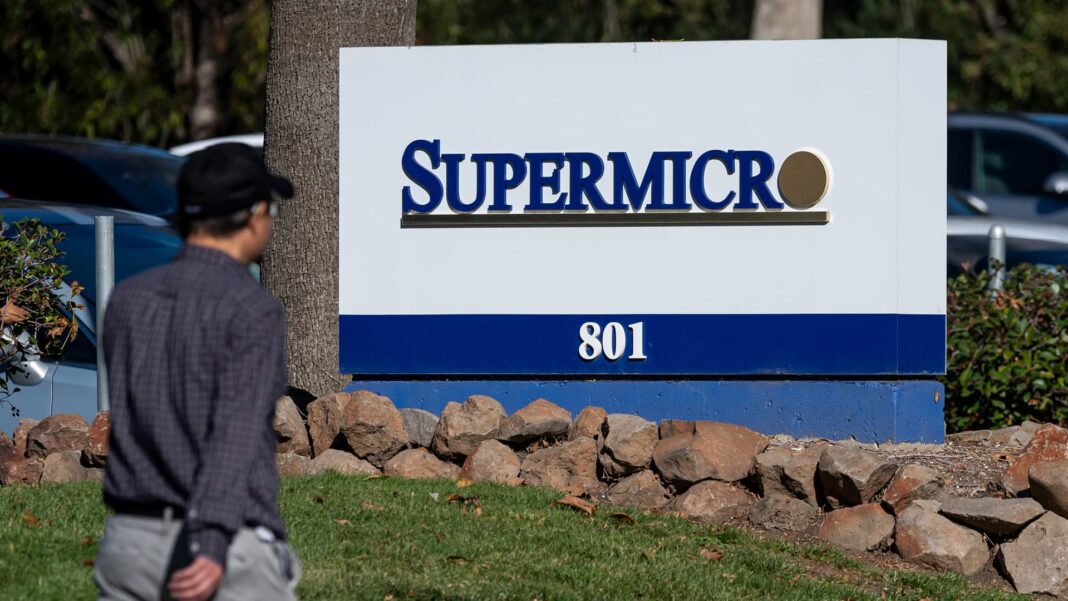


Yih-Shyan “Wally” Liaw, the 71-year-old co-founder of server manufacturer Supermicro, faces federal charges for allegedly orchestrating a $2.5 billion scheme to smuggle Nvidia’s most advanced AI chips to China. Prosecutors claim Liaw constructed an elaborate pipeline that rerouted servers containing restricted GPUs through Southeast Asia, bypassing U.S. export controls that have been tightening since 2022.
The indictment, unsealed Tuesday evening, sent Supermicro’s stock tumbling 12% in after-hours trading, erasing hundreds of millions in market value. For a company that has quietly powered everything from streaming services to AI data centers, the charges represent a stunning reversal that has investors scrambling to assess potential fallout.
The $2.5B Vanishing Act: How the Feds Say It Worked
According to the indictment, Liaw and two co-conspirators moved $2.5 billion worth of Nvidia-powered servers by routing orders through an unnamed Southeast Asian company. The servers would ship to Taiwan first, then be quietly redirected to China—circumventing export bans that prohibit these advanced chips from reaching Chinese customers.
About $510 million worth of servers allegedly completed the journey, delivering restricted Nvidia GPUs to Chinese entities. These chips represent the backbone of modern AI systems, capable of processing the massive computations required for everything from facial recognition to military simulations.
Liaw’s personal exposure adds another dimension to the case. With approximately $464 million in Supermicro stock holdings, according to FactSet, he risked a fortune on an operation that could result in a 20-year prison sentence under the Export Controls Reform Act, plus additional penalties for conspiracy and smuggling charges.
From Server Kingpin to International Fugitive: The Fallout
Supermicro has spent decades as Silicon Valley’s invisible workhorse, manufacturing the motherboards and servers that power Google, Amazon, and countless AI startups. The indictment transforms that narrative overnight, raising questions about whether company culture enabled or ignored these alleged gray-market transactions.
Export-control attorneys expect this case to expand beyond a single indictment. Subpoenas, compliance audits, and potentially massive fines could follow. Washington’s strategy for maintaining AI supremacy depends on keeping advanced chips domestic—if a major supplier appears compromised, regulators will respond aggressively.
The arrest delivers a personal blow to Liaw’s legacy. Co-founders typically embody corporate values and stability; instead, federal agents marched him into a San Jose courthouse, accused of transforming his company into a smuggling operation. With U.S.-China tensions already elevated, this case provides ammunition to those arguing that China’s tech sector systematically evades American sanctions.
Hollywood Couldn’t Script a Better Tech Thriller
The elements are cinematic: clandestine shipments, shell corporations in tropical jurisdictions, a septuagenarian mogul risking everything for one final score. But this isn’t entertainment—it’s the latest development in an escalating technological cold war that could reshape global power dynamics.
Nvidia has already begun tightening serial-number tracking and revamping customer verification, fearing that any appearance of complicity could devastate its China business. Competitors are courting Supermicro customers, offering cleaner compliance records. In the hyperscale data center market, where trust determines contracts, Supermicro’s reputation is hemorrhaging value.
The next phase will reveal courtroom strategies, examine how Hollywood’s visual effects studios—dependent on Supermicro servers—might be affected, and test whether America’s AI chip embargo can ever be truly airtight.
The Great GPU Gold Rush: Why Everyone Wants What America Won’t Sell
Nvidia’s H100 and A100 GPUs represent the oil fields of artificial intelligence. Washington imposed export restrictions in October 2022 because these chips can perform 70-teraflop calculations while consuming just 400 watts—ideal for training the advanced AI models China hopes will surpass American capabilities in everything from missile guidance to deepfake technology.
Black-market sources indicate a single H100 commands 300-400% markup inside China. An 8-GPU Supermicro server retailing for approximately $300,000 in San Jose can exceed $1.2 million on Shenzhen’s gray market—profit margins that allegedly motivated Liaw to jeopardize his $464 million Supermicro fortune.
| Chip Model | Legal U.S. Price | Est. Black-Market Price in China | Performance (FP16) |
|---|---|---|---|
| Nvidia A100 80 GB | $12k | $40k | 312 TFLOPS |
| Nvidia H100 80 GB | $25k | $80k | 989 TFLOPS |
| Nvidia H200 (new) | $35k | $110k | 1.2 PFLOPS |
Smuggling 40-pound servers requires sophisticated logistics. The alleged scheme involved shipping to legitimate Taipei data centers, then swapping labels mid-transit and relabeling freight as “used test equipment” bound for Chengdu recycling facilities. Customs officers saw generic server chassis; China received the high-performance processors hidden inside.
Hollywood Ending or Tragedy? The Fallout for Supermicro and Silicon Valley
Supermicro has operated as Hollywood’s anonymous stylist—essential but invisible. That anonymity vanished overnight. Institutional investors are questioning whether they hold “the next Huawei.” If the Department of Commerce imposes a temporary denial order, Supermicro’s shipments could freeze instantly—the same corporate death penalty that crippled ZTE in 2018.
The larger question concerns how many similar schemes remain hidden. Startup CEOs report that every major contract manufacturer has received “Can you route through Malaysia?” inquiries within the past year. The federal government just fired a warning shot across the entire supply chain; boards are demanding executive sign-offs on every export certificate. The result: extended lead times, inflated server costs, and new opportunities for Nvidia competitors like AMD and Intel who can legally sell to China without equivalent restrictions.
On a personal level, Liaw—the immigrant who arrived from Taiwan with a suitcase and built a server empire—could spend his 70s in federal prison. A conviction on export-violation charges carries up to 20 years plus fines totaling twice the contraband’s value. Even for a centimillionaire, that’s devastating.
Conclusion: The Real Heist Isn’t Just Money—It’s Trust
While $2.5 billion grabs headlines, the actual theft involves something more valuable than cash: the trust that allows Silicon Valley to ship its most advanced technology worldwide without military escorts. Every founder pitching “borderless innovation” now faces export-control scrutiny. Venture capital due-diligence checklists include new questions: “Could your supply chain land you in prison?” Washington’s response will inevitably mean more regulations, more licensing requirements, more headaches for the 99% of companies that never considered smuggling.
Liaw’s indictment represents an “Empire Strikes Back” moment in the ongoing conflict between technology and geopolitics. Just when open commerce seemed capable of unlimited expansion, nation-state politics imposed new constraints. Whether Supermicro survives or becomes a cautionary tale, the AI gold rush has encountered its first major blood feud—and the industry is still waiting for the next chapter to load.