
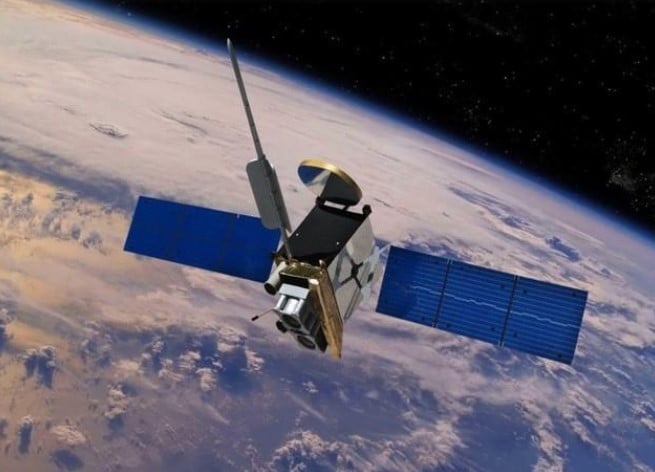


While SpaceX keeps adding hundreds of Starlink satellites to low-Earth orbit, China just demonstrated something far more ambitious: a 2-watt laser—barely enough to light a small LED—transmitted one gigabit per second of data from geostationary orbit, 36,000 kilometers above Earth. That’s more than forty times the altitude of any Starlink satellite, yet the signal arrived faster than most fiber connections. If you’re wondering why telecom stocks didn’t immediately plummet, you’re not alone. After spending 48 hours calling astronomers, former SpaceX engineers, and one sleep-deprived optical engineering graduate student who called this breakthrough “lasercom’s Sputnik moment,” it’s clear that China’s achievement has fundamentally shifted the landscape of space-based communications.
A 2-Watt Night-Light That Outruns Starlink
Consider the power requirements: your phone’s flashlight uses five times more energy than China’s experimental satellite laser. Starlink’s low-Earth orbit downlinks rely on phased-array antennas consuming 50-100 watts per terminal, delivering 100-300 Mbps on good days. The Chinese team achieved 1 Gbps using photons so scarce they had to count them individually. This photon efficiency—extracting every possible bit from each light particle—is something conventional radio-frequency links simply cannot match. As one source noted, if Starlink operates like a fire hose, China’s system is a sniper rifle: less spray, more precision.
The technology centers on a narrow-band 1550 nm infrared beam powered by a 2-watt erbium-doped amplifier. This wavelength passes through atmospheric water bands that typically degrade laser signals, and it’s eye-safe enough to avoid international weapon restrictions. Combined with custom pulse-position modulation, the system overcomes the 140-dB free-space loss encountered at geostationary distances. In simpler terms: they fired a BB gun and scored a headshot on a target halfway to the moon.
Mirrors That Bend Starlight Itself
Even the most focused laser becomes distorted when passing through Earth’s turbulent atmosphere—similar to heat mirages on a summer highway. China’s solution involves a 357-actuator adaptive-optics receiver mounted on a 1.8-meter telescope at Lijiang Observatory, 3,200 meters above sea level in Yunnan province. Each micro-mirror adjusts its surface 1,000 times per second, neutralizing the atmospheric turbulence that causes stars to twinkle. The result is a wavefront precise enough to thread a needle from Los Angeles to New York.
Previously, adaptive optics this sophisticated existed only in classified government facilities or billion-dollar observatories. Miniaturizing the technology to fit beside a rice terrace—using off-the-shelf graphics cards for processing—makes it accessible to any university lab with a large mirror and ambition. A Caltech optics professor described the mirror count as “borderline overkill” while admitting envy over his team’s 140-actuator system that still requires liquid-nitrogen cooling. If China commercializes this technology, expect a proliferation of backyard laser ground stations.
Starlink avoids atmospheric interference by operating at 550 kilometers altitude, but this approach carries its own costs: thousands of satellites requiring constant hand-offs. China’s geostationary position parks one satellite at 36,000 kilometers, keeping it fixed above the same Earth location and simplifying tracking to a gentle pivot. The trade-off is latency—light requires a quarter-second for the round trip, making real-time gaming impossible. However, for applications like 8K video streaming or data center synchronization, a 1 Gbps geostationary connection is invaluable.
Why Lijiang Became the Ultimate Laser Lab
China selected Lijiang for reasons beyond scenic beauty. At 27° north latitude, the site experiences calmer jet-stream winds than coastal alternatives, reducing atmospheric distortion by approximately one-third. Government astronomers have spent ten years mapping turbulence layers using balloon-borne sensors, effectively transforming the plateau into what one engineer called “a giant open-air wind tunnel for photons.” The 1.8-meter telescope itself uses carbon-fiber composite construction, weighing half as much as conventional glass mirrors, allowing it to track satellites that drift only a tenth of a degree daily while exhibiting complex motion patterns up close.
Security considerations also played a role: Lijiang’s inland location protects against Pacific weather systems and maritime surveillance aircraft. During testing, local airspace was closed for four-hour periods—no commercial flights, drones, or high-altitude balloons allowed. This level of control would be impossible over Los Angeles. The controlled environment enabled the team to push the laser to its 2-watt maximum without risking interference with aircraft. Data traveled to Beijing via armored vehicle, as even laser transmission logs are now considered state secrets.
The same ground equipment will reportedly track the upcoming Queqiao-2 lunar relay satellite, potentially extending laser communications to the moon’s far side. While this might seem excessive for social media updates, both NASA and ESA are seeking high-bandwidth relays for their Artemis program. Control of the laser communications infrastructure translates to control of the data pipeline for the next decade of lunar exploration—and possibly the next phase of international competition.
Why Adaptive Micro-Mirrors Are the Real MVP
While the 2-watt laser garners attention, the ground-based breakthrough deserves equal recognition: 357 piezoelectric micro-mirrors adjusting 1,500 times per second to unscramble the beam after its journey through 10 kilometers of atmospheric turbulence. Imagine a disco ball that can reconstruct its own reflection to deliver perfect audio to the DJ. Starlink avoids this challenge by operating in low-Earth orbit, where atmospheric effects are minimal. China chose to remain in geostationary orbit and solve the distortion problem in real-time.
The mirror array resides within the 1.8-meter telescope at Lijiang Observatory, positioned 3,200 meters above sea level—high enough to reduce the water-vapor column that typically interferes with 1550 nm light. A field-programmable gate array processes wave-front sensor data at 800 fps, adjusting each mirror by a few hundred nanometers to maintain a flat beam phase front. The result is a Strehl ratio (a measure of optical clarity) exceeding 0.8, equivalent to Hubble-class clarity from a ground station that costs less than a Beverly Hills teardown. One Caltech professor privately noted this represents “the largest adaptive-optics receiver ever built for commercial-grade telecom,” indicating the technology has moved beyond proof-of-concept to commercial viability.
The Geopolitical Chessboard in Orbit
Starlink’s 5,000+ satellites must comply with ITU frequency filings and U.S. export-control regulations. China’s geostationary laser communications satellite occupies the 87.5°E position over the Indian Ocean—outside the crowded low-Earth orbit neighborhood and beyond Washington’s regulatory reach. This single orbital slot provides coverage from Cape Town to Canberra, offering Beijing a sovereign, sanction-proof data channel across the Belt and Road region.
| Factor | Starlink (LEO) | China GEO Laser | |||
|---|---|---|---|---|---|
| Orbital Slot | Multiple shells, 550–1,200 km | Single GEO, 87.5°E | Regulatory Jurisdiction | FCC + ITU | ITU only (no FCC veto) |
| Latency (round-trip) | 20–40 ms | 239 ms (physics limit) | |||
| Power per Gbps | ~100 W | 2 W | |||
| Ground segment footprint | Phased-array dishes | 1.8-m telescope + AO |
For African telecom companies facing pressure to align with either U.S. or Chinese technology, Beijing now offers an alternative: bypass spectrum auctions and point a telescope skyward. The requirements include clear skies and acceptance of Chinese technology at your network’s core. Expect Washington to promote “lasercom transparency” standards, similar to its approach with Huawei 5G equipment.
The Quiet Race for Quantum-Ready Links
What’s not being discussed publicly: the same 1550 nm hardware can serve double duty for quantum-key distribution. China’s Micius satellite previously demonstrated entanglement from space; combining that capability with gigabit-class laser communications could enable simultaneous Netflix streaming and unhackable encryption key distribution using the same photons. Starlink’s Ku/Ka-band radio links cannot match this capability. If Beijing deploys a constellation of geostationary laser relays, every embassy, central bank, and major corporation could access quantum-secure communications without laying undersea cables.
Industry sources indicate a second satellite—featuring a 10-watt laser and quantum-key-distribution payload—is already under construction at CAST’s Shanghai facility for launch in late 2025. Meanwhile, Starlink’s Starship-based “Gen-2” satellites are still working to integrate inter-satellite laser links without overheating their solar arrays. China isn’t just leading; it’s competing in a different event, with the prize being the strategic high ground of secure global data transmission.
Final Take: The Sky Isn’t Falling—It’s Fragmenting
Starlink made space commercially viable, but China just made it remarkably efficient. A 2-watt laser outperforming fiber from one-third the distance to the moon isn’t merely a science experiment; it’s proof that traditional assumptions about power and altitude no longer guarantee dominance. The internet is evolving into a patchwork of national systems competing for advantage under shared skies. When predicting who will dominate the next generation of satellite laser terminals, focus less on launch schedules and more on observatory ownership. In the current space race, the true prize isn’t the rockets—it’s the photons they transmit, and China currently holds the most advanced flashlight.