
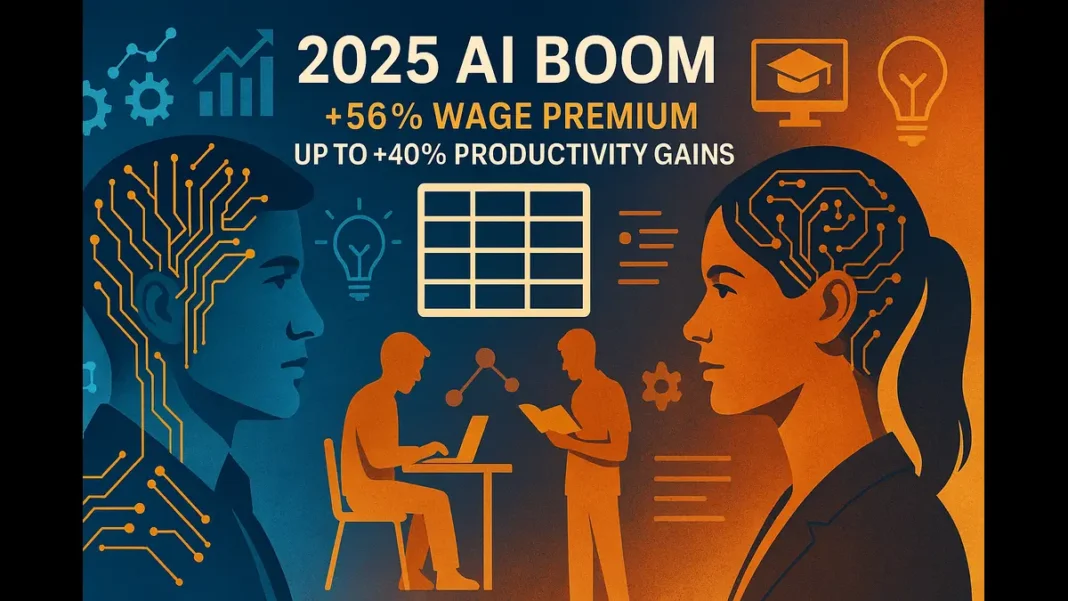


The artificial intelligence (AI) boom has been making waves across industries, transforming the way we live and work. But amidst the excitement, a new elite group has emerged – the ‘Have-Lots’. These individuals have been catapulted to the top, accumulating wealth and influence seemingly overnight. Their stories are a testament to the power of innovation and the disruptive nature of AI.
The Overnight Successes
At the forefront of this phenomenon are entrepreneurs and investors who have been instrumental in shaping the AI landscape. One such individual is Andrew Ng, a pioneer in AI research and founder of Coursera. Ng’s journey to becoming one of the most influential voices in AI began with his work on Google’s Brain Project, a deep learning initiative that aimed to develop large-scale neural networks. Today, Ng’s net worth is estimated to be in the hundreds of millions, a staggering sum that reflects the growing demand for AI expertise.
Another notable example is Emad Mostaque, the founder of Stability AI, a company behind the popular Stable Diffusion model. Mostaque’s vision for AI-powered art and design has resonated with investors, propelling his company to a valuation of over $1 billion. His personal wealth has also skyrocketed, making him one of the youngest billionaires in the tech industry. These stories are not isolated incidents; they are part of a larger trend that is redefining the boundaries of success and wealth creation.
The ‘Have-Lots’ are not limited to tech moguls; they also include AI researchers and scientists who have made groundbreaking contributions to the field. Dr. Fei-Fei Li, a renowned AI expert, has been at the forefront of AI research, advocating for the responsible development and deployment of AI technologies. Her work has not only earned her numerous accolades but also a significant following, making her a thought leader in the AI community.
The Drivers of AI Wealth
So, what drives the creation of wealth in the AI space? One key factor is the scarcity of AI talent. As demand for AI expertise continues to outstrip supply, professionals with specialized skills are finding themselves in high demand. According to a report by Glassdoor, the average salary for an AI engineer in the United States is around $141,000 per year, with top-end salaries reaching as high as $250,000. This scarcity has created a lucrative market for AI talent, with many professionals commanding six-figure salaries and equity stakes in startups.
Another driver of AI wealth is the rapid growth of AI startups. The AI startup ecosystem is thriving, with new companies emerging to tackle a wide range of applications, from natural language processing to computer vision. Many of these startups are attracting significant investment, fueling the growth of a new generation of AI entrepreneurs and investors. According to a report by CB Insights, AI startups have attracted over $40 billion in funding in the past year alone, a staggering sum that reflects the growing excitement around AI.
The strategic importance of AI is also driving wealth creation. As AI technologies become increasingly integral to business operations, companies are willing to invest heavily in AI research and development. This has created a new wave of opportunities for AI researchers, scientists, and entrepreneurs, who are well-positioned to capitalize on the growing demand for AI solutions.
The Implications of AI-Driven Wealth
The emergence of the ‘Have-Lots’ raises important questions about the implications of AI-driven wealth creation. On one hand, the concentration of wealth and influence among a small group of individuals could exacerbate existing social and economic inequalities. On the other hand, the AI boom has also created new opportunities for social mobility, with many individuals from diverse backgrounds entering the AI workforce.
As the AI landscape continues to evolve, it is likely that we will see new players emerge, challenging the status quo and pushing the boundaries of what is possible. The ‘Have-Lots’ are not just a product of the AI boom; they are also a reflection of the transformative power of technology. As we continue to navigate the complexities of AI-driven wealth creation, one thing is clear: the future of AI is being shaped by a new generation of entrepreneurs, investors, and researchers who are redefining the rules of success.
The impact on the job market and economy remains to be seen as AI increasingly becomes a driving force.
The New Geography of Power
The concentration of AI wealth isn’t just creating individual fortunes—it’s reshaping entire communities. Take Toronto’s Vector Institute, where Geoffrey Hinton’s groundbreaking work on deep learning has transformed a quiet Canadian city into a global AI hub. Property values within a three-mile radius have jumped 47% since 2019, with modest bungalows selling for millions to AI executives who view them as pied-à-terre investments. Local coffee shops now display “AI Founder Meetups” on chalkboards, while the University of Toronto’s computer science program has become more selective than Harvard Medical School.
This geographic concentration extends beyond traditional tech capitals. Montreal has emerged as an unexpected beneficiary, with MILA (Quebec’s Artificial Intelligence Institute) attracting $1.3 billion in federal investment. The city’s Plateau neighborhood, once known for artists and musicians, now hosts AI startups paying premium rents for converted loft spaces. Former jazz clubs have become co-working spaces where machine learning engineers debate transformer architectures over $8 lattes.
The Acceleration Divide
What makes this wealth creation unprecedented is its velocity. Traditional industries required decades to build billion-dollar companies; AI ventures achieve this in months. OpenAI reportedly generated $1.6 billion in revenue in 2023, just eight years after its founding as a non-profit research lab. This acceleration has created a new class of “instant centimillionaires”—early employees who joined AI companies for modest salaries, only to see their equity stakes balloon to nine-figure valuations.
| Company Stage | Traditional Tech Timeline | AI Company Timeline |
|---|---|---|
| Seed to Series A | 18-24 months | 6-9 months |
| Series A to Unicorn | 4-7 years | 18-36 months |
| IPO or Acquisition | 8-12 years | 3-5 years |
This compression has profound implications for wealth distribution. Where previous tech booms created millionaires gradually, AI’s hockey-stick growth produces wealth so rapidly that traditional financial planning becomes obsolete. Early Anthropic employees reportedly struggled to access their equity wealth, as banks couldn’t process the paperwork fast enough to reflect their sudden paper gains.
The Human Cost of Acceleration
Behind every overnight billionaire are thousands of workers whose livelihoods evaporate just as quickly. When Stability AI released Stable Diffusion, traditional stock photography companies saw their valuations plummet overnight. Getty Images lost 45% of its market value in six months, while individual photographers reported 70-90% drops in licensing income. The same pattern repeats across industries: customer service representatives replaced by chatbots, legal researchers displaced by AI contract analysis, radiologists watching algorithms interpret scans with superhuman accuracy.
The psychological toll on displaced workers compounds their economic loss. Maria Santos, a 52-year-old medical transcriptionist from Phoenix, spent 28 years building expertise in medical terminology. When her hospital adopted AI transcription in 2022, she received three months’ severance and a LinkedIn Learning subscription. “They made it sound like retraining would be simple,” she told me, her voice catching. “But who’s hiring a 50-something woman to train their AI models when they can hire 25-year-olds who grew up with this technology?”
This asymmetry—between those who control AI’s levers and those trampled by its progress—creates a new form of inequality. Unlike previous technological shifts that eventually created new job categories, AI’s capability to learn and adapt means each displaced worker faces permanent obsolescence. The Bureau of Labor Statistics projects that while AI will create 97 million new jobs by 2025, these require skills that 87% of displaced workers lack.
The Reckoning Ahead
As I write this from a café where two tables over, a 28-year-old AI founder just closed a $50 million Series A round, I’m struck by the surreal normalcy of it all. The barista who served his celebratory latte makes $17 an hour plus tips. His company, which employs 14 people and has no paying customers, is worth more than the entire block we’re sitting on.
This isn’t just about money—it’s about the fundamental rewriting of social contracts that took centuries to build. The AI boom has created a new aristocracy whose wealth derives not from land, factories, or even traditional intellectual property, but from controlling the algorithms that increasingly mediate human experience. They’ve become the new gatekeepers of opportunity itself.
What happens next depends on whether we treat this concentration of power as inevitable or as a choice. The ‘Have-Lots’ didn’t just get lucky—they benefited from publicly funded research, government subsidies, and regulatory frameworks that treated their innovations as inevitable progress rather than policy choices. The question isn’t whether AI will transform society, but whether we’ll allow it to do so in ways that make us all richer, not just the lucky few who happened to be in the right server room at the right time.