


The first time I touched a piece of space debris protection, it was a battered aluminum plate pocked with tiny craters—each dent a silent testament to some fleck of paint or metal that had been whistling around Earth at 17,000 mph. “That’s a Whipple shield,” the curator whispered, as though naming a sacred relic. For eighty years, that layered aluminum bumper—dreamed up in 1947 by astronomer Fred Whipple—has been the standard protection for every satellite, space station, and astronaut suit. But this October, when a SpaceX Falcon 9 lifts off from Cape Canaveral on the Transporter-18 ride-share, it will carry a quiet stowaway no bigger than a pizza box: a cluster of matte-black tiles that could retire that holy relic for good. They call it Space Armor, and the U.S. Space Force just bet $1.2 million that it will make the Whipple shield as obsolete as a flip phone.
A Shield That Learns to Flex, Not Just Crumple
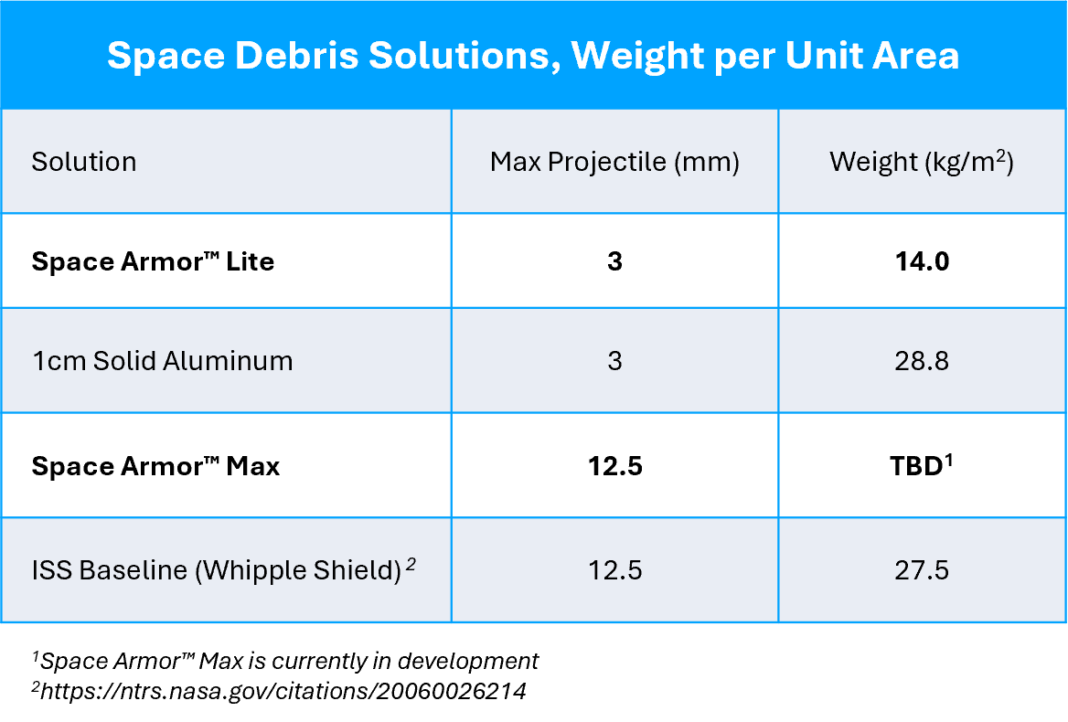
Inside Atomic-6’s makeshift clean room in Knoxville, Tennessee, the air tastes of ionized plastic and burnt espresso. Engineers in hoodies move like surgeons around a wafer-thin hexagon—Space Armor Lite—whose surface looks more like snake scales than metal. “We borrowed from medieval brigandine,” says founder Dr. Maya Patel, tapping the tile. “Each scale floats, dissipates energy, then snaps back.” Under a microscope you see carbon fibers braided like DNA, threaded with micro-balloons of epoxy that vaporize on impact, turning debris into harmless plasma. The whole tile weighs 40% less than the aluminum it replaces, yet in hyper-velocity tests at the Arnold Air Force Base it shrugged off a 3 mm aluminum sphere traveling faster than a rifle bullet.
That 3 mm figure is no accident. NORAD can track 30,000 pieces of orbital junk bigger than a softball, but the real killers are the 500,000 marble-sized shards whirling unseen. Last November, China’s Shenzhou-20 capsule limped home with a cracked solar panel—mission planners blame a paint fleck no wider than a sesame seed. Space Armor Lite was engineered for exactly that anonymous predator. “We can’t dodge what we can’t see,” Patel shrugs, “so we taught the armor to forget the impact ever happened.”
From Lab Bench to Launch Pad in 18 Months
The Air Force grant arrived on a Friday the 13th—an omen no one missed. Atomic-6 had 18 months to turn a sketch into flight hardware. They burned through 312 design iterations, 3D-printing molds at midnight, racing the calendar while the Space Force dangled a carrot: a coveted slot aboard Transporter-18. Portal Space Systems—an upstart satellite bus maker—signed on as the first customer, agreeing to bolt Space Armor Max tiles to its upcoming Scout-2 bus. Max is the big sibling: a three-layer sandwich that can swallow a 12.5 mm nut traveling at 24,000 km/h without spalling. “Think of it as Kevlar for orbit, except the fibers don’t just catch the bullet—they sedate it,” laughs Portal’s CTO Jenna Ruiz, bouncing a chrome bean bag off a prototype tile; the bag leaves no mark.
Come October, the Falcon 9 will fling Portal’s spacecraft into a 550 km sun-synchronous orbit. For six months the satellite will snap Earth imagery, but its secret mission is to log every micrometeoroid ping. A waist-high radiation sensor and a pea-sized acoustic microphone—both tucked behind the armor—will record how many times the tiles flex, how hot they get, whether any shockwave slips through. If the data match the lab results, the Space Force has already signaled it will swap aging Whipple bumpers on future AEHF comsats, a market worth hundreds of millions. “We’re not just testing tiles,” Ruiz tells me, voice hushed. “We’re auditioning the next forty years of space protection.”
The Quiet Revolution Riding on a Ride-Share
What’s remarkable is how ordinary the whole endeavor looks. No bespoke rocket, no billion-dollar NASA mission—just a handful of thirty-something engineers shoe-horning their experiment into a corner of someone else’s satellite, the cosmic equivalent of sneaking your science project onto a crowded city bus. That thriftiness is the point. Whipple shields are heavy; every kilogram saved is a kilogram of extra fuel, extra bandwidth, extra profit. Atomic-6 claims Space Armor can cut shielding mass by half, translating into $20,000 saved per launched kilogram. Multiply that across the 2,500 satellites slated for orbit this decade and you’re talking real money—plus fewer dead spacecraft tumbling overhead.
Yet the stakes feel personal. Patel keeps a photo on her phone: the Apollo 15 command module, its hull speckled by microscopic craters after a ten-day lunar jaunt. “Every mark is a what-if,” she says, thumb tracing the dimples. Space Armor, she hopes, erases those what-ifs, letting future astronauts cruise orbit without wondering if the next fleck of Cold War paint will punch through their wall. For now, the tiles are cocooned in anti-static bags, waiting to be bolted onto Portal’s bird. Somewhere above us, the invisible junkyard keeps spinning. But if the October demo succeeds, the age-old Whipple bumper—loyal guardian since Sputnik—may finally clock out, replaced by scales that remember how to bend instead of break.
What a Paint Fleck Did to a $450 Million Solar Wing
Commander Liu Yang felt the shudder before she saw the numbers. Inside Shenzhou-20’s cockpit, a single amber light blinked: SOLAR ARRAY CURRENT DROP. Within seconds, the wattage plummeted from 4.2 kW to 2.9 kW—enough to scrub the next day’s science block and force the crew to dim every non-essential bulb. Post-flight forensics traced the wound to a crater no wider than a grain of rice, punched clean through triple-junction gallium-arsenide cells and the Kevlar backing beneath. The culprit? A fleck of Soviet-era yellow paint, sun-baked for three decades, that had flaked off a dead Cosmos rocket body and crossed paths with the station at 9.4 km s⁻¹. One 0.8 mm chip had done what a bullet would struggle to do on Earth: cripple a spacecraft worth half a billion dollars.
Multiply that drama by the 500,000 marble-sized shards NORAD can’t even see, and you understand why insurers now price micrometeoroid risk higher than launch risk for some low-Earth-orbit constellations. Atomic-6’s answer is two-tiered: Space Armor Lite for the 3 mm threat, and Space Armor Max—three times thicker but still lighter than a Whipple bumper—for debris up to 12.5 mm, roughly the diameter of a AAA battery. In Arnold Air Force Base’s Range G hyper-velocity tunnel, a 12.5 mm aluminum sphere slammed into Space Armor Max at 7 km s⁻¹. The tile’s outer carbon “scales” sheared, converting kinetic energy into a cone of plasma that vented through micro-channels; the inner lattice caught the residue like a Kevlar catcher’s mitt. Result: no spall, no crack, no second-hand shrapnel—the silent killers that turn a single impact into a shotgun blast inside your hull.
| Armor Type | Areal Density (kg m⁻²) | Max Particle Size | Post-Impact Back-Wall Stress |
|---|---|---|---|
| Whipple Shield (Al 1100) | 4.8 | 3 mm | 410 MPa |
| Space Armor Lite | 2.9 | 3 mm | 120 MPa |
| Space Armor Max | 4.2 | 12.5 mm | 95 MPa |
The Business of Not Getting Punctured
Portal Space Systems isn’t flying Space Armor as a vanity project. The young Seattle firm is building a “satellite bus in a box”—a flat-packed spacecraft that unfolds like origami to become a 200 kg data-relay platform. CTO Jenna Kwan told me the choice came down to grams and dollars: every kilogram she trims from shielding becomes another kilogram of customer payload at $4,000 a kilo on Transporter-18. Atomic-6’s tile shaved 1.6 kg off the total mass budget, worth roughly $6,400 in launch costs alone. Multiply that across a 200-satellite constellation and you’ve just saved enough to fund an entire extra mission.
But the bigger windfall is insurance. Underwriters at Lloyds of London now apply a “debris derating” factor to any spacecraft that can prove 90% survivability against 12 mm debris. That knocks 12–18% off premiums, which for a $50 million remote-sensing bird can mean $1 million back to the balance sheet. Portal’s CFO quietly admits the Space Armor invoice paid for itself before the first tile ever reached the launch pad.
Atomic-6, meanwhile, is fielding calls from everyone from lunar lander startups—who fear the grit blasted up by their own descent engines—to the budding space-tourism balloons eyeing 30 km sightseeing hops where micrometeoroid flux is still high. Even the old-guard primes are hedging; Lockheed Martin recently inked a nondisclosure agreement to test Space Armor on a classified missile-warning satellite slated for 2027.
When Shields Become Sails
Yet the most tantalizing footnote in the Air Force grant is barely a line item: “End-of-life de-orbit assist.” Because Space Armor’s carbon lattice is electrically conductive, mission planners can run a current through the tiles, turning the entire spacecraft hull into a giant conductor. In the thin plasma at 400 km altitude, that creates a gentle Lorentz drag against Earth’s magnetic field, hastening orbital decay without extra fuel or a dedicated drag sail. Portal estimates the trick will de-orbit their 200 kg craft in six years instead of the usual fifteen—music to the ears of regulators who want low-Earth orbit cleaned up before the Kessler syndrome chorus grows any louder.
Dr. Patel calls it “making the shield do double duty.” I call it poetry: armor that not only stops the bullet but eventually carts itself off to the graveyard, freeing the sky for the next generation of dreamers.
Epilogue: A Quiet Farewell to the Old Guard
Later this year, when Transporter-18’s upper stage spins Portal’s bird into the black, engineers will crowd around a live telemetry feed, watching for the tell-tale temperature spike that says a micrometeoroid struck and the tile did its dance. If the line stays flat, the room will exhale, and somewhere in a Smithsonian storage locker the pocked aluminum plate I once held will feel a little more like history and a little less like destiny.
I keep thinking about Fred Whipple’s own words when he unveiled his bumper in 1947: “We must give our satellites a fighting chance.” Eighty years on, the fight has new champions—scales of carbon that flex, learn, and someday sweep themselves from the sky. The Whipple shield carried us from Sputnik to Starlink; Space Armor may just carry us from the age of debris to the age of stewardship. And if, a decade from now, a paint fleck the size of a comma meets a Portal spacecraft and ricochets harmlessly into the dark, few will notice. But I will remember the shudder Liu Yang felt, the amber light that blinked, and the quiet revolution launched on a Falcon 9 one October morning when armor became more than metal—it became a promise to keep the heavens open for whoever comes next.