
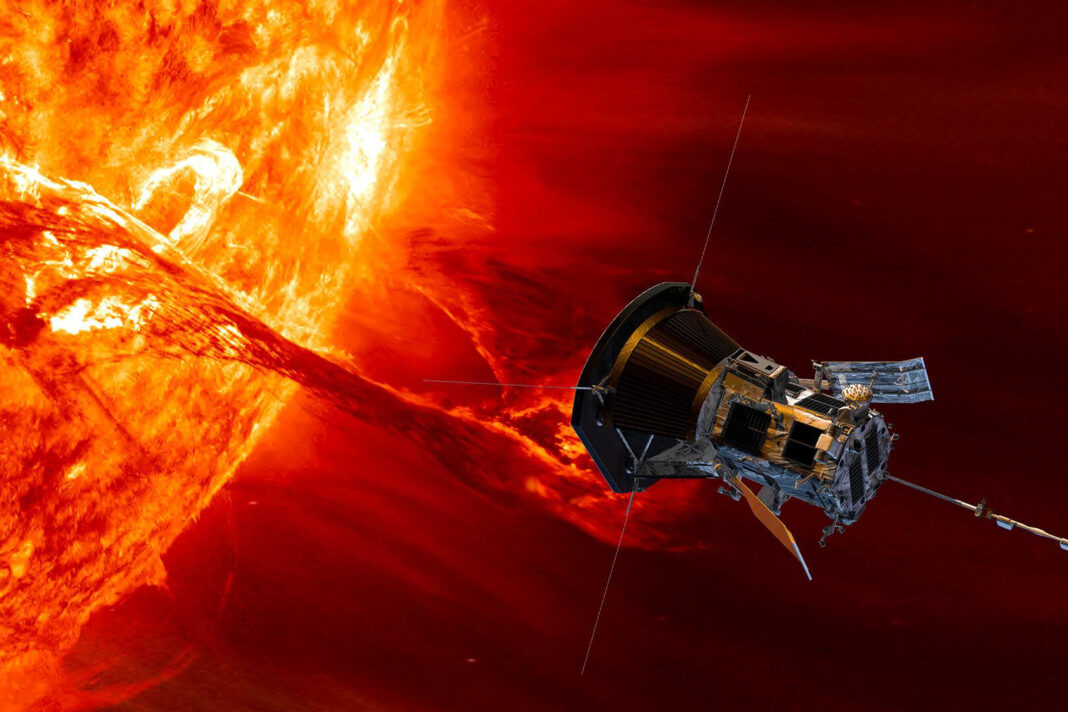


When the Parker Solar Probe slipped past the Sun’s fiery veil on Dec. 14, 2021, it wasn’t just a scientific triumph—it was the kind of headline that makes even the most casual pop‑culture junkie pause the binge‑watch and stare up at the sky. For the first time ever, a human‑made spacecraft dove into the Sun’s outer atmosphere, the corona, turning a celestial mystery that’s haunted astronomers for decades into a front‑row seat for real‑time data. Think of it as the ultimate backstage pass, except the stage is a ball of plasma 27 million miles away and the band is a chorus of magnetic fields, charged particles, and blistering heat.
Inside the Corona: A First‑Hand Look at the Sun’s Hottest Secrets
Picture this: the probe swoops to within roughly 9 million km of the Sun’s visible surface—just a hair’s breadth in astronomical terms. That’s closer than any spacecraft has ever dared to venture, and it gave scientists a literal taste of the corona’s wild side. Instruments aboard the Parker measured magnetic fields, charged particles, and the energy flows that spark everything from dazzling auroras to the dreaded geomagnetic storms that can knock out power grids. The data are already confirming the long‑standing “corona temperature paradox”—the outer atmosphere is hundreds of times hotter than the Sun’s photosphere, a puzzle that’s finally getting a solid, in‑situ answer.
What’s thrilling for the nerds in the lab is that we now have direct samples of the coronal plasma and the solar‑wind particles that stream out into the solar system. Before Parker, the corona was a beautiful but distant silhouette seen only during total eclipses; now it’s a laboratory we can walk into—well, fly into. The probe’s suite of sensors is painting a high‑resolution picture of how the corona heats up, how the solar wind gets its kick, and how those streams accelerate to near‑light speeds. It’s like swapping a grainy Instagram filter for a 4K livestream of the Sun’s most dramatic moments.
Engineering a Sun‑Dancing Mission: Gravity Assists and Heat Shields
Getting a spacecraft that close to the Sun isn’t a “just point and go” kind of deal. Launched in 2018, the Parker Solar Probe has been pulling off a series of daring Venus gravity‑assist flybys, each one shaving off a slice of its orbit to bring it ever nearer to our star. Think of it as a cosmic slingshot, using Venus’s pull to tighten the probe’s trajectory without burning extra fuel. This clever choreography lets the probe repeatedly skim the corona, each pass gathering richer data than the last.
The real star of the show (pun intended) is the probe’s heat shield—a carbon‑composite marvel that can withstand temperatures soaring above 1,370 °C while keeping the delicate instruments cool enough to function. It’s a bit like a celebrity’s designer outfit that looks fabulous on the red carpet but is actually engineered to survive a desert trek. The shield’s success is a testament to the collaboration between NASA’s Johns Hopkins Applied Physics Laboratory and an international network of scientific partners, all working to keep Parker safe as it flirts with the Sun’s blistering embrace.
Why It Matters to Your Everyday Tech (and Your Next Netflix Binge)
Beyond the awe factor, the Parker Solar Probe’s findings are already reshaping how we predict space‑weather events that can wreak havoc on Earth’s digital infrastructure. High‑resolution measurements of the corona’s plasma environment are feeding into next‑generation models of solar‑wind behavior. In plain English, that means more accurate forecasts of solar storms that could otherwise fry satellites, disrupt GPS navigation, or even trigger blackouts on the grid. For the tech‑savvy among us, that’s a big deal—our streaming services, smartphones, and smart homes all rely on a stable space‑weather backdrop.
And there’s a cultural ripple, too. When a mission that sounds like a sci‑fi blockbuster (thanks, NASA) delivers hard data that demystify a celestial phenomenon, it fuels the imagination of filmmakers, game designers, and musicians alike. Expect to see the corona’s sizzling visuals inspire everything from sci‑fi set pieces to album covers—after all, pop culture thrives on the spectacular, and the Sun just gave us its most intimate performance yet.
Engineering Marvel: How Parker Beats the Sun’s Heat Shield
When you hear “the Sun is a furnace,” you picture a place no human‑made object could survive. Yet the Parker Solar Probe’s thermal protection system turned that metaphor on its head. The spacecraft’s heat shield—officially called the Johns Hopkins Applied Physics Laboratory, whose decades‑long pedigree in deep‑space missions (think New Horizons) gave Parker the “know‑how” to survive where nothing else could. The engineering triumph has sparked a wave of pop‑culture fascination—think TikTok videos of the shield’s “glowing orange” launch, or the viral “Parker vs. Sun” meme that’s now a staple in meme‑culture forums.
From Data to Daily Life: Space‑Weather Forecasting Gets a Boost
It’s easy to think of solar research as the domain of astrophysicists in lab coats, but Parker’s real‑time data are already reshaping the way we protect Earth’s digital arteries. The probe’s measurements of magnetic reconnection events and high‑energy particle bursts feed directly into the Solar Orbiter—launched in 2020—complements Parker by offering high‑resolution imaging from a slightly higher orbit, allowing scientists to cross‑reference visual data with Parker’s in‑situ measurements. Together, they form a “two‑camera” system that’s akin to having both a backstage pass and a front‑row seat at a concert.
Beyond Solar Orbiter, NASA’s upcoming Heliospheric Probe Plus (still in the concept phase) aims to venture even farther out, sampling the solar wind at the edge of the heliosphere where it meets interstellar space. If Parker is the “first act,” Heliospheric Probe Plus will be the “grand finale,” potentially answering the age‑old question of how the Sun’s influence wanes into the galaxy.
These missions also open doors for commercial partnerships. Companies like SpaceX and Blue Origin are already discussing “solar‑power relay” concepts that could harvest solar energy directly from near‑Sun orbits—a futuristic idea that feels ripped straight from a sci‑fi blockbuster. The notion that a private‑sector “Sun‑satellite” could beam clean energy back to Earth is no longer pure fantasy; it’s a logical extension of the data pipeline Parker has established.
Why It Matters: My Take on the Cultural Shockwave
From an entertainment‑insider perspective, Parker’s journey is the kind of narrative that fuels both headlines and hashtags. It blends the awe of a cosmic adventure with the gritty reality of engineering, and then it loops back to affect our daily lives—whether that’s a smoother Netflix stream during a solar flare or a new meme that makes you laugh while you stare at a sun‑spot image.
What’s most compelling is the way Parker turns a traditionally “hard‑science” story into a cultural touchstone. The probe’s sleek design, its “sun‑kiss” selfies, and the sheer audacity of “flying into a star” have given pop culture a fresh hero: not a superhero in a cape, but a spacecraft with a carbon‑fiber shield and a mission to solve a mystery that has puzzled humanity since the ancients first worshipped the Sun.
In the grand tapestry of pop culture, moments like Parker’s corona dive become the modern myths we retell—think of the Apollo moon landing or the launch of the Hubble Space Telescope. They remind us that curiosity, when paired with daring engineering, can turn the impossible into a headline, a meme, and ultimately, a stepping stone toward a future where the Sun powers not just our myths, but our very infrastructure.