
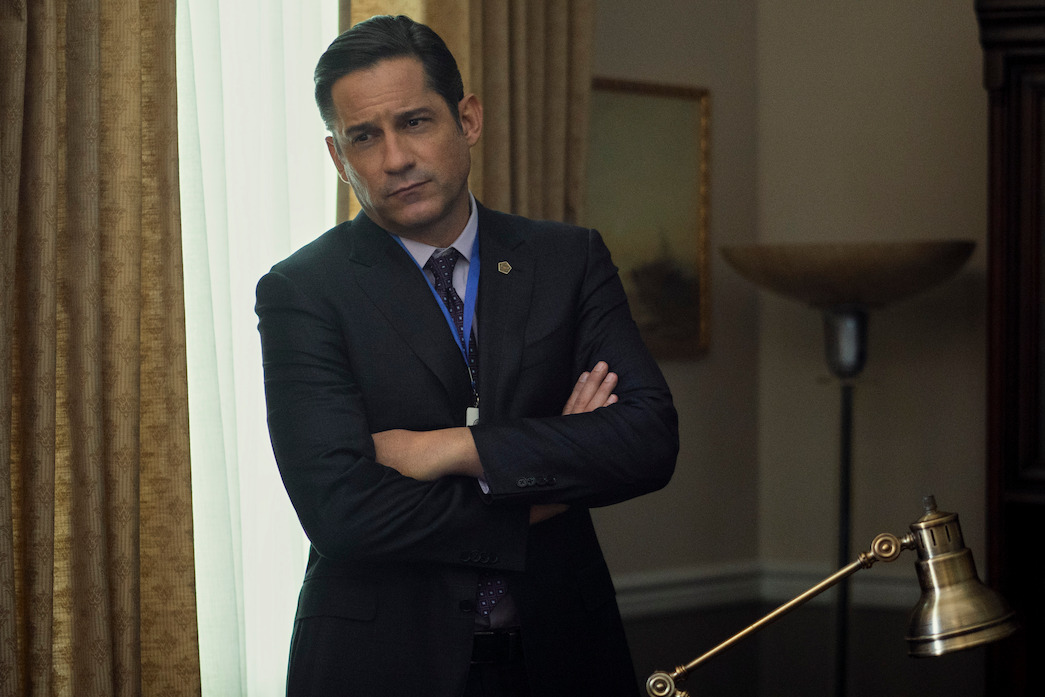


The phone rings at 3 a.m. in the White House residence, but this time it’s not some foreign crisis—it’s Jacob Monroe, the intelligence broker who owns a president like a hedge-fund manager owns a distressed asset. In the crackling silence that follows, President Richard Hagan discovers what every viewer of The Night Agent now knows: the most powerful office on earth has been mortgaged to a man who trades state secrets the way other people trade baseball cards. Netflix’s pulpy thriller has always sprinted along the ceiling of plausibility, yet Season 3 lands its most unsettling punch by asking a question that feels ripped from tomorrow’s headlines—what happens when the commander-in-chief is merely a middle manager for dark money and darker agendas?
A President on a Leash
We first met Hagan on the campaign trail, all jaw-jutting optimism and Kennedy-adjacent charm. But the glint off his smile now looks like light bouncing off handcuffs. Monroe didn’t bankroll the election out of civic duty; he bought futures in the First Family, cutting a deal with the First Lady—yes, the First Lady—to guarantee her husband’s ascent. In exchange, Monroe gets a shadow seat at every national-security meeting, a direct line to the nuclear football, and the kind of access that makes lobbyists salivate. The show never lingers on partisan labels, preferring to paint corruption in bipartisan shades of green, and the result is a Washington that feels less like Aaron Sorkin’s walk-and-talk paradise and more like a casino where the house always wins because the house is also dealing the cards.
What makes the betrayal sting is how ordinary it looks. Monroe doesn’t strong-arm the president with kompromat or a silenced pistol; he simply reminds Hagan that every donor check has a string attached, and those strings have now been braided into a noose. When Hagan tries to wiggle free—tentatively, the way you might test a rotten floorboard—his wife tightens the knot. Their marriage, once the administration’s fairytale subplot, curdles into a boardroom merger gone toxic. You half-expect the presidential couple to sign quarterly earnings reports rather than bedtime stories for their kids.
The Death That Reset the Board
Into this snake pit strides Catherine Weaver, the Night Action program’s unflappable boss, clutchting a flash drive she believes will blow the conspiracy sky-high. Amanda Warren plays her with the regal calm of a woman who has read every classified memo and still believes in the promise of the republic—right up until the moment Monroe’s trap springs. A bogus rendezvous in a parking garage, a flicker of muzzle flash reflected in a car window, and suddenly Peter Sutherland’s mentor becomes another statistic in the show’s growing cemetery of idealists. Creator Shawn Ryan admits the writers argued for weeks over whether to kill Catherine, finally deciding her demise was the only way to prove Monroe’s reach is longer than Secret Service perimeter fencing.
Peter’s grief arrives in messy, human waves—anger at himself for missing the ambush, guilt for the voicemail he never returned, and the dawning realization that his own deal with Monroe last season helped hoist the broker into the presidential stratosphere. Gabriel Basso lets the pain settle behind the eyes rather than splatter across the room, giving us a protagonist who is slowly learning that surviving the night is not the same as winning the war. Catherine’s empty chair back at ops center becomes the show’s latest ghost, a reminder that in The Night Agent’s universe, integrity is a perishable commodity with a very short shelf life.
A New Partner, A New Target
With tech-whiz Rose Larkin written out this season—off chasing her own startup dreams in Palo Alto—Peter needs fresh blood to help him trace the money trail that links Monroe to the Oval Office. Enter Isabel, a financial journalist whose laptop is stuffed with leaked spreadsheets and whose father just happens to be the very broker they’re hunting. Genesis Rodriguez plays her with a caffeinated intensity, the kind of reporter who sleeps with her phone on dictation mode in case inspiration strikes at 2 a.m. Their partnership crackles with mutual distrust—Peter still carries CIA instincts; Isabel believes every source is guilty until corroborated—but the chemistry works because both are orphans of the same corrupt ecosystem.
Their first joint assignment: find Jay Batra, a baby-faced Treasury agent who murdered his boss and vanished with a thumb drive containing evidence that could unspool the administration faster than you can say “dark-money network.” Jay’s disappearance turns the season into a road-trip scavenger hunt—through dimly lit server farms in Virginia, a hedge-fund gala in Manhattan where champagne flows like tap water, and a windswept safe house on the Maryland coast. Each locale is shot in bleary blues and surveillance-camera yellows, as if the cinematographer wants us to feel the exhaustion of people who can’t remember the last time they saw an honest sunrise.
The Dark‑Money Engine: Inside Isabel’s Investigation
When Isabel first walks onto the dimly‑lit newsroom, her notebook is already stained with coffee and a single, stubborn question: who is paying the price for the President’s silence? The series uses her partnership with Peter Sutherland to turn the abstract notion of “dark money” into a pulse‑quickening chase through offshore accounts, shell corporations, and encrypted chat rooms. In a world where a single spreadsheet can reroute the fate of a nation, Isabel’s role is the audience’s guide‑post, translating numbers into narratives that feel as personal as a family dinner gone wrong.
What makes the show’s financial thriller feel fresh is its willingness to let the audience see the human cost of each transaction. The door(politics)” target=”blank”>Wikipedia article on the revolving door describes how former government employees move into industries that benefit from their insider knowledge—a dynamic that the series amplifies to a dystopian extreme.
Season 3’s climax—Monroe’s secret meeting with the First Lady, sealed with a signed nondisclosure agreement—mirrors actual instances where personal relationships have been leveraged to influence policy. The