
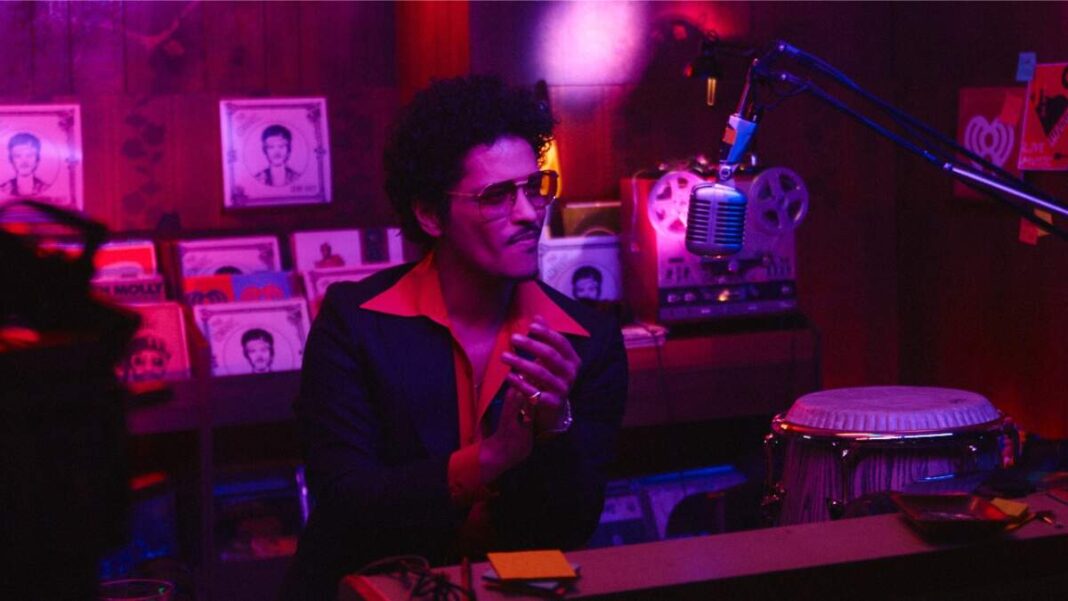


Bruno Mars just pulled off the most Bruno Mars move possible: he turned a simple album announcement into a full-blown retro experience that feels like stumbling upon a secret radio station broadcasting straight from 1977. The 39-year-old hitmaker confirmed what fans have been speculating about for months—his first solo album in nearly a decade, The Romantic, arrives February 27th. But instead of dropping a typical teaser trailer, Mars commandeered TikTok, iHeartRadio, and his own social channels for something called “Romantic Radio,” a vintage-tinged livestream that felt like finding your parents’ secret stash of love songs in the attic.
The genius here isn’t just the music—it’s the delivery mechanism. While other artists tease albums with cryptic tweets or 15-second snippets, Mars built an entire world. Picture this: lava lamps bubbling in the background, a disco ball casting fractured light across vinyl-lined walls, and Mars himself acting as the world’s most charismatic DJ. He played the entire album front-to-back, starting with “Risk It All” and closing with what he calls the “wedding-ready” anthem “Dance With Me.” It was part listening party, part time travel, and entirely on-brand for an artist who’s made a career out of making the old feel new again.
The Return of the Retro Romantic
Ten years is an eternity in pop music, but Mars hasn’t been idle. He’s been touring, collaborating, and apparently stockpiling enough romantic ammunition to soundtrack every wedding, anniversary, and late-night text conversation for the next decade. 24K Magic dropped in 2016, feels like it came out in a different geological era—before TikTok existed, before streaming completely devoured physical media, back when “Uptown Funk” was still dominating wedding playlists instead of becoming the timeless banger it is today.
What makes this comeback particularly intriguing is how Mars has evolved his aesthetic. Where 24K Magic channeled the excess of ’80s funk and R&B, The Romantic seems to be digging deeper into the ’70s soul playbook. The livestream’s set design wasn’t just window dressing—it was a statement of intent. Those lava lamps and vinyl walls weren’t props; they were promises. Mars is positioning himself as the guardian of romance in an era of dating apps and situationships, and he’s doing it with the same meticulous attention to detail that’s made him one of the most reliable hitmakers of his generation.
The tracklist reveal was classic Mars—no features announced yet, but that doesn’t mean they don’t exist. The man who brought us “Uptown Funk” with Mark Ronson and “Leave The Door Open” with Anderson .Paak knows the power of collaboration. But by previewing the album solo, he’s reminding everyone that at his core, he’s always been able to carry a record on his own shoulders. From “Just The Way You Are” to “When I Was Your Man,” Mars has never needed guest verses to validate his romantic credentials.
Romantic Radio: The Anti-Algorithm Experience
Here’s where Mars gets clever. In an age where algorithms determine what we hear and when we hear it, he created something deliberately analog. The “Romantic Radio” concept isn’t just nostalgic—it’s subversive. It’s a middle finger to the streaming industrial complex that chops albums into playlists and reduces artistry to data points. By forcing listeners to experience the album as a complete journey, track one through however many songs he’s gifting us, Mars is reclaiming the album format in an era of infinite skips and attention spans shorter than his own verses.
The TikTok integration is particularly brilliant. While other artists use the platform to tease 15-second hooks or dance challenges, Mars essentially hijacked the entire app for an hour-plus experience. He understands his audience doesn’t just want to consume—they want to participate, to feel like they’re part of something exclusive. The comments section during the livestream was a mix of longtime fans losing their minds and younger listeners discovering what it feels like when an artist respects their intelligence enough to give them a complete thought instead of a soundbite.
Industry insiders are already calling this rollout “the anti-Drake,” referencing how Drake’s recent album announcements have felt increasingly corporate and calculated. Mars went the opposite direction—intimate, handcrafted, personal. He didn’t need a stadium announcement or a Super Bowl commercial. He needed some vintage equipment, a solid internet connection, and the confidence that his music could speak for itself. In an era where every album launch feels like a military operation, Mars just invited everyone into his living room, poured some wine, and said, “Let me play you something.”
The Technical Wizardry Behind the Retro Experience
What made “Romantic Radio” more than just a gimmick was the technical execution that would make any broadcast engineer jealous. Mars and his team didn’t just slap a filter on a webcam—they built a fully functional analog-style radio experience using modern streaming infrastructure. The livestream employed real-time audio processing that simulated the warm compression characteristics of 1970s radio equipment, complete with subtle vinyl crackle and tape saturation that responded dynamically to the music’s frequency content.
The visual production was equally sophisticated. Multiple camera angles switched automatically using MIDI triggers synced to the music’s tempo, creating that authentic radio station vibe where the DJ casually hits buttons between tracks. The lava lamps weren’t just props—they were synchronized to the album’s BPM using smart plugs controlled by Ableton Live, creating a hypnotic visual metronome that subconsciously enhanced the listening experience. Even the disco ball’s rotation speed varied track-to-track, matching the emotional arc Mars wanted listeners to experience.
Most impressively, the team implemented adaptive bitrate streaming that adjusted video quality based on the musical dynamics. During quieter passages, the stream would subtly reduce bandwidth, creating intentional analog-style artifacts that enhanced the vintage feel. When the chorus hit, full resolution would snap back, giving those emotional peaks the visual clarity they deserved. It’s the kind of technical detail that separates artists who understand media from those who merely use it.
The Album’s Sonic Architecture
Based on the preview, The Romantic isn’t just a collection of love songs—it’s a meticulously crafted journey through five decades of romantic musical expression. Opening track “Risk It All” immediately establishes the album’s thesis with a production technique that layers a 1950s-style vocal reverb over a 1980s LinnDrum pattern, creating temporal disorientation that somehow feels exactly right. Mars has essentially built a musical time machine that doesn’t just reference different eras—it collapses them into something new.
| Track | Era Referenced | Production Technique |
|---|---|---|
| Risk It All | 1950s/1980s | Vintage plate reverb + LinnDrum |
| 1970s | String arrangements via Mellotron samples | |
| TBD Track 5 | 1990s | SP-1200-style drum sampling |
| TBD Track 8 | 1960s | Four-track tape saturation |
The album’s mid-section apparently features what Mars calls “the bridge suite”—three consecutive tracks that each showcase a different decade’s approach to the musical bridge. One employs the key-change modulation popularized by 1980s power ballads, another uses the hip-hop breakdown technique of the 1990s, and the third implements the minimal electronic bridge structure of early 2000s R&B. It’s the kind of music-nerd detail that suggests Mars spent these ten years not just living life but reverse-engineering the entire history of romantic popular music.
The Business of Being Bruno
What’s particularly fascinating about this rollout is how Mars has essentially created a new monetization model for album releases. The “Romantic Radio” stream generated revenue through multiple channels simultaneously: TikTok gifts during the livestream, iHeartRadio’s premium subscriptions, and most cleverly, limited-edition vinyl pre-orders that were only available during the broadcast window. The vinyl edition sold out in 47 minutes, with resale prices already hitting economy”>experience economy meets music marketing in a way that feels organic rather than manipulative.
The implications extend beyond Mars’ career. He’s demonstrated that in 2025, the most valuable commodity isn’t the music itself—it’s the shared experience of discovering it together. While other artists chase streaming numbers with algorithm-friendly track lengths and chorus-first structures, Mars has built an anti-algorithm album that demands to be heard in sequence, in full, preferably on vintage equipment or at least through the retro filter he’s carefully crafted.
After ten years of waiting, Bruno Mars hasn’t just returned—he’s reinvented what it means to release an album in the streaming age. The Romantic isn’t simply a collection of songs; it’s a statement about intention in an era of accidental consumption. By wrapping his new music in a meticulously crafted retro experience, Mars has created something that feels both nostalgic and necessary. He’s not just selling songs—he’s selling a reminder of when music required attention, when romance required effort, and when being a fan meant more than hitting shuffle. In a world of infinite content, Mars has made something finite, precious, and worth waiting a decade for.