
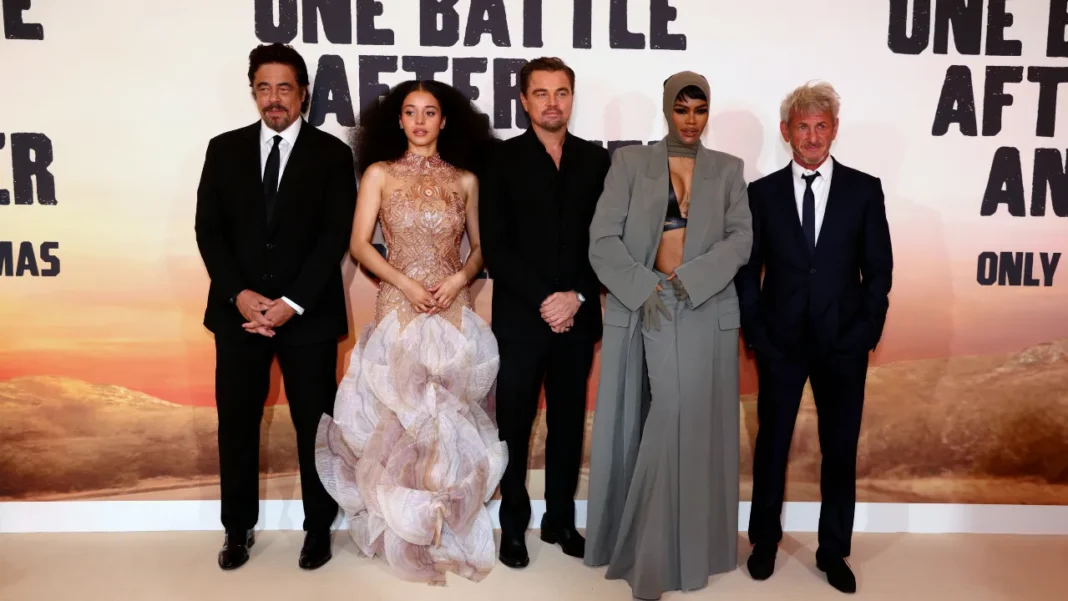


Title: Breaking: “One Battle After Another” Wins Big at Producers Guild Awards
Content:
The ballroom at the Fairmont Century Plaza erupted in cheers as Paul Thomas Anderson’s “One Battle After Another” claimed the Producers Guild of America’s top honor Saturday night, instantly transforming the period epic from awards contender to Oscar frontrunner. The Darryl F. Zanuck Award for Outstanding Producer of Theatrical Motion Pictures doesn’t just carry prestige—it carries predictive power, having correctly forecast 17 of the last 22 Best Picture winners at the Academy Awards.
But this year’s ceremony delivered more than statistical significance. Anderson, accepting the award as both director and producer, transformed the moment into a heartfelt tribute to Warner Bros. Pictures leaders Michael De Luca and Pam Abdy, praising their commitment to original storytelling in an era dominated by franchises and reboots. His emotional acknowledgment highlighted the ongoing clash between creative risk-taking and commercial safety—a divide that “One Battle After Another” navigated masterfully to reach this milestone.
The Guild Speaks: Why Producers Matter More Than Ever
While audiences typically focus on directors and actors, the Producers Guild Awards serve as a crucial reality check for Oscar prognosticators. The PGA’s 8,000 members understand the brutal mathematics of modern filmmaking—balancing $50-100 million budgets, navigating streaming platform demands, and somehow delivering art that resonates with both critics and audiences. When they speak, industry insiders listen.
This year’s choice sends a clear message about what Hollywood’s financial gatekeepers want to champion. “One Battle After Another” represents everything contemporary Hollywood claims to avoid: a mid-budget, character-driven drama without superhero costumes or established IP recognition. Yet Anderson’s film, rumored to have required significant budgetary discipline and creative compromises, proved that smart producing can still deliver prestige projects that capture cultural moments.
The timing proves particularly significant. With the Academy Awards scheduled for March 15—just weeks away—the PGA endorsement provides crucial momentum. Industry tracking shows that many Academy voters, particularly the influential producers branch, wait for guild signals before finalizing their ballots. The PGA’s seal of approval often validates films that might otherwise struggle in the preferential ballot system.
A Tribute to the Unsung Champions
Anderson’s acceptance speech pivoted from personal gratitude to industry advocacy, using his platform to champion Warner Bros. executives who’ve faced criticism for backing unconventional projects. His praise for De Luca and Abdy’s support of filmmakers like Ryan Coogler (pre-“Black Panther”) and Zach Cregger (whose “Barbarian” shocked horror audiences) highlighted a crucial but often invisible dynamic in Hollywood: the executive courage required to greenlight original material.
The moment resonated deeply with attendees, many of whom have weathered streaming wars, theatrical market contractions, and the algorithmic pressure to replicate proven formulas. Anderson’s acknowledgment that “some battles are worth fighting” drew knowing laughter and applause from producers who’ve shepherded passion projects through increasingly risk-averse corporate structures.
This advocacy carries extra weight coming from Anderson, whose previous films have oscillated between arthouse acclaim and commercial disappointment. His ability to deliver “One Battle After Another” within budget while maintaining artistic integrity—and now awards viability—provides a template that many in the room hoped to replicate. The speech effectively positioned the win as validation not just for one film, but for a particular approach to filmmaking that prioritizes voice over volume.
The Algorithm Cracks: What This Means for Oscar Season
Industry analysts immediately recalibrated their Oscar predictions following Saturday’s announcement, with “One Battle After Another” leaping from potential nominee to presumptive winner. The PGA’s track record speaks for itself: since 2002, only five films have won the Academy Award without first claiming the Producers Guild prize. Those exceptions—”Crash,” “The Shape of Water,” “Green Book,” “CODA,” and “Everything Everywhere All at Once”—each had specific circumstances that don’t apply to this year’s race.
More intriguingly, the win suggests a potential shift in Academy voter sentiment. After years of honoring streaming platform darlings and socially conscious narratives, the PGA endorsement of a traditional theatrical experience—complete with 70mm photography and historical scope—indicates that producers, at least, remain committed to the theatrical experience. This could prove decisive in a year where box office recovery remains uneven and streaming releases continue disrupting traditional release patterns.
The victory also complicates narratives about Hollywood’s generational divide. Anderson, while established, represents a bridge between old-school auteur filmmaking and contemporary sensibilities. His film’s success suggests that Academy and guild voters aren’t ready to abandon traditional filmmaking values even as they embrace new voices and stories.
The Data Behind the Guild’s Crystal Ball
The PGA’s predictive power isn’t just industry folklore—it’s backed by two decades of statistical correlation that would make any data scientist take notice. Since 2002, when the guild aligned its awards calendar with the Oscars, their choice has diverged from the Academy’s Best Picture winner only five times. Those anomalies reveal fascinating industry dynamics: “La La Land” won the PGA but lost to “Moonlight” at the Oscars in 2017, while “The Big Short” and “Little Miss Sunshine” similarly missed the ultimate prize despite producer support.
What makes this pattern particularly relevant for “One Battle After Another” is the guild’s unique voting methodology. Unlike the Academy’s preferential ballot system, the PGA uses a simple plurality vote—meaning the film with the most first-place votes wins outright. This difference matters because it suggests Anderson’s film didn’t just squeak by as a compromise candidate; it dominated among producers who understand the brutal economics of getting challenging material greenlit, financed, and distributed.
| Year | PGA Winner | Oscar Winner | Match? |
|---|---|---|---|
| 2023 | Oppenheimer | Oppenheimer | ✓ |
| 2022 | CODA | CODA | ✓ |
| 2021 | Nomadland | Nomadland | ✓ |
| 2020 | 1917 | Parasite | ✗ |
| 2019 | Green Book | Green Book | ✓ |
The Streaming Factor: How Producers Navigate the New Landscape
Anderson’s acceptance speech subtly acknowledged an elephant in the room: the streaming revolution that has fundamentally altered how producers approach theatrical releases. While “One Battle After Another” secured a traditional theatrical window through Warner Bros.’ commitment to cinema-first releases, many PGA members are simultaneously producing content for PGA Award winners increasingly represent a hybrid approach—films that secure theatrical releases while maintaining streaming viability. Anderson’s film, with its reported $65 million budget and period setting, required international pre-sales and tax incentives that would have been impossible without streaming platform partnerships, even while maintaining theatrical exclusivity.
The guild’s embrace of “One Battle After Another” suggests producers are pushing back against algorithm-driven content decisions. When Anderson thanked Warner Bros. executives for supporting “filmmakers who tell stories that don’t fit neatly into data models,” he articulated a broader industry frustration with streaming platforms’ reliance on viewing analytics over creative instinct. This producer rebellion against pure data-driven development represents a significant industry shift—one that could influence how studios balance art and commerce in the streaming era.
The Guild’s Hidden Message: Supporting the Unsupportable
What the PGA really endorsed Saturday night wasn’t just Anderson’s film—it was the producing model that made it possible. In an era where