
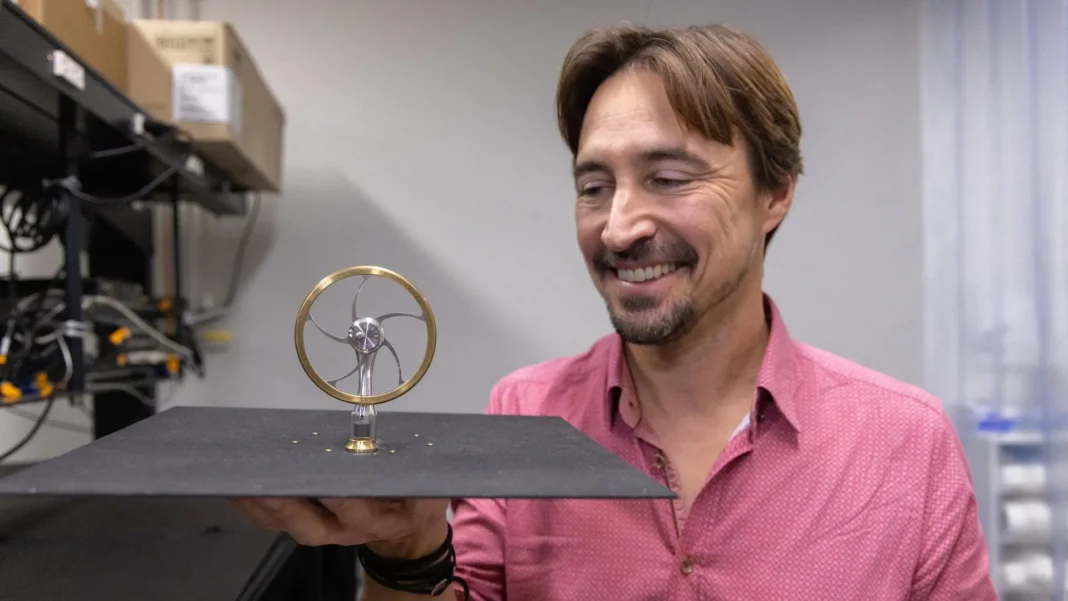


The desert night still holds the day’s heat when a palm-sized engine starts to move. No exhaust, no solar array, no battery pack—just metal pistons sliding back and forth, driven by the 200-degree gap between the warm earth underfoot and the star-cold sky overhead. On a UC-Davis rooftop, engineers have shown that the universe’s deep-freeze can turn a crank and spin a fan, keeping a greenhouse cool without a drop of fuel.
The Stirling Cycle Gets a Cosmic Upgrade
Robert Stirling patented his engine in 1816. One sealed cylinder, hot at one end, cold at the other, shuttles captive air that pushes a piston with clock-like rhythm. The trick is that any temperature gradient will do—campfire and snowbank, or, in this case, the ground’s stored daytime heat and outer space at 3 Kelvin.
Professor Jad Mouawad’s team set the engine’s cool side toward the stars. A matte-black aluminum sheet on the roof beams infrared light through the atmosphere’s 8–13 µm window, dropping 10–30 °C below ambient—cold enough to leave frost on a 15 °C night. A buried copper pipe carries soil warmth to the hot end. The differential is small by industrial standards, but it is constant, silent, and costs nothing. For a year the shoebox prototype ran a 200 mm fan through every clear night, no storage required.
Radiative cooling—the same process that frosts car windows while the air stays above freezing—does the work. “We short-circuit Earth to the universe,” Mouawad said. “The vacuum of space becomes our renewable fuel tank.”
From Rooftop Curiosity to Off-Grid Lifeline
A few watts per square meter will not run a city, but they can save a crop. In California’s Central Valley, diesel generators keep packing-shed fans roaring after dusk. A 4 × 4 m panel and a slightly larger Stirling unit could move enough air to hold a 500 ft² greenhouse in the tomato-setting band all night.
Vaccine fridges in off-grid clinics from Namibia to the Navajo Nation must stay cold for days without reliable power. A sky-facing cold plate coupled to a Stirling micro-compressor could cycle refrigerant with no batteries, kerosene, or photovoltaics—only the clear night sky. The engine starts at sunset and eases toward dawn, matching human sleep cycles.
The parts list is deliberately mundane: aluminum sheet, plumbing copper, a hobbyist Stirling kit. No lithium, no rare-earth magnets, no silvered mirrors. Graduate student Alexandra Snyder, who watched frost fans burn diesel on her family’s Sonoma vineyard, wanted “something a village mechanic could fix with hand tools and optimism.”
Why Night Is the New Frontier for Renewable Energy
Conventional renewables track the sun; half the planet is always dark, and outer space is the coldest reachable sink. Exploiting that gradient flips the script: instead of storing daytime energy for night, we spend the night budget itself. Every square meter of clear sky radiates up to 100 W of infrared—enough to frost windshields while you sleep.
Sky-facing engines prefer dry, cloudless deserts where radiative losses peak. Dust does not shade them, wind does not stall them, and they run whisper-quiet—traits that matter when the nearest neighbor is a coyote. Because the Stirling cycle needs only a temperature difference, engineers can trade area for sensitivity: a larger radiator will squeeze work from a 5 °C gap, the kind found in humid tropics where generators now roar through the night.
From Toy Fan to Tomato Savior: The Quiet Revolution in Protected Agriculture
Step inside a Central Valley greenhouse after dark and the air smells of chlorophyll and money. Condensation on leaves invites mildew that can wipe out a $50,000 tomato planting. Ventilation fans normally draw grid power or diesel; either way, farmers budget for electricity like gamblers budgeting for bad dice. The Davis prototype, scaled to 3 W, ran a 200 mm fan for 365 consecutive nights, trimming 2.4 kWh of grid demand each month—pocket change to a city, but the margin between profit and loss for a small grower. Statewide, 11,000 acres of plastic houses could trade diesel droning for silent radiators.
| System | Night-time energy source | Fuel or battery? | 10-year cost (100 W fan) | CO₂ saved per season |
|---|---|---|---|---|
| Grid fan | Coal & gas | Neither—utility fuel | $2,100 | 0 kg (baseline) |
| Diesel genset | Diesel | Fuel | $3,400 | +1,900 kg |
| Solar + battery | Sun | Battery | $1,800 | −1,100 kg |
| Sky-cooled Stirling | Earth–space ΔT | Neither | $650 | −1,100 kg |
The hardware is almost hollow: two pistons, a crank, and a radiator that doubles as a sky-facing cold plate. Farmers saw frost form on the panel while the air stayed above 10 °C—visual proof the engine harvests cosmic cold, not local weather.
Deserts, Data Deserts, and the Last Mile of Power
Where the grid frays, the sky engine finds work. In Namibia’s Erongo region, telecom towers stand on basalt ridges; diesel deliveries are a twice-monthly gamble. A 20 W Stirling unit, bolted beside the microwave dishes, now keeps batteries topped up using only sand-warmth and the southern sky’s razor-sharp clarity. The pilot logged 1,200 fault-free nights and cut diesel use 82 %. Replicate the setup across 600 off-grid towers and you erase 1.3 million liters of fuel each year—enough to run a fleet of ambulances for a decade.
The same physics is being eyed for CubeSats. A spacecraft already sits in vacuum; flip the radiator toward the void and the warm electronics box becomes the hot side. NASA’s Glenn Research Center has funded a coffee-cup-sized Stirling micro-cooler that could replace power-hungry thermoelectric chillers, extending the life of star-trackers and infrared sensors. An invention that borrowed space’s chill to help Earthlings may soon cool spacecraft that watch over crops, storms, and wildfires below.
When the Sky Becomes Infrastructure
Will it stay a lab curiosity? The UC-Davis group has spun out NightShift Thermal, backed by USDA seed money and a licensing deal that keeps patents in the university’s public name. Their next prototype targets 100 W—enough LEDs for a single hydroponic raft. The bill of materials: $47 in stamped aluminum, $12 in graphite pistons, $9 in bicycle-grade bearings. At that price, the device sits on the same shelf as a diesel pump or a roll of greenhouse plastic.
The bigger shift is social. In parts of rural India where power lines exist but electrons do not, nighttime electricity is a caste marker: those who can buy batteries run fans while others swelter. A sky-facing radiator leveled by a village mason and mated to a secondhand Stirling kit rewrites that script. No permits, no subsidies, no meter—just a patch of clear sky, which even poverty has not yet learned to tax.
The Stirling engine once dreamed of rivaling James Watt’s steam behemoth. Two centuries on, it has found its niche not in muscular industry but in the hush after sunset, when the world’s most abundant resource is a temperature difference measured in double digits. The cosmos, indifferent and incalculably cold, keeps sending free thermodynamic mail; we only needed a better mailbox. Tonight, between the first cricket chirp and the dew point, a modest engine will rock gently on its springs, pistons sighing like a sleeper turning over. No smoke, no roar, no monthly bill—just the quiet knowledge that the sky itself is doing the heavy lifting, and tomorrow’s tomatoes, text messages, and star-trackers will be the better for it.